

Summary: Shipping medical equipment safely involves assessing its value and sensitivity, selecting suitable transportation, following manufacturer packaging instructions, confirming insurance coverage and coordinating delivery. Healthcare facilities should verify carrier capabilities, equipment handling requirements and delivery access before dispatch to help protect valuable devices and minimize operational disruption.
Overview
Chicago healthcare facilities rely on the dependable movement of diagnostic instruments, patient monitoring systems, laboratory equipment, imaging components and other specialized medical devices. These shipments may involve expensive assets, delicate components and strict handling requirements.
Insured medical equipment shipping Chicago involves more than purchasing a transportation label and declaring a shipment value. Healthcare organizations need to understand the equipment's physical characteristics, the risks associated with transit, applicable carrier restrictions and the scope of available insurance.
UNIVAL Logistics helps customers assess transportation requirements and consider appropriate logistics arrangements for valuable equipment. The exact service, insurance coverage, handling arrangements and delivery requirements should be confirmed before booking, particularly when equipment is fragile, unusually heavy or sensitive to environmental conditions.
Key Takeaways
-
Assess equipment value, fragility, dimensions, weight and manufacturer handling instructions before shipping.
-
Use suitable protective packaging, cushioning, restraints and custom crating where necessary.
-
Confirm that the selected carrier accepts the equipment and can meet its handling requirements.
-
Review cargo insurance terms, exclusions, deductibles and declared-value limits before dispatch.
-
Coordinate delivery access, unloading, receiving personnel and installation requirements in advance.
-
Keep invoices, serial numbers, photographs, shipment records and insurance confirmations.
-
Consult UNIVAL Logistics to evaluate practical transportation options for healthcare equipment.
Quick Answer: Insured medical equipment shipping Chicago combines appropriate transportation, equipment-specific packaging, accurate documentation, suitable cargo insurance and coordinated delivery to help protect valuable healthcare devices in transit.
Why Medical Equipment Requires Specialized Shipping Arrangements
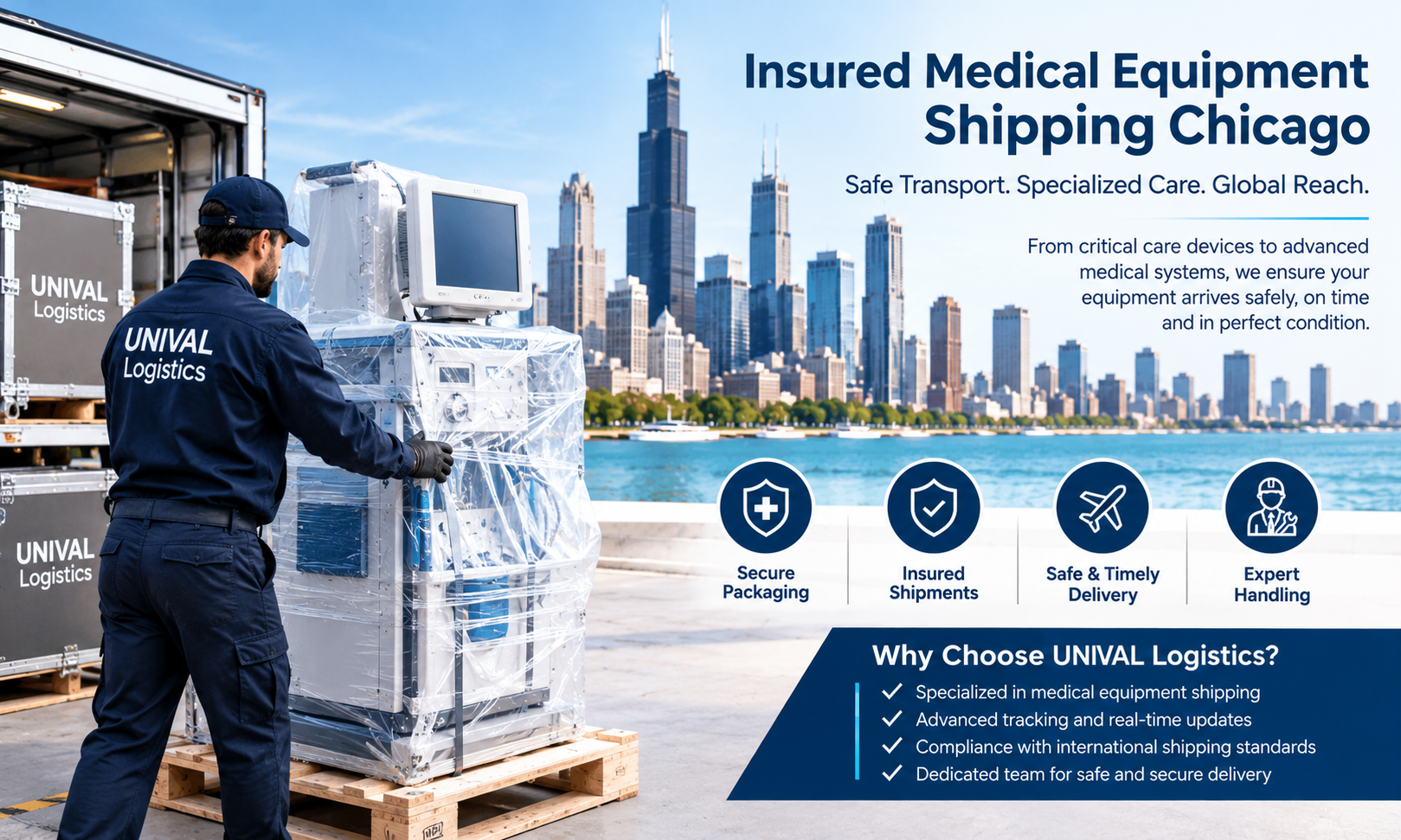
Medical equipment can be expensive, delicate and essential to everyday healthcare operations. Even equipment that appears sturdy on the outside may contain sensitive sensors, calibrated components, precision optics or electronic assemblies that require careful handling.
Protecting Sensitive Components
Diagnostic instruments, laboratory analyzers and patient monitoring systems may be vulnerable to vibration, impact, moisture, electrostatic discharge or temperature changes. The risks vary according to the equipment type and manufacturer specifications.
Before arranging transportation, review the manufacturer's instructions for packing, storage, disassembly and movement. Some equipment may require specialized cushioning, anti-static protection, environmental controls or preparation by qualified technical personnel.
Do not assume that standard parcel packaging is sufficient for a precision medical device.
Preventing Financial Loss
Medical devices can have significant purchase, replacement and repair costs. Damage may also require inspection, recalibration, replacement parts or technical servicing before equipment can be used again.
Appropriate cargo insurance may help address eligible financial losses, subject to policy terms and exclusions. Accurate valuation and documentation are essential to establishing what was shipped and supporting a potential claim.
Reducing Operational Disruption
A delayed or damaged shipment can affect equipment installation, laboratory workflows, scheduled maintenance or planned healthcare services. A replacement device may not be readily available, particularly when it is specialized or configured for a specific facility.
Planning the delivery date, confirming receiving arrangements and allowing time for inspection can help healthcare organizations manage these operational risks.
Types of Medical Equipment That May Need Insured Transportation
Different categories of healthcare equipment require different packaging and transportation considerations.
Diagnostic and Imaging Equipment
Diagnostic devices, imaging components and precision instruments may contain delicate electronics, optical assemblies or calibrated parts. Large or sensitive units may require custom crating, specialist lifting equipment or controlled handling.
Some imaging systems are shipped as separate components rather than fully assembled units. Confirm the packing configuration, component inventory and any manufacturer requirements before collection.
Laboratory and Testing Equipment
Laboratory analyzers, microscopes and diagnostic testing systems may require protection against vibration, shock and moisture. Equipment that uses reagents or other regulated materials may also be subject to separate transport requirements.
Before dispatch, identify whether the shipment contains only equipment or includes batteries, chemicals, biological substances or other items that could trigger additional carrier restrictions.
Patient Monitoring and Clinical Devices
Patient monitors, infusion devices and related clinical equipment may contain sensitive electronic components and accessories that can be misplaced if they are not inventoried carefully.
Use appropriate protective packaging, secure loose accessories and record serial numbers when available. Confirm whether batteries must be installed, removed or prepared according to the carrier's and manufacturer's requirements.
Surgical and Specialized Medical Instruments
Precision instruments and specialized clinical equipment may require individual protective cases, separation between components and packaging designed to prevent movement.
If instruments are reusable or have been used clinically, ensure they are cleaned, decontaminated and prepared according to applicable facility procedures and manufacturer instructions before shipping. Transportation packaging does not replace required infection-control procedures.
Heavy or Oversized Healthcare Equipment
Large equipment may require palletization, reinforced crates, specialist loading equipment or coordinated delivery to a designated receiving area.
Measure the equipment and assess access conditions before booking. Doorway dimensions, elevators, loading docks, floor capacity and lifting requirements may affect how and when the shipment can be delivered.
How to Arrange Insured Medical Equipment Shipping Chicago
A structured shipping process helps healthcare facilities identify risks before equipment leaves the premises.
1. Assess the Equipment and Its Value
Prepare an inventory containing the equipment description, manufacturer, model, serial number where available, dimensions, weight and approximate value. Record any accessories or components that will travel separately.
Valuation should reflect the basis required by the relevant insurance policy. Purchase invoices, replacement quotations, asset records or other supporting documents may be useful, depending on the policy terms.
Also identify any special handling needs, such as upright transport, shock protection, humidity control or restrictions on tilting.
2. Select a Suitable Transportation Method
The right shipping method depends on the equipment's size, sensitivity, destination, urgency and budget.
Parcel services may suit smaller, appropriately packaged devices that the carrier accepts.
Freight transportation may be suitable for heavier equipment, palletized shipments or multiple units moving together.
Specialized or dedicated transport may be appropriate when equipment requires fewer transfers, special handling arrangements or a coordinated delivery window.
Faster delivery does not automatically mean better protection. Ask about handling procedures, transfer points, shipment visibility, delivery limitations and the carrier's experience with comparable equipment.
3. Confirm Insurance Before Dispatch
Determine whether the shipment is eligible for coverage and whether the policy protects the equipment throughout the intended transit. Review the insured amount, deductible, exclusions, packaging conditions and claims requirements.
Ask whether coverage applies during loading, unloading, transfers or temporary storage when these stages are part of the planned movement. Do not assume that every stage is covered automatically.
Insured medical equipment shipping Chicago should be arranged only after the sender understands the available protection and any required declarations or approvals have been completed.
4. Coordinate Collection and Delivery
Confirm the collection address, receiving facility, delivery hours, loading access and contact details. Identify whether the receiving location has a loading dock, freight elevator or other access requirements.
For heavy or delicate equipment, confirm who will handle unloading and whether specialist rigging, installation or technical support is needed. Transport providers should not be assumed to offer installation, calibration or clinical equipment commissioning unless those services are explicitly confirmed.
Packaging and Handling Best Practices for Medical Devices
Proper packaging reduces the likelihood of damage and helps the equipment arrive in a condition suitable for inspection and preparation.
Follow Manufacturer Instructions
Use the original shipping materials when they remain suitable and are available. For other shipments, choose packaging designed for the device's dimensions, weight, fragility and expected handling conditions.
Sensitive components may require fitted foam, anti-static materials, moisture barriers or vibration protection. Heavy equipment may need engineered crates, reinforced pallets and secure restraints.
If a device must remain upright or has specific temperature or humidity requirements, make these conditions clear during planning and follow the manufacturer's instructions.
Secure Components and Accessories
Remove or secure detachable components according to manufacturer guidance. Pack cables, probes, sensors and accessories so they cannot strike the main unit or become lost.
Create an inventory before sealing the shipment. Photograph the equipment's condition, accessories and packaging arrangement, and record any existing damage.
Prepare Equipment for Movement
Some equipment may require disconnection, draining, stabilization, battery preparation or removal of sensitive components before transportation. These tasks should be completed by personnel qualified to prepare the particular device.
Do not move equipment that contains hazardous materials or regulated substances without checking the applicable requirements. Batteries, compressed gas cylinders, chemicals and biological materials may require separate documentation or specialized handling.
Inspect the Completed Package
Before collection, verify that the outer crate or carton is secure, labels are accurate and handling instructions are visible where appropriate. Keep copies of the packing list, shipment reference and photographs.
Packaging should be appropriate to the transportation method and the equipment's requirements. A fragile label alone does not replace adequate physical protection.
Medical Equipment Shipping Insurance: What Healthcare Facilities Should Know
Cargo insurance may help protect healthcare organizations against eligible financial losses arising from covered incidents during transportation. However, policy terms vary, and insurance should not be treated as a guarantee against every loss.
Carrier Liability Versus Cargo Insurance
Carrier liability is determined by the applicable contract, service terms and relevant law. It may be limited by weight, declared value, commodity restrictions or other provisions.
Cargo insurance is a separate form of protection that may cover specified losses, subject to its limits, exclusions, deductibles and conditions. It is important to distinguish the carrier's liability from the terms of an actual insurance policy.
Before booking, ask for written clarification of the available coverage and who is responsible for arranging it.
Establish the Correct Insured Value
The appropriate value may depend on whether the equipment is new, used, refurbished, leased or being moved between facilities. The policy may specify replacement cost, invoice value, repair cost or another valuation basis.
Keep supporting documents such as purchase invoices, asset records, replacement quotations and available serial-number records. If accessories or separate components are included, verify how they are accounted for in the declared value.
Understand Exclusions and Conditions
Review the policy for exclusions involving inadequate packaging, mechanical or electrical breakdown, pre-existing damage, improper preparation, unattended delivery or other relevant circumstances.
Transit insurance may not cover routine wear, calibration issues, equipment malfunction unrelated to a covered event or losses caused by an excluded condition. These distinctions are particularly important for precision instruments.
Confirm whether the policy covers loading, unloading, approved temporary storage and any planned transfers. Also identify claim deadlines and the evidence required to report damage or loss.
Document Condition Before and After Transport
Photograph the equipment before packing and retain the shipping records. Upon delivery, inspect the exterior packaging and document visible damage before discarding materials.
If damage is suspected, notify the carrier and insurer promptly, preserve the packaging and follow the relevant claim procedures. Do not assume that equipment should be powered on immediately after a potentially damaging impact; follow manufacturer guidance and arrange technical inspection when necessary.
Tracking, Documentation and Chain of Custody
Shipment visibility and reliable documentation help healthcare facilities manage valuable equipment throughout transportation.
Maintain Complete Shipment Records
Keep the packing list, commercial invoice or asset documentation, serial numbers, photographs, insurance confirmation and carrier booking information together.
For equipment moving between hospitals, clinics, laboratories or storage facilities, internal transfer records can help identify who authorized the shipment, who released it and who received it.
Monitor Shipment Progress
Use the tracking options provided by the selected carrier and establish a contact process for unexpected delays. If the shipment requires a specific delivery window, coordinate updates with the receiving facility.
Tracking can improve visibility, but it does not independently guarantee secure handling or prevent damage. It should be combined with appropriate packaging, documentation and delivery procedures.
Confirm Receipt and Inspect the Equipment
At delivery, verify the shipment count and inspect the external packaging. Compare the contents with the inventory and document any missing components or visible damage.
For sensitive or high-value equipment, consider arranging technical inspection before the device is put back into service. The appropriate inspection depends on the manufacturer's recommendations and the equipment's intended use.
Planning Delivery to Chicago Healthcare Facilities
Successful medical equipment transportation depends on more than the route between collection and destination. Receiving arrangements can affect cost, timing and the risk of handling problems.
Confirm Site Access
Determine whether the delivery location has a loading dock, suitable elevator access, adequate doorway clearance and space for unloading. Large or heavy equipment may require a planned route through the building.
For facilities with restricted receiving hours or security procedures, confirm the appointment and identify the person authorized to accept the shipment.
Coordinate Installation and Technical Support
Some devices can be unpacked and inspected by facility personnel, while others require qualified technicians, specialist rigging or manufacturer-authorized installation.
Clarify responsibilities before dispatch. Transportation, unloading, installation, calibration and commissioning may be separate services and should not be assumed to be included in one quotation.
Plan for Delays and Contingencies
Healthcare operations may depend on equipment arriving before a scheduled installation, maintenance window or clinical service requirement. Allow reasonable time for transportation, receiving, inspection and any required setup.
For urgent shipments, ask about available service levels and realistic transit estimates. Confirm the procedures for reporting delays and arranging an alternative delivery time.
Estimated Costs for Medical Equipment Shipping in Chicago
The cost of medical equipment transportation depends on dimensions, weight, distance, handling requirements, packaging, delivery speed and insurance needs. Sensitive, oversized or high-value devices may require more preparation than ordinary freight.
The following figures are illustrative planning estimates in US dollars, not verified quotations or guaranteed rates. Actual charges may vary significantly according to the equipment and service selected.
-
Small medical devices and instruments: approximately $30–$150+ per shipment for eligible, appropriately packaged parcels, depending on size, weight and delivery speed.
-
Palletized medical equipment freight: approximately $150–$800+ per shipment for some domestic freight movements, depending on distance, dimensions, weight and handling requirements.
-
Oversized or specialized equipment transport: approximately $500–$2,000+ or more, depending on route, loading needs, dedicated transport and specialist handling.
-
Protective packaging and custom crating: approximately $75–$600+, with larger or specially engineered crates potentially costing more.
-
Cargo insurance: pricing depends on the declared value, equipment type, route, deductible, coverage terms and underwriting requirements. A reliable premium requires shipment-specific information.
-
Additional handling, liftgate or scheduled delivery services: approximately $50–$300+ where applicable, depending on equipment, site access and service requirements.
Important Disclaimer
These cost prices are baseline estimates only and are subject to market fluctuations, supplier changes, and variable logistics fees. They are intended for general planning and should not be treated as confirmed quotations. Actual charges and insurance eligibility depend on equipment specifications, transportation requirements, packaging, route and coverage terms. For the latest and most accurate prices, please contact UNIVAL Logistics for professional guidance.
Common Medical Equipment Shipping Mistakes to Avoid
One common mistake is using packaging that is unsuitable for sensitive equipment. A standard carton may not provide enough support for a calibrated instrument or a device with delicate internal components. Follow manufacturer instructions and use appropriate cushioning or crating.
Another mistake is assuming that carrier liability provides full financial protection. Confirm the applicable limits and insurance terms before the equipment leaves the facility.
Incomplete documentation can also complicate delivery and claims. Keep accurate asset details, invoices, photographs and shipping records, and ensure that the equipment description matches the information provided to the carrier and insurer.
Finally, failing to coordinate delivery access can lead to missed appointments, extra handling charges or delays. Confirm receiving hours, unloading arrangements and technical requirements before collection.
How UNIVAL Logistics Can Help With Medical Equipment Transportation
Healthcare equipment shipments often require coordination between the sender, carrier, receiving facility and, where applicable, an insurer or technical service provider. UNIVAL Logistics can help customers review shipping requirements, consider suitable logistics options and identify important questions about packaging, insurance and delivery arrangements.
When requesting a quotation, prepare the equipment description, model and serial number where available, dimensions, weight, approximate value, collection and delivery details, preferred timeframe and any special handling instructions.
It is also helpful to disclose whether the shipment includes batteries, regulated materials, temperature-sensitive components or equipment that must remain upright. These details can affect carrier acceptance, packaging and transportation arrangements.
Specific services, insurance coverage, delivery capabilities and handling procedures should be confirmed before booking. Healthcare facilities should arrange any required disconnection, decontamination, specialist lifting, installation or calibration separately unless explicitly included in the agreed service.
Conclusion
Medical equipment is a valuable operational asset, and its safe transportation depends on careful planning. Appropriate packaging, suitable carrier selection, verified insurance, complete documentation and coordinated delivery can help reduce the risks of damage, loss and unnecessary disruption.
When arranging insured medical equipment shipping Chicago, assess the device's value and sensitivity, follow manufacturer instructions and confirm the available coverage before dispatch. Prepare the receiving location in advance and inspect the shipment promptly after arrival.
UNIVAL Logistics can help customers evaluate their transportation requirements and consider practical logistics arrangements for medical equipment. A clear plan before collection supports better coordination and more informed decisions throughout the shipment journey.
Frequently Asked Questions
1. What is insured medical equipment shipping Chicago?
It refers to arranging transportation for medical devices and healthcare equipment with appropriate handling, packaging and suitable insurance protection for eligible transit risks. Coverage and service availability depend on the equipment, carrier and policy terms.
2. Which medical equipment may require specialized shipping?
Diagnostic instruments, laboratory analyzers, imaging components, patient monitoring systems, surgical equipment and other sensitive or high-value devices may require specialized packaging or handling. Requirements depend on their size, fragility, value and manufacturer instructions.
3. Does medical equipment shipping automatically include insurance?
No. Carrier liability and cargo insurance are different. Carrier liability may be limited, while a separate insurance policy has its own coverage limits, exclusions and conditions. Confirm the available protection before dispatch.
4. How should medical equipment be packaged for shipping?
Follow manufacturer instructions and use packaging suited to the device's size, weight and sensitivity. Depending on the equipment, this may involve fitted cushioning, anti-static protection, moisture barriers, reinforced cartons or custom crating.
5. How much does medical equipment shipping in Chicago cost?
Eligible small parcels may cost tens to hundreds of dollars, while freight and specialized transportation can cost hundreds or thousands. Packaging, equipment dimensions, delivery requirements and insurance affect the total. Request a shipment-specific quotation for accurate pricing.
6. What information is needed for a medical equipment shipping quotation?
Provide the equipment description, dimensions, weight, approximate value, collection and delivery locations, delivery timeframe and any special handling requirements. Serial numbers, packing details and information about batteries or regulated materials may also be needed.
7. What does medical equipment cargo insurance cover?
Coverage depends on the specific policy. It may protect against certain covered transit losses or physical damage, but exclusions, deductibles, valuation rules and claims requirements apply. Confirm coverage for the equipment and the entire intended shipment before dispatch.
8. Can large medical equipment be transported to a healthcare facility?
Potentially, yes, provided the selected provider can accommodate its dimensions, weight, handling needs and delivery conditions. Large equipment may require custom crating, specialist lifting, suitable site access and a scheduled receiving appointment.
9. What should a healthcare facility do if equipment arrives damaged?
Document the damage with photographs, retain the packaging, record the shipment details and notify the carrier and insurer promptly. Follow their reporting procedures and deadlines, and arrange a technical inspection when required before putting the equipment into service.
10. Can UNIVAL Logistics help plan insured medical equipment transportation?
UNIVAL Logistics can help customers review shipment requirements and consider logistics options, including questions about packaging, insurance and delivery coordination. Specific services, carrier acceptance and coverage must be confirmed before booking.
11. Should medical equipment be inspected after delivery?
Yes. Check the package for visible damage, verify the contents against the inventory and follow the manufacturer's inspection and setup instructions. Sensitive or precision equipment may require qualified technical inspection before use.

Add comment