

A 64 percent majority of US respondents think political violence in the country will increase over the next few years, compared to 57 percent in December 2021, according to a CBS News poll.
54 percent said the US will be "less of a democracy" for the next generation than it is now. 86 percent believe using force and violence is "always unacceptable" as a method to achieve political goals.
80 percent believe the US is more divided today than it was during their parents' generation and 67 percent are pessimistic that Americans with different political beliefs can still come together and work out their differences.
The poll was conducted from Aug 29 to Aug 31 among 2,085 US adults.
Similarly, there were other polls showing how political violence could be on the rise.
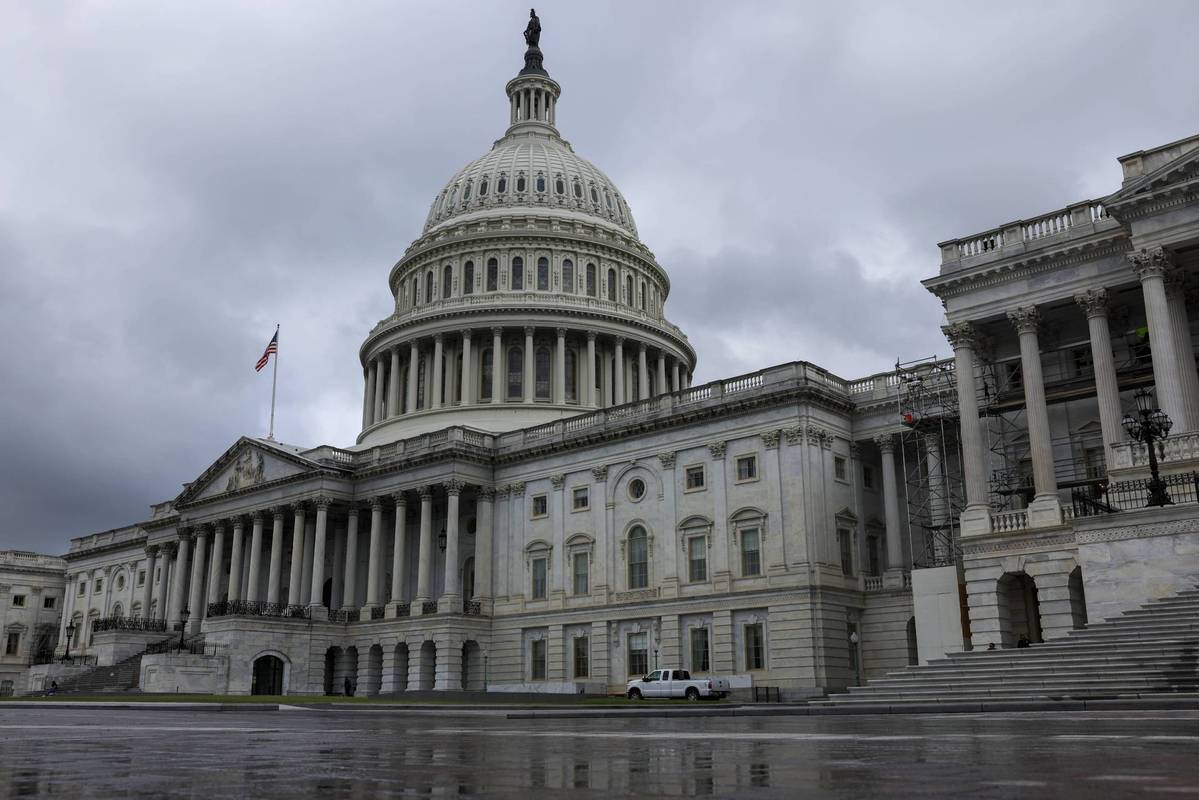 Rain clouds hang over the US Capitol Building in Washington, DC on Sept 6, 2022. [Photo/Agencies]
One in five adults in the US would be willing to condone acts of political violence, a survey commissioned by public health experts found.
The online survey of more than 8,600 US adults was conducted from mid-May to early June by the research firm Ipsos on behalf of the Violence Prevention Research Program at the University of California, Davis.
In the poll, 20.5 percent of respondents believed political violence was at least "sometimes justified."
The CBS News poll also found most voters believe there will be issues with the next election that could harm democracy, with a 67 percent majority believing it's at least somewhat likely some state or county officials will refuse to certify election results.
Dr Garen Wintemute used to laugh off warnings of a civil war coming to America as “crazy talk”. Then the emergency room doctor in California saw the figures for gun sales.
Wintemute, who founded a centre to research firearms violence after years of treating gunshot wounds, had long observed that the rush to buy weapons came in waves, often around a presidential election. Always it fell back again.
“Then in January of 2020 gun sales took off. Just an unprecedented surge in purchasing and that surge continued,” he said. “We were aware that, contrary to prior surges, this one wasn’t ending. People are still buying guns like crazy.”
Many were buying a weapon for the first time.
Wintemute wanted answers and they stunned him. A survey for his California Firearm Violence Research Center released last month showed that half of Americans expect a civil war in the United States in the next few years. One in five thought political violence was justified in some circumstances. In addition, while almost everyone said it was important for the US to remain a democracy, about 40% said that having a strong leader was more important.
“Coupled with prior research, these findings suggest a continuing alienation from and mistrust of American democratic society and its institutions. Substantial minorities of the population endorse violence, including lethal violence, to obtain political objectives,” the report concluded.
Suddenly Wintemute didn’t think talk of a violent civil conflict was so crazy any more.
The doctor is quick to note that large numbers of those people expecting a civil war say it is only “somewhat likely”. But half of the population even considering such a possibility reflects the failing confidence of large numbers of Americans in a system of government under assault by Donald Trump and a good part of the Republican party.
The FBI’s search of Trump’s Mar-a-Lago residence earlier this month for classified documents removed from the White House unleashed the latest barrage of threats of violence, this time directed at an institution widely regarded as a bastion of establishment conservatism.
The Florida senator Rick Scott likened the FBI to the Gestapo. In Ohio, the police killed an armed US navy veteran who attacked an FBI office. In Pennsylvania, a man with a history of vaccine denial was charged with threatening to “slaughter” federal agents he described as “police state scum”, and compared to the Nazi SS and the Soviet secret police.
In the days after the search of Mar-a-Lago, the FBI and Department of Homeland Security warned of a surge in threats of violence against federal agents, their families and the judge who issued the search warrant. The FBI said these included calls for “civil war” and “armed rebellion”.

You must be logged in to post a comment.