
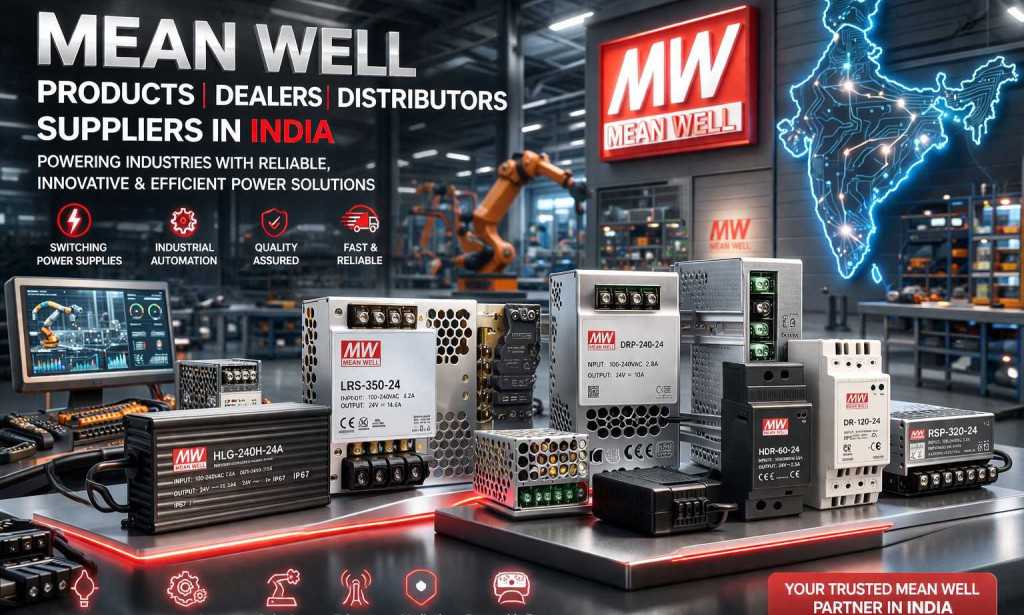
A shipment gets delayed by nine days because a batch of power supplies failed burn-in at 45°C. That’s not theory.
It’s what happens when buyers compromise on Mean Well Products or pick the wrong channel partner. Most buyers assume all switching supplies are interchangeable. They’re not. A 2% failure rate in a lab becomes 7.3% in a dusty panel environment running 18 hours a day. And once those units are inside your machines, replacing them costs more than the component itself.
That’s exactly why serious Mean Well Suppliers in India stick with proven SKUs, verified sourcing, and documented handling practices.
The Spec Detail Most Buyers Skip
Voltage Stability Isn’t Just a Datasheet Line
That’s where things break down. A Meanwell Power Supply rated for ±1% regulation behaves very differently under fluctuating grid input common in Indian industrial zones. Many buyers ignore transient response time — yet a 2–5 ms delay can trip sensitive PLCs.
Thermal Derating in Real Conditions
Here’s what nobody tells you. A unit rated for 240W at 25°C may drop to 180W at 50°C ambient. And yes, control panels in cities like Ahmedabad or Faridabad regularly cross that.
Protection Mechanisms That Actually Matter
Short-circuit, overload, overvoltage — standard terms. But the difference lies in recovery mode. Hiccup vs latch-off determines whether your line stops or recovers automatically.
Mounting and Form Factor Compatibility
Which means rework costs. DIN rail vs enclosed vs open-frame impacts panel layout, airflow, and maintenance access. A mismatch here can delay commissioning by 2–3 days.
Overlooked Detail: Hold-Up Time
This is where buyers slip. A 20 ms hold-up time can protect against minor dips. Below that, even a small fluctuation can reset systems mid-operation.
What Separates Reliable Mean Well Dealers from Risky Ones
-
Stock Authenticity Proof
Good answer: Batch traceability and importer documentation
Bad answer: “We source from multiple channels depending on availability” -
Technical Pre-Sales Support
Good answer: Load calculation and derating recommendations
Bad answer: “This model works for most applications” -
Failure Replacement Policy
Good answer: Defined DOA replacement within 7 days
Bad answer: “We’ll evaluate once you send it back”
A supplier who says this is pushing risk onto you. -
Inventory Consistency
Good answer: Regular stock of core SKUs like LRS, MDR series
Bad answer: “Currently unavailable, but we can suggest alternatives” -
After-Sales Responsiveness
Good answer: Response within 24–36 hours
Bad answer: Silence after dispatch
And yet, buyers still pick the lowest quote and act surprised when supply breaks mid-project.
What You Actually Gain by Choosing the Right Mean Well Suppliers
-
Reduced Line Downtime
Stable supplies mean fewer unexpected shutdowns. Even a 1-hour stoppage in a mid-size plant can cost ₹18,000–₹42,000 depending on output. -
Consistent Output Quality
Voltage stability protects sensors, drives, and PLCs from erratic behavior. -
Lower Maintenance Cycles
Better thermal design means fewer replacements over 18–24 months. -
Predictable Procurement Planning
Working with reliable Mean Well Dealers ensures repeat availability of the same models. -
Warranty Claims That Actually Close
Documentation-backed sourcing avoids disputes during replacement. -
Better Integration Performance
Especially in automation systems where compatibility matters more than price.
Why Availability of Meanwell Distributors in India Impacts Your Lead Time
India’s industrial clusters don’t behave the same. Supplies move faster in western corridors than in eastern belts. That’s a logistics fact, not a guess.
Most credible Meanwell Distributors in India operate through hubs in Mumbai, Delhi NCR, and Bengaluru. Which means if your supplier isn’t aligned with these channels, your lead time can stretch from 3 days to 11 days — especially during quarter-end demand spikes.
Here’s the catch. Some vendors claim to be Mean Well Suppliers but actually depend on third-party sourcing after you place the order. That delay hits your production schedule, not theirs.
About SS Electronics
We’ve been handling Mean Well Products long enough to know which models fail in real-world conditions — not just on paper.
We work directly with verified sourcing channels and maintain active stock for high-movement SKUs used by OEMs and panel builders across India. In 2022, we stopped pushing a specific low-cost alternative after three clients reported inconsistent output under high humidity conditions. We don’t repeat mistakes just to close orders.
And yes, we’ve seen projects stall over a ₹450 component.
Send your load details, input voltage range, application type, and expected operating temperature. That’s the minimum.
We typically respond within 24 hours. MOQ depends on the series, but most industrial buyers start from 10–25 units. If you’re working on a project requirement, mention your timeline clearly — it helps us plan stock allocation.
Reach out to SS Electronics with actual specs, not just part numbers.
CONCLUSION
Mean Well Products aren’t chosen because they’re cheap. They’re chosen because they fail less, behave predictably, and integrate cleanly into systems that can’t afford downtime.
And as automation tightens tolerances across industries, that predictability will matter even more over the next 3–5 years.
FAQs
Why are Mean Well Products preferred over local alternatives?
Failure rates are lower under stress conditions. Many local units perform fine at room temperature but drift under load and heat. That difference shows up after installation, not before.
How do I verify genuine Mean Well Dealers?
Ask for batch traceability and importer details. If a dealer avoids documentation, you’re likely dealing with grey-market stock.
Are Meanwell Distributors in India consistent with stock availability?
Not always. Tier-1 distributors maintain stock, but smaller vendors often depend on them. That adds 3–7 days delay you didn’t plan for.
What is the typical lifespan of a Meanwell Power Supply?
Under proper conditions, 3–5 years is realistic. But poor ventilation or overloading can cut that nearly in half.
Do Mean Well Suppliers provide technical support?
Some do, some don’t. Many just sell boxes. If your supplier can’t explain derating, you’re on your own after purchase.
Is it safe to substitute models during shortage?
Sometimes, but not blindly. A mismatch in hold-up time or mounting type can create bigger issues than the delay you’re trying to avoid.
Why do prices vary across Mean Well Dealers?
Source channel, stock availability, and authenticity all affect pricing. Cheaper isn’t always better — especially if replacements become a fight later.

You must be logged in to post a comment.