

At the time, GM president Daniel Ammann said, “When you are working on the large-scale deployment of mission-critical safety systems, the mindset of ‘move fast and break things certainly does not cut it.”
In 2016, BMW had announced its collaboration with Intel and Mobileye to develop autonomous cars and set an ambitious goal of getting ‘highly and fully automated driving into series production by 2021.’ However, in 2019, BMW partnered with Daimler’s Mercedes to develop Level 4 self-driving vehicles, ready to roll by 2024.
Brands like Honda, Ford, Toyota, Waymo have also made similar promises. Ironically, they all seem to have five-year projections.
Despite the numerous successes of machine learning, self-driving technology seems to be stuck in reverse gear.
In a paper, ‘Autonomy 2.0: Why is self-driving always five years away?’, the researchers from Lyft detailed the history, composition, and development bottlenecks of the modern self-driving stack.
SDVs are complicated
Since the DARPA Grand Challenges in 2005-2007, self-driving vehicles have been an active research area and have made headlines regularly. Many companies have been attempting to develop the first level 4+ self-driving vehicles for more than a decade.
Citing Sam Altman, Elon Musk, and Ford, the researchers said, despite the numerous unrealized predictions that ubiquitous SDVs are ‘only five years away,’ production-level deployment remains elusive.
Download our Mobile App


According to Lyft, ‘after the DARPA challenges, most of the industry decomposed the SDV technology stack into HD mapping, localization, perception, prediction, and planning. Following breakthroughs enabled by ImageNet, the perception and prediction parts started to become primarily machine-learned. However, simulation and behavior planning are still largely rule-based.’
The team believes the slow progress arises from approaches that require too much hand-engineering, an over-reliance on on-road testing, and high fleet deployment costs. The study noted that the classical stack has several bottlenecks that preclude the necessary scale from capturing the long tail of rare events.
The researchers argued the current self-driving industry progress is slow due to inefficient human-in-the-loop development and said these issues are solved by training a differentiable self-driving stack in a closed-loop simulation constructed out of a large collection of human driving demonstrations (aka Autonomy 2.0).
According to Lyft, ‘after the DARPA challenges, most of the industry decomposed the SDV technology stack into HD mapping, localization, perception, prediction, and planning. Following breakthroughs enabled by ImageNet, the perception and prediction parts started to become primarily machine-learned. However, simulation and behavior planning are still largely rule-based.’
The team believes the slow progress arises from approaches that require too much hand-engineering, an over-reliance on on-road testing, and high fleet deployment costs. The study noted that the classical stack has several bottlenecks that preclude the necessary scale from capturing the long tail of rare events.
The researchers argued the current self-driving industry progress is slow due to inefficient human-in-the-loop development and said these issues are solved by training a differentiable self-driving stack in a closed-loop simulation constructed out of a large collection of human driving demonstrations (aka Autonomy 2.0).
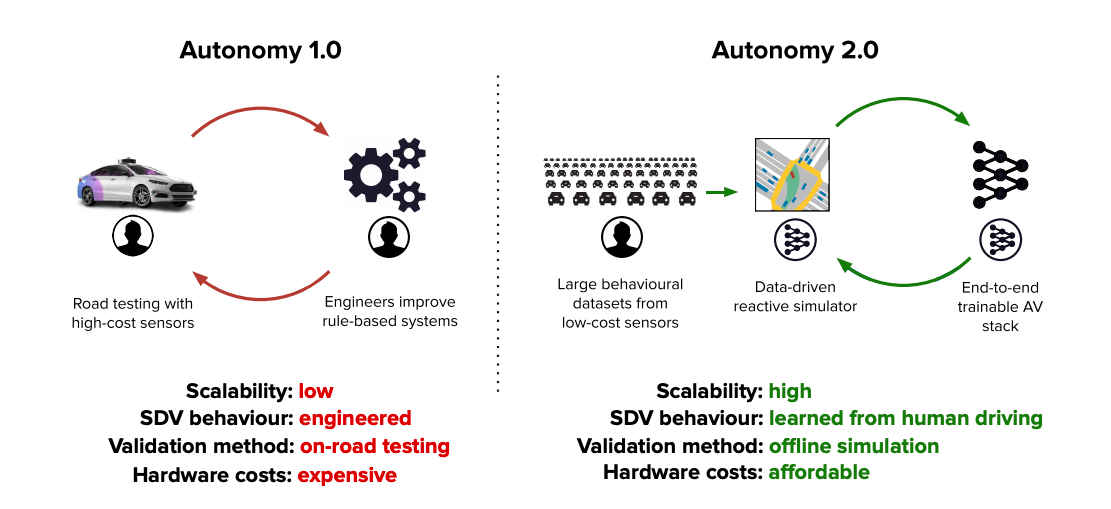
SOTA autonomy stack (Autonomy 1.0) vs. the proposed ML-first stack (Autonomy 2.0). (Source: arXiv)
The researchers believe Autonomy 2.0 unlocks the scalability required for mastering the long tail of rare events and scaling to new geographies and calls for the need to collect large enough datasets.
However, it also comes with challenges. The critical hurdles to Autonomy 2.0, as highlighted by the researchers, include:

You must be logged in to post a comment.