
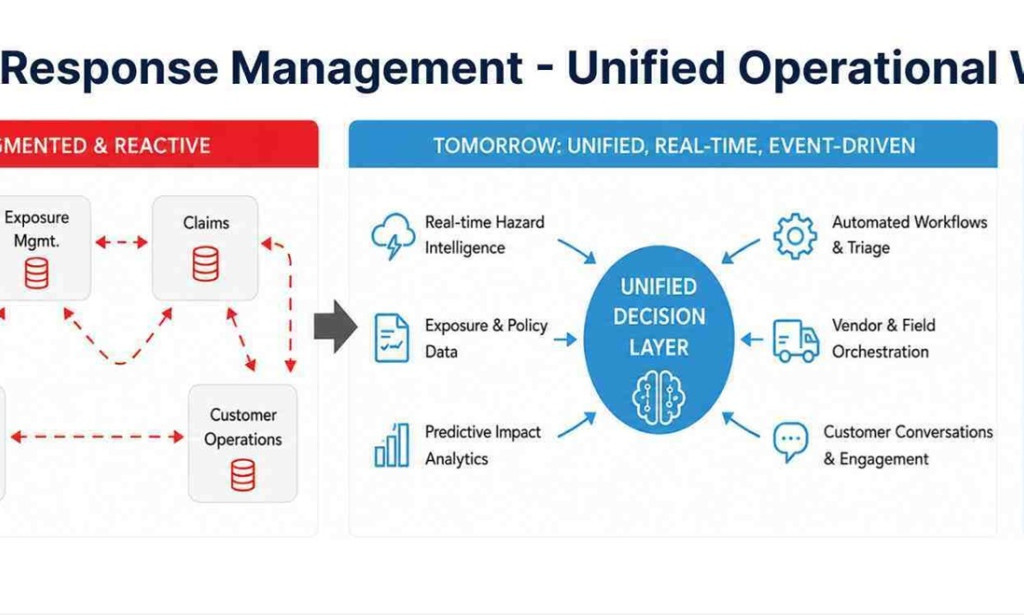
The insurance industry has entered a new era of catastrophe response. Advanced analytics, artificial intelligence, geospatial mapping, and live weather feeds now give insurers unprecedented visibility during disasters. Yet despite this technological leap, one question still dominates the industry conversation: how do insurers handle catastrophe claims when speed matters most?
The answer is more complicated than most policyholders realize.
Today’s carriers can identify affected homes and businesses within minutes of a hurricane, wildfire, tornado, or flood. Data from agencies like the National Oceanic and Atmospheric Administration and the National Weather Service allows insurers to track storm paths, rainfall intensity, wind speeds, and flood risks almost instantly. AI-powered platforms can overlay this information with policyholder exposure data to estimate losses before the first claim is even filed.
But while catastrophe intelligence operates in near real time, claims decisions often do not.
The Real Problem Isn’t Data — It’s Decision Latency
When people ask how do insurers handle catastrophe claims, they often assume delays happen because insurers lack information. In reality, the industry now has more data than ever before.
The bigger issue is decision latency — the gap between receiving information and acting on it.
This delay typically appears in three major stages:
1. Validating Incoming Data
Insurers collect data from multiple sources during catastrophic events:
- Satellite imagery
- Drone footage
- IoT sensors
- Weather agencies
- Claims photos
- Geospatial hazard platforms
The challenge is that these systems rarely communicate seamlessly with one another. Claims teams may see one version of the event while underwriting departments rely on another. Before any payment or response action occurs, carriers must validate and reconcile the information.
That process consumes valuable time during emergencies.
2. Assigning Ownership for Action
Another major reason catastrophe claims slow down is operational confusion.
Large insurers operate through multiple departments:
- Claims
- Underwriting
- Risk management
- Reinsurance
- Compliance
- Customer service
During major disasters, responsibilities can overlap. One team may identify impacted customers while another controls payment authorization. Without clear workflows, catastrophe response becomes fragmented.
This is one of the biggest reasons why insurers struggle to scale real-time catastrophe response despite having advanced analytics tools.
3. Approval Structures Slow Execution
Traditional approval hierarchies were designed for normal claim volumes — not disaster-level surges.
When hurricanes or wildfires generate tens of thousands of claims simultaneously, adjusters become overwhelmed. Many files require supervisory review, compliance checks, or fraud screening before payments can move forward.
As a result, the system becomes bottlenecked precisely when policyholders need immediate support.
Siloed Systems Continue to Hurt Catastrophe Response
One overlooked issue in modern insurance operations is system fragmentation.
Exposure data often sits inside underwriting platforms. Claims photos remain trapped inside mobile adjuster apps. CAT intelligence is managed separately through third-party vendors.
Because these systems operate independently, insurers struggle to create a unified view of catastrophe events.
The 2025 Los Angeles wildfire season exposed this weakness dramatically. Insured losses reportedly approached $40 billion, while tens of thousands of claims flooded insurers during the first quarter alone. Many underwriting teams lacked the ability to dynamically reprice risk mid-event because hazard feeds and exposure engines were disconnected.
This disconnect shows why insurers still face operational paralysis despite having access to sophisticated catastrophe modeling tools.
Secondary Perils Are Increasing Claim Complexity
Another important factor when discussing how do insurers handle catastrophe claims is the rise of secondary perils.
Historically, insurers focused primarily on major hurricanes and earthquakes. Today, secondary events create a much larger share of insured losses, including:
- Flash floods
- Wildfires
- Winter freezes
- Severe convective storms
- Post-storm flooding
These layered disasters create cascading claims that are harder to process quickly.
For example, a hurricane may trigger wind damage first, followed by flooding days later. Multiple policies, adjusters, and coverage reviews may become involved in a single claim file.
This complexity slows response times significantly.
AI Is Improving Claims Triage
Despite these challenges, insurers are making progress.
Artificial intelligence now helps carriers prioritize high-severity claims, detect fraud patterns, and automate routine documentation reviews. Some insurers use AI-powered image recognition to assess roof damage within minutes after a storm.
Parametric insurance models are also gaining attention. These policies trigger automatic payouts when measurable conditions occur — such as specific wind speeds or rainfall totals — eliminating parts of the traditional claims process entirely.
This could dramatically reduce catastrophe claim delays in the future.
The Future of Catastrophe Claims Depends on Connected Decisions
The industry’s next breakthrough will not come from collecting more data. It will come from connecting systems, workflows, and decisions in real time.
Insurers already possess the technology needed to identify catastrophe exposure almost instantly. The remaining challenge is operational execution.
The companies that succeed in the next decade will be the ones that build unified “decision engines” capable of turning live catastrophe intelligence into immediate action.
For policyholders, that means faster inspections, quicker payments, and improved trust during some of life’s most stressful moments.
So, when asking how do insurers handle catastrophe claims, the modern answer is this: insurers are no longer limited by visibility — they are limited by the speed of decision-making.

You must be logged in to post a comment.