

Key Features
The Barsha Pump is the first type of hydro-powered pump developed by aQysta. It is a water wheel propelled pump that utilizes the energy from the flow of rivers and canals to pump water without requiring any fuel or electricity to be operated. Depending upon the soil, crop, climatic conditions, and irrigation technique, one Barsha Pump can irrigate up to 2 hectares of land, and process up to 40,000 liters per day. Although optional, it is recommended to use the Barsha Pump in integration with the storage system and efficient water distribution techniques such as a sprinkler system, drip system, mister, etc. as it helps irrigate larger areas with one Barsha Pump. In addition, every Barsha Pump that replaces a fuel pump saves over 1 ton of CO2 annually.
Social Impact
As a company, we aim to provide sustainable hydro-powered pumping solutions that can have a positive economic, environmental, and social impact. In South Asia, we have our affiliated entity in Nepal which has been operational since 2015. aQysta Nepal is responsible for selling and implementing pumps within the country and serves as a platform for carrying out research and experiments and gathering valuable market feedback. Our flagship product, the Barsha Pump is an award-winning innovative pump, which has been rolled out worldwide to various countries, including Colombia, Malawi, Kenya, Nepal, and India. Until today, we have deployed 300 pumps in over 20 countries and made a positive impact for smallholder farmers.
Future Plans
We aim to grow around the globe and fulfill the possibility of reaching out to and helping farmers around the world, creating a better and sustainable future. Our second product, the HyPump, is also in our plans as we aim to grow with it. It is a more powerful pump, as it pumps up to 800,000 liters of water, and one HyPump can serve about 10 to 20 hectares of land.
Main Target Group
Smallholder farmers in Nepal, India, Colombia, Kenya, Malawi, Indonesia, and Spain, as well as NGOs and governments in those countries.
Main User
Smallholder farmers.
Price (in USD)
$1,373
Key Facts
- 1.The Barsha Pump uses energy from the flow of water in order to pump water towards land.
- 2.The Barsha Pump helps smallholder farmers irrigate their crops in a more sustainable way.
- 3.One Barsha Pump can irrigate up to 2 hectares of land, and process up to 40,000 liters per day.
- 4.Every Barsha Pump that replaces a fuel pump saves over 1 ton of CO2 annually.
- 5.Qysta has deployed 300 pumps in over 20 countries.
The Barsha Pump is a water wheel propelled pump that uses the flow of rivers to pump water to irrigate farms, without the use of electricity or fuel. This product is designed to help small-holder farmers to irrigate their farms at a low energy cost. The pump can be integrated with storage systems like tanks and ponds to enable farmers to store water. This product can al be linked to water distribution systems like a sprinkler system, drip system, mister, etc. to help farmers irrigate a larger area of land.
The Barsha Pump is a water pump designed to operate without fuel or electricity. The pump can be used in rivers, streams, and canals. Barsha Pump is available in two different sizes: the narrow and the wide sizes. The dimensions of the narrow pump are 144 x 179 x 150 cm and the dimensions of the wide pump are 164 x 179 x 150 cm. The weight of the narrow pump is 75 kg and that of the wide pump is 80 kg.
The pump consists of spirals where the air is compressed between water columns resulting in air pressure that lifts the water. The pump can lift water to a height of up to 20 m or pump to a distance of 1 km, while reaching up to 40,000 liters of water per day, depending on the flow velocity of the water. Since no fuel or electricity is required for its operation, the pump does not emit polluting greenhouse gases.
In order to pump water from the water source, the pump must be connected to an HDPE pipe with a diameter of 40 mm and the length needed for the distribution of the water pumped.
For the pump to work properly, the flow rate of the river or stream or canal should be at least 0.8 m/s. The river should have a minimum depth of 20-50 cm and a minimum width of 150 cm.
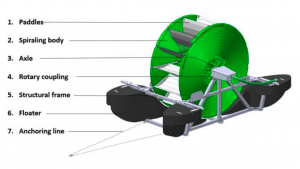
The Barsha pump has a patented modular structure that allows water to be scooped up and pumped. The design consists of a spiral pump that is formed by a tube wrapped around a horizontal axis as can be seen in the image. One end of the tube is open and once per revolution, it is submerged underwater, filling partially the spiral. In each revolution, the air inside the spiral is compressed building up the pressure to pump the water outwards on the other end.

You must be logged in to post a comment.