


 Madurai: Prolonged protests by villagers against the tungsten mining project at Nayakkarpatti in Madurai district concluded in celebrations on Thursday after the Union mines ministry annulled the auction of the tungsten mineral block.
Hindustan Zinc Limited (HZL), a subsidiary of Vedanta, had secured the mining rights in an auction conducted by the ministry on November 7, 2024. However, concerns over potential environmental damage, threats to cultural heritage, and risks to historical sites prompted sustained protests from villagers since November. Political leaders from various parties had visited Nayakkarpatti, extending their support to the protesters.
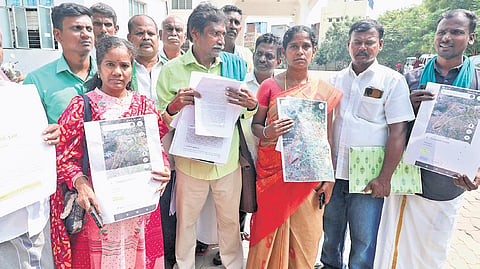
The decision to cancel the auction sparked jubilant celebrations in Arittapatti village. Farmers, women, and villagers gathered to burst crackers, distribute sweets, and perform traditional dances like kummi pattu. The villagers expressed gratitude to the state government for opposing the project and thanked the Centre for its decision.
Tuticorin MP Kanimozhi highlighted the state's opposition on her X handle, noting that a resolution against the project was passed in the assembly under chief minister M K Stalin's leadership. She also raised the issue in the Lok Sabha, calling the annulment a victory for people's protests and democratic action. Kanimozhi urged the Centre to refrain from proposing projects that compromise public welfare.
Villagers from Arittapatti, Melur and nearby areas of Madurai district, along with political leaders from various parties, have voiced strong opposition to the proposed tungsten mining project by Hindustan Zinc Ltd, a subsidiary of Vedanta, in one of Tamil Nadu’s most biodiverse regions.
They are protesting to highlight their concerns about the environmental damage and the loss of ancient sites as the project is located near Azhagar Malai, a site rich in natural and cultural heritage.CPI(M) MP from Madurai, Su Venkatesan, led the charge against the mining initiative, highlighting that Arittapatti is the state’s first biodiversity site, which is now at risk. Hindustan Zinc Ltd has acquired 2,015 hectares for the mining project through a critical minerals auction held by the central government. The site, located just 1.5 km from Azhagar Malai, is home to several ancient Tamil inscriptions, megalithic sites, Jain settlements, stone pavements built by the Sangam Era Pandya kings, and several prominent temples, Venkatesan pointed out.
A total of 193.215 hectares of land spread across the villages of Arittapatti and Meenakshipuram in Madurai district, Tamil Nadu was notified as ‘Arittapatti Biodiversity Heritage Site’ under the Biological Diversity Act of 2002. Arittapatti is one of India’s 19 biodiversity heritage sites.
The most notable geographical feature of Arittapatti is the chain of seven barren granite hillocks. This rocky landscape surprisingly supports a total of 72 lakes, 200 natural springs and three check dams. One of these lakes, Anaikondan Lake, dates back to the 16th century Pandya kingdom. Arittapatti village is also home to a number of megalithic structures, rock-cut temples that are 2,200 years old, several Tamil-Brahmi inscriptions, and a very rich population and fauna and avifauna. The region has approximately 250 species of birds which includes three flagship raptor species: Laggar falcon, shaheen falcon and bonelli’s eagle. The region also has endangered animal species such as slender loris, Indian pangolin and python.
Pattali Makkal Katchi leader Anbumani Ramadoss echoed Venkatesan’s concerns, stating: “The biodiversity in Arittapatti has no equal, and the proposed Tungsten mining project would have irreversible consequences. The central government should revoke the mining permit immediately.”
Amma Makkal Munnetra Kazhagam (AMMK) leader TTV Dhinakaran also joined the chorus of dissent, stressing the environmental risks posed by the project. “This region is home to 250 bird species, endangered animals, 72 lakes, and 200 natural springs. Allowing Tungsten mining here would cause irreparable harm to the local ecosystem and the environment,” Dhinakaran said, urging the central authorities to cancel the mining permit.
Locals have also mobilised against the project, fearing that the mining activities would devastate their agricultural land and threaten their water sources. Villagers in Arittapatti have been staging protests to urge the state government to intervene and prevent the clearance for the mining operation.
The protests come after Vedanta, a mining and metals conglomerate, was involved in a controversy surrounding the Sterlite Copper Plant dating back to 2018, when the Tamil Nadu Pollution Control Board (TNPCB) ordered its closure following widespread protests from local residents.
These protests were fueled by allegations that the plant was causing severe pollution and spreading diseases. In response, Vedanta challenged the closure in court, arguing that the plant's operations had the necessary environmental clearance.
However, the Madras High Court upheld the closure order in August 2020, siding with the TNPCB’s assessment of the plant’s environmental impact. Vedanta, not satisfied with this ruling, took the matter to the Supreme Court, seeking to reopen the facility.
During hearings in February 2024, the Supreme Court emphasised the need to balance public health concerns with economic interests, particularly as the plant had been linked to significant pollution. While Vedanta proposed the formation of an expert committee to assess the reopening conditions, Tamil Nadu strongly opposed it, citing repeated findings of pollution at the site.
Tungsten
- Tungsten is a rare, heavy, and dense metal with the highest melting point (3,422°C) among all metals.
- It is known for its exceptional hardness and resistance to heat, corrosion, and wear.
- Appearance: Greyish-white, lustrous metal in its pure form.
- Ore Sources: Majorly obtained from minerals such as scheelite (calcium tungstate) and wolframite (iron manganese tungstate).
- Tungsten is considered a "critical mineral" due to its indispensable role in defense, high-tech industries, and clean energy applications.
- Applications:
- Industrial Tools:
- Used in cutting tools, drills, and abrasives due to its hardness and heat resistance.
- Tungsten carbide, a compound of tungsten, is widely used for manufacturing durable tools.
- Electronics:
- Filaments in light bulbs, X-ray tubes, and electrical contacts.
- Semiconductor materials and heating elements in electronics.
- Aerospace and Defense:
- Alloyed with other metals for high-strength military-grade armor and aerospace components.
- Used in missile tips and radiation shielding due to its density.
- Medical Applications:
- Utilized in medical imaging devices and as radiation shielding material in cancer treatments.
- Green Energy & High-Tech Applications:
- Essential in wind turbines and in the production of superalloys for energy and technology sectors.
- Industrial Tools:
- Tungsten in India:
- Primary Deposits:
- Rajasthan: Degana mines in Nagaur district are historically significant for tungsten mining.
- Andhra Pradesh: Scheelite deposits in Srikakulam district.
- Karnataka: Concentrated reserves in Chitradurga and Mysuru regions.
- Current Status: India imports a significant portion of its tungsten requirements due to limited domestic production.
- Primary Deposits:
- Global Reserves & Producers:
- Major Tungsten Reserve-Holding Countries:
- China: Holds the largest tungsten reserves and accounts for over 80% of global production.
- Russia and Canada: Significant reserves and growing production capacity.
- Vietnam, Bolivia, and Austria: Other notable contributors to tungsten mining.
- Top Producers:
- China: Dominates global production due to vast reserves and advanced processing facilities.
- Russia: Increasing production for industrial and defense purposes.
- Austria and Bolivia: Key exporters to international markets.
- Major Tungsten Reserve-Holding Countries:
About the Controversy
- The Union Ministry of Mines recently awarded tungsten mining rights to Hindustan Zinc Limited, a subsidiary of Vedanta Limited, through an auction on November 7, 2024.
- One of the chosen sites was the biodiversity-rich Melur region in Madurai, Tamil Nadu.
- The auction was part of Tranche IV under the Mines and Minerals (Development and Regulation) Act, 1957, focusing on strategic minerals like tungsten, phosphorite, and vanadium essential for high-tech and green energy applications.
- Significance of the Mining Site:
- The 2,015.51-hectare Nayakkarpatti tungsten block is known for its deposits of scheelite, a primary tungsten ore.
- The Periyar canal has been identified as the water source for mining operations.
- Despite its resource potential, the site overlaps with biodiversity heritage areas in Arittapatti and Meenakshipuram villages, which were designated to protect ecological and cultural assets.
Opposition to the Project
- Environmental Concerns:
- The biodiversity heritage site, notified by Tamil Nadu in 2022, spans 193.63 hectares across Arittapatti and Meenakshipuram villages.
- Environmentalists argue that mining could harm flora, fauna, and cultural landmarks, including ancient temples and Jain relics.
- Tailings from ore processing may release harmful metals like arsenic, cadmium, and lead, posing risks to human health and the environment.
- Activist and Public Outcry:
- Environmental groups, including Poovulagin Nanbargal, highlighted the potential ecological damage.
- Activist R.S. Mugilan criticized Vedanta's environmental record, citing pollution from its copper smelting unit in Thoothukudi.
- Cultural Significance:
- The region is rich in heritage, and locals fear mining could distort its cultural identity.
Government’s Position
- State Government's Position:
- Tamil Nadu’s Chief Minister M.K. Stalin urged the Union government to cancel the mining rights, vowing to pass a resolution in the State Assembly to reject the project.
- The State government claims it informed the Centre about the biodiversity heritage site's existence during land discussions.
- Union Government’s Response:
- The Union Ministry of Mines contends there was no opposition from the Tamil Nadu government during the auction process, which began in February 2024.
Conclusion
- The tungsten mining project in Madurai underscores the complex balance between resource exploitation and environmental preservation.
- While the Union government highlights strategic benefits, the Tamil Nadu government and environmental groups emphasize protecting biodiversity and cultural heritage.
- The outcome of this controversy could set a precedent for how India navigates similar resource management disputes in the future.

You must be logged in to post a comment.