

Abstract
The utilization rate of water resources of mines in China is still relatively low. The evaluation of mine water recycling has practical guiding significance for the planning, positioning, development, and construction of groundwater in today’s society. This article constructs an evaluation system for mine water recycling based on the key performance index (KPI) via the Internet of Things and big data platforms. This system evaluates the recycling status of mine water. First, the micro-seismic monitoring system and the hydrological dynamic detection system are deployed in work. The installation and debugging methods are compared to meet the monitoring requirements. Second, the filtered clear water is used for equipment cooling and firefighting dust removal at the mining face through the constant pressure supply pump. The excess clear water is discharged to the surface. Finally, 16 indicators are screened from four dimensions to construct a key KPI mine water evaluation system for evaluation and optimization. The results demonstrate that the first mine water monitoring system runs well and is fully functional, achieving the expected goal. The utilization rate evaluation score has increased yearly, from 3.05 points in 2016 to 3.39 points in 2020. However, the per capita utilization rate score still needs improvement. It is essential to improve the rationality of development and utilization.
Introduction
The treatment of mine water in China commenced in the mid-1980s and has since witnessed remarkable progress and technological advancements. Currently, the majority of registered mining enterprises nationwide, with the exception of a few water-free mines in the northwest region, have established and operated mine water treatment systems. Based on incomplete statistics and estimates, the total treatment capacity for various types of mine water in the country exceeds 5 billion cubic meters per year. With the exception of a few mines employing pre-drainage or underground diversion measures, enabling direct discharge of clean mine water, most mines necessitate water quality treatment. Achieving comprehensive recycling and utilization of mine water has become an essential aspect of cost reduction and efficiency enhancement in mine operations. As a result, ensuring efficient and cost-effective comprehensive utilization of mine water poses a significant challenge for mine management and technical personnel.
Since the introduction of the Internet of Things (IoT) concept, substantial theoretical advancements have been made, and significant economic and social benefits have been realized through its application in various domains, including transportation, logistics, electricity, healthcare, agriculture, and urban management. Drawing inspiration from the extensive implementation of the IoT, the concept of smart water management, referred to as “Smart Water Conservancy”, has emerged to address the needs of mine water resource supply, demand, and distribution. However, mine water differs from logistics, and the dual depiction of water flow concerning “field” and “quality” traditionally renders water networking more intricate and challenging in comparison to the IoT. Smart water management, based on IoT principles, enables real-time perception, process tracking, and dynamic simulation of the complete mine water circulation process. By integrating information fusion and data mining of both market water networks and physical water networks, it optimizes the allocation and intelligent supervision of mine water resources, thereby enhancing the efficiency of mine water utilization.
This article aims to propose a comprehensive and universally applicable performance evaluation index system for mine water circulation, guided by the concepts of a healthy city and mine water circulation. By utilizing detailed, quantifiable, and widely applicable performance evaluation indicators, the article adheres to the principle of performance assessment and seeks to establish a generalized evaluation system. Firstly, this article elucidates the operation of existing microseismic monitoring systems and hydrological dynamic detection systems. Secondly, the filtration process is accomplished by leveraging the water storage capacity of goafs and the height difference of tunnels, facilitating the natural flow of wastewater within goafs. The filtered clean water is then utilized for equipment cooling and fire dust removal in the mining working face using a constant pressure water supply pump, while any excess clean water is discharged to the surface. Finally, 16 key performance indicators (KPIs) are selected from four dimensions: ecological level, water resource abundance, water resource quality, and water resource utilization. These indicators form the evaluation system for mine water circulation, serving the purpose of assessment and optimization.
Literature review
Extensive research has been conducted by numerous scholars on issues related to urban water circulation. For instance, Hou elaborated on the developmental process of urban hydrology, with a particular focus on the impacts of urbanization on various aspects of the water cycle, including precipitation, runoff, infiltration, and evapotranspiration. Manikandan introduced the concept of social water circulation and examined the sustainability of urban water resources, establishing an evaluation system for the environmental sustainability of urban water systems. Pinotti investigated the transformation process of urban water circulation and explored the necessary conditions for a well-functioning water system cycle, proposing a rational application sequence for urban water resources. Scanlon discussed the connection between modern socioeconomic factors and sustainable water resource utilization, suggesting a range of measures to promote urban water circulation within a circular economy framework.
Research and application of IoT technologies in the realm of smart water management primarily focus on real-time perception, water information interconnection, process tracking, and intelligent processing. Ighalo utilized IoT data acquisition and environmental sensing technologies to study and enhance the timeliness and accuracy of data acquisition from various water monitoring devices. Friha leveraged the achievements of IoT in intelligent identification, tracking positioning, and monitoring management to achieve refined management of basin water resource allocation processes, water environment changes, hydrological element evolution, and other water-related factors. Yasin utilized the IoT's capabilities to acquire and process data from diverse business systems in a dynamic, open, and uncontrollable environment, enabling water information sharing in a watershed context. Sinha capitalized on the research findings of IoT in industrial intelligent control, domain knowledge processing, and big data analysis to improve the efficiency and accuracy of water-related business processes, progressively realizing smart water management.
Okudan, through an analysis of urban water circulation processes and drawing from the principles of a key performance indicator system, developed an evaluation index system for the health assessment of urban water circulation systems. This evaluation index system facilitated the calculation of indicator weightings through modeling, enabling the quantitative analysis of the health status of water circulation in Tianjin. The analysis provided insights into the health conditions of Tianjin's water circulation across different levels, aspects, and years. D'Inverno, considering the natural and social characteristics of urban water circulation, focused on the processes of water supply, water use, wastewater drainage, and reuse. By examining their interrelationships and coordination, a health evaluation system for urban water circulation was established. Zhang, taking into account the characteristics of water resources in Xi’an, employed a subjective–objective weighting method and selected 16 indicators from four dimensions. Using a rating description method with five levels of evaluation, a key performance indicator-based evaluation system for the health of water circulation in Xi'an was constructed, providing theoretical support for water resource management.
However, previous studies have focused mostly on the specific water resource cycle, cycle sustainability, and water cycle law. Scholars have examined some technologies of coal mines in many regions, combined with the mine’s hydrogeological conditions and actual production conditions. Innovatively, the filtered sewage from the mining area is supplied directly to the underground for firefighting and cooling by adding constant pressure water supply equipment. This solution realizes the underground recycling of mine water, effectively reduces mine production costs, and increases mine efficiency. In addition, 16 indicators are selected from four dimensions using subjective and objective assignments. Besides, a five-level water cycle health evaluation based on key performance indicators is built using the hierarchical description method. This system provides theoretical support for water resources management.
Model design
In the coal mining process, groundwater is in contact with coal seams and rock formations. During the coal mining process, a series of physical, chemical, and biochemical reactions occur due to the contact between groundwater and coal and rock seams, with the influence of human activities. Consequently, the water quality has significant coal industry characteristics. Mine water with poor sensory properties has a much higher suspended matter content than surface water. It contains suspended matter with small particle size, light-specific gravity, slow settling speed, poor coagulation, and organic pollutants, such as waste machine oil and emulsified oil. Mine water contains a much higher content of total ions than normal surface water. Among them, sulfate ions account for a large proportion. Mine water often has a deficient pH value. It is often accompanied by a large number of ferrous ions, increasing the treatment difficulty. Presents the industrial application of mine water.
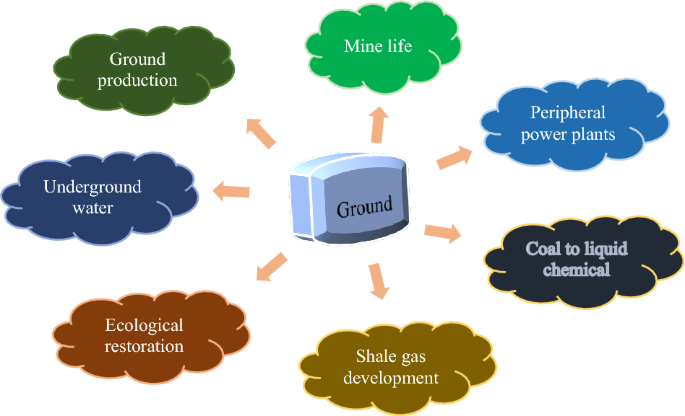
Applications of the mine water industry.
The pending mine water can be divided into general suspended matter mine water, high salinity mine water, acid mine water, and clean mine water. The categories are the basis for selecting a proper mine water quality treatment process. In addition, mine water is affected by human activities as it flows through mining workings, roadways, and extraction areas. Meanwhile, rock dust, coal dust, and other organic matter enter the water body, making the water quality complex. Therefore, the resource utilization of mine water should adopt different treatment processes according to different types of mine water. Displays the basic process flow of traditional mine water treatment.
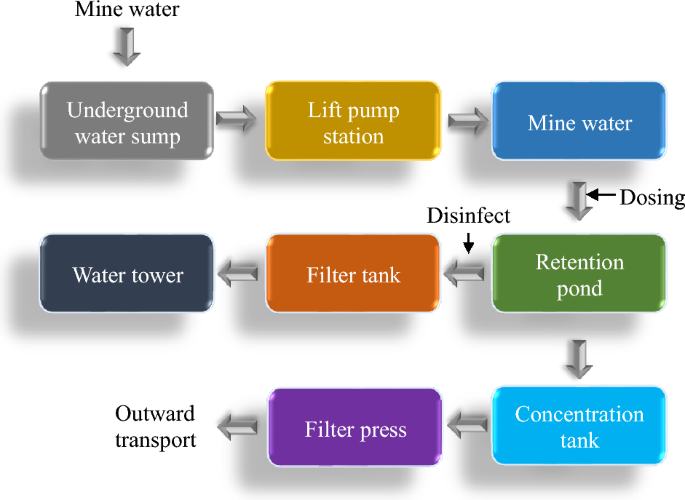
Basic process flow of traditional mine water treatment.
The key is the development and application of an automatic dosing system and the selection of appropriate coagulants. These operations can save chemicals, simplify processes, improve effluent quality, and realize the recycling of mine water resources.
The development of IoT, cloud computing, and big data technology has injected new vitality into the informatization of water conservancy. IoT is characterized by sensing, interconnection, and intelligence. Its wide application has dramatically improved the standardization, efficiency, and ease of use of information services in various industries and pushed water conservancy information into a new stage. At this stage, problems such as water resource shortage and environmental pollution become even more prominent. Floods and droughts caused by extreme weather significantly impact social and people’s livelihoods, and the traditional water conservancy industry faces severe challenges. The development and application of IoT-related technologies provide effective measures for intelligently solving water conservancy problems. Illustrates the composition of its key technologies.
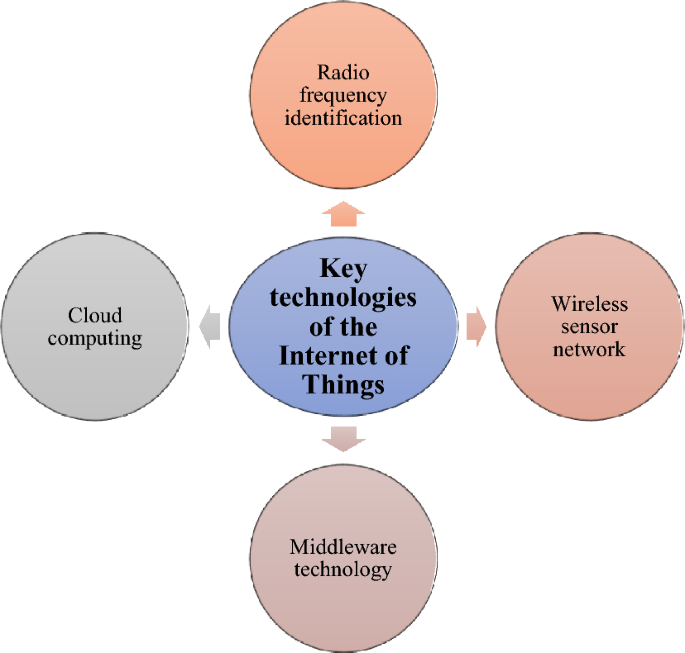
Composition of the key IoT technologies.
The transformation of IoT technology from concept to the practical application requires integrating several key IoT technologies. Common techniques include radio frequency identification technology, wireless sensor technology, middleware technology, and cloud computing technology. The integration of these technologies enables the application of IoT technology in many industries and provides the necessary conditions for the intelligence of the sector.
This article uses IoT technology to build a smart mine water resource network. It applies water resources-related sensors (for metering facilities, water quality, water level, flow monitoring, etc.). This network is conducive to mine water resources development, utilization, and protection. Then, the sensors of each node are connected to the existing wireless network and the Internet. The intelligent mine water resources network is mainly composed of three levels of systems.
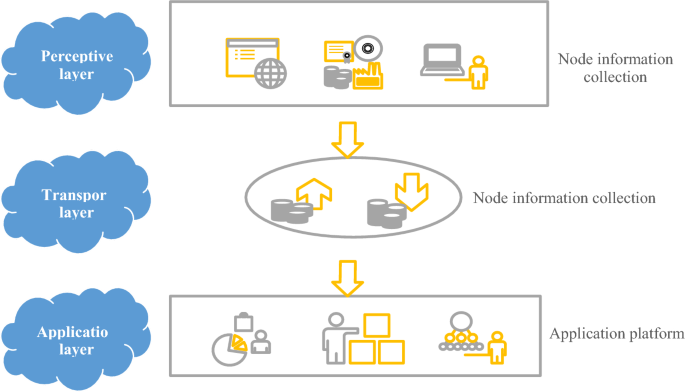
Constitute of the mine water resource smart network.
The intelligent mine water resource network consists of three layers: the perception layer (node information collection), the transmission layer (information transmission), and the application layer (the application platform). The perception layer mainly collects information such as water volume, temperature, level, and quality to form each node of the intelligent network of mine water resources. The transmission layer transmits the information collected by each node to the application platform. As a platform for data storage, processing, analysis, and application, the application layer provides application software for mine water resources management. The intelligent mine water resource network depends on the synergy of three levels of perception, transmission, and application. It realizes intelligent monitoring, measurement, scheduling, and management functions of the mine water resources environment.
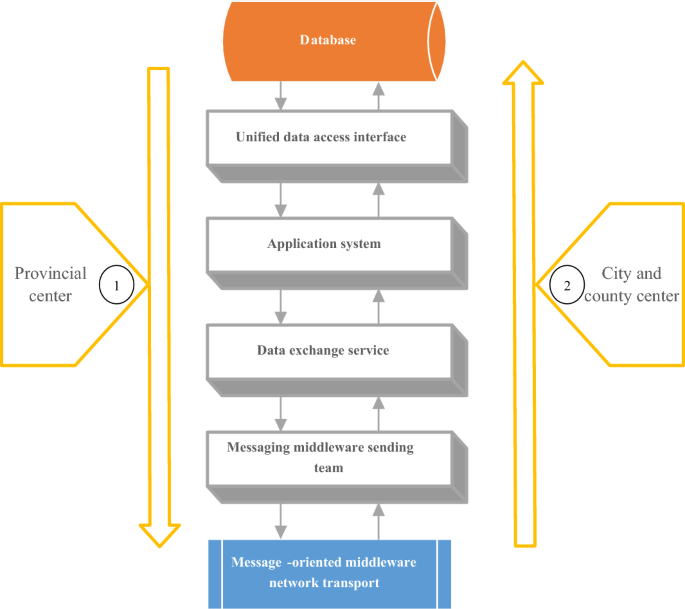
Data transmission process of the mine water resource smart network.

You must be logged in to post a comment.