

The heart is the first organ to form during development of the body. When an embryo is made up of only a very few cells, each cell can get the nutrients it needs directly from its surroundings. But as the cells divide and multiply to form a growing ball, it soon becomes impossible for nutrients to reach all the cells efficiently without help. The cells also produce waste that they need to get rid of. Thus, the first organ system to develop is the heart, blood and circulatory system, so that nutrients and waste can be transported throughout the growing embryo. The heart continues carrying out this same vital job throughout our lives.
When the heart can’t do its job, people’s lives are at risk. The World Health Organization states that more people die from heart diseases every year than from any other cause. In 2015, an estimated 31% of all deaths worldwide were due to heart diseases – that’s roughly 17.7 million people.
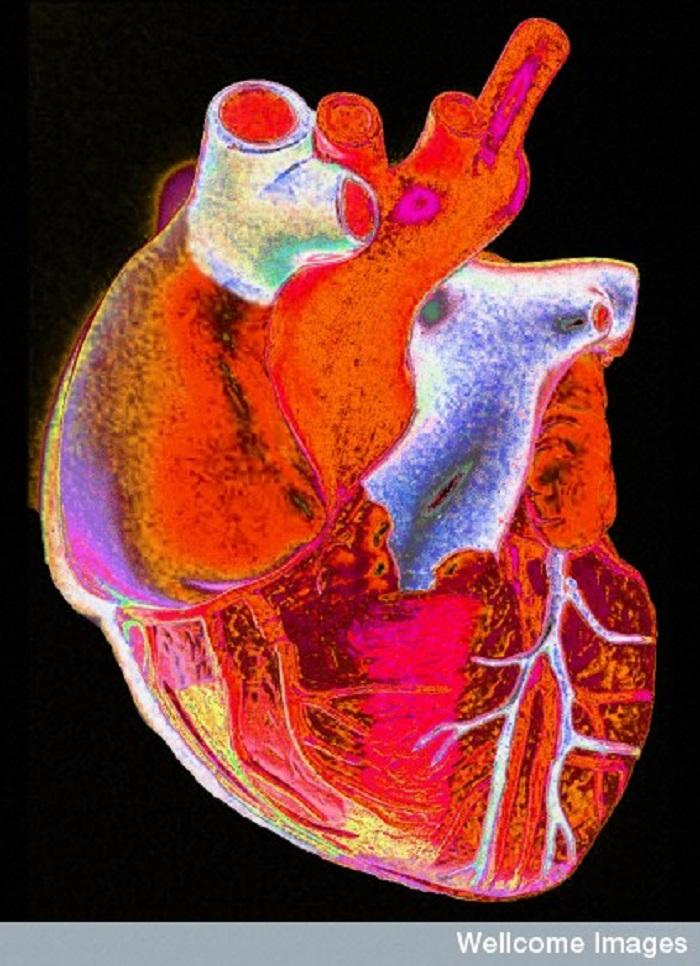 Once damaged, the adult human heart cannot heal itself like other organs in the body. The only current treatment for a seriously failing heart today is a heart transplant. However, scientists are researching ways that stem cells might help treat heart diseases in the future by repairing or replacing damaged heart cells.
NATURAL STEM CELLS IN THE HEART
For some time, scientists believed that the adult heart had no capacity to make new heart muscle cells (cardiomyocytes). Believe it or not, nuclear weapon tests from the 1950s and 1960s gave researchers a way to study how fast heart cells are replaced. Nuclear tests created large amounts of a special type of carbon called C-14 in the earth’s atmosphere. Archaeologists regularly use C-14 to calculate the age of once-living materials based on the amount of C-14 they contain, a process called ‘carbon-dating’. Methods for carbon-dating have gotten so accurate that biologists have used this method to determine how old cells are in people that lived through the surge of C-14 generated from nuclear tests. They found that the average age of cardiomyocytes in an adult’s heart are about six years younger than the individual the heart comes from. This means that our adult bodies must be making new cardiomyocytes, just very slowly.
This discovery has created a new field of research to determine where these new cardiomyocytes come from, what biological signals control their production and how this process might be used to treat heart diseases. It now seems most likely that cardiomyocytes themselves can divide to make more cardiomyocytes. If we could somehow enhance this process, we might be able to replace those lost to damage from heart attacks.
Unfortunately, it’s also been shown that our body's production of new cardiomyocytes declines with age. In the first decades of our lives, about two per cent of our cardiomyocytes are replaced every year, but by the time we are in our seventies only a fraction of one per cent of the cells are being replaced.
The cardiomyocytes in this developing mouse heart can be identified using proteins on the surface of the cells. Red indicates a cardiomyocyte protein is present, and green marks a protein found on certain cells in the inner most layer of the heart.
This is a cardiomyocyte (heart muscle cell) obtained from stem cells and identified using a 'bar code' of proteins found on the surface of the cells.

You must be logged in to post a comment.