

From mules to ligers, the list of human-bred hybrid animals is long. It’s also ancient, with the oldest of these being the kunga. Its breeders lived some 4,500 years ago in a part of Asia known as Syro-Mesopotamia. Researchers have now identified the parents of these animals as a cross between a donkey and a type of wild ass called a hemippe.
Kungas were no common barnyard animal. “They were highly valued. Very expensive,” says Eva-Maria Geigl. She studies genetic material found in the remains of ancient organisms. Geigl works at Institut Jacques Monod in Paris, France. She was part of a team that tracked down the kungas’ parents genetically.
Their findings appeared January 14 in Science Advances.
In the early 2000s, dozens of horselike skeletons were dug up in northern Syria. They came from a royal burial complex at the site of an ancient city called Umm el-Marra. The skeletons dated back to 2600 B.C. Domesticated horses wouldn’t appear in this region for another 500 years. So these weren’t horses. The animals also did not look like any known relative of horses.
The skeletons instead appeared to be “kungas.” These horselike animals were depicted in artwork. Clay tablets from this area also mentioned them from long before horses arrived.
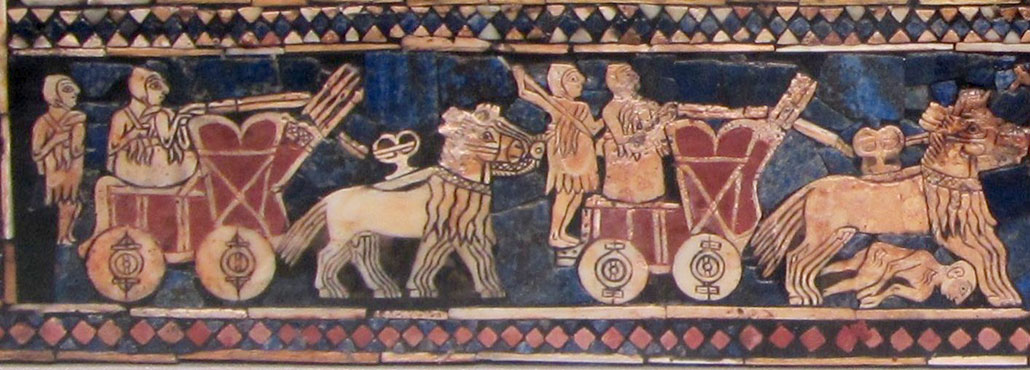 This scene on a Sumerian artifact — a wooden box called the Standard of Ur that depicts war scenes — includes images of hybrid kungas pulling wagons.
Geigl and her colleagues analyzed one kunga’s genome, or genetic instruction book. The team then compared that genome with those of horses, donkeys and wild asses from Asia. The wild asses included one — the hemippe (Equus hemionus hemippus) — which has been extinct since 1929. The kunga’s mother had been a donkey. A hemippe was its father. That makes it the oldest known example of a hybrid animal bred by people. A mule from 1000 B.C. in Anatolia — modern-day Turkey — is the next oldest hybrid.
Geigl thinks kungas were created for warfare. Why? Because they could pull wagons. Coaxing donkeys into dangerous situations is hard, she says. And no wild ass from Asia can be tamed. But a hybrid might have had the traits people sought.
Coauthor E. Andrew Bennett also studies genetic material from ancient remains. He works at the Chinese Academy of Sciences in Beijing. Kungas were like “bioengineered war machines,” he says. And, he adds, “it’s impossible to make these animals again” as the last hemippe died a century ago.
organism: Any living thing, from elephants and plants to bacteria and other types of single-celled life.
trait: A characteristic feature of something. (in genetics) A quality or characteristic that can be inherited.
genetic: Having to do with chromosomes, DNA and the genes contained within DNA. The field of science dealing with these biological instructions is known as genetics. People who work in this field are geneticists.
genome: The complete set of genes or genetic material in a cell or an organism. The study of this genetic inheritance housed within cells is known as genomics.
DNA: (short for deoxyribonucleic acid) A long, double-stranded and spiral-shaped molecule inside most living cells that carries genetic instructions. It is built on a backbone of phosphorus, oxygen, and carbon atoms. In all living things, from plants and animals to microbes, these instructions tell cells which molecules to make.

You must be logged in to post a comment.