
Conversion Guide Every Tech Professional Needs in 2026
If you've ever stared at a timestamp from an API log, a server alert, or a global team calendar and thought "wait, what time is that actually for me?" you're not alone. Converting UTC to EST is one of those small but surprisingly costly things that trips up developers, remote teams, traders, and anyone coordinating across time zones every single day.
Here's the thing most people don't realize: UTC to EST isn't just a matter of subtracting five hours. There's the EST vs EDT distinction, daylight saving transitions, date rollovers at midnight, and a whole range of specific time values that people look up constantly — like 14 UTC to EST, 8 UTC to EST, or 1900 UTC to EST. Get it wrong and you're late to a meeting, miss a trading window, or ship a deployment at 3 AM instead of 11 PM.
This guide covers everything. You'll walk away knowing exactly how the UTC to EST conversion works, when EST becomes EDT, how to handle military-style UTC timestamps, and how to convert every common UTC hour into Eastern time without second-guessing yourself. We've also packed in a full reference table covering every hour of the day — both directions — so you can bookmark this and come back whenever you need it.
What Is UTC? Understanding the Global Time Standard
UTC stands for Coordinated Universal Time. It's the world's primary time standard, the one that keeps every clock, server, satellite, and software system synchronized across the planet. You'll also see it called "Zulu time" in aviation and military contexts — that "Z" you sometimes spot at the end of a timestamp (like 2026-05-20T14:00:00Z) means UTC.
What makes UTC different from every other time zone is that it never changes. No daylight saving, no seasonal adjustments, no political time zone shifts. UTC is always UTC. That's exactly why it's the standard for APIs, databases, server logs, cloud infrastructure, financial systems, and any technical context where consistency matters.
UTC replaced Greenwich Mean Time (GMT) as the official world standard in 1972. For casual use, UTC and GMT are essentially the same thing — both sit at zero offset — but they're technically defined differently. Scientists and engineers use UTC; GMT tends to show up in older systems and informal references.
What Is EST? Eastern Standard Time Explained
EST stands for Eastern Standard Time. It's the time zone used across the Eastern United States and Canada during the winter months, running from the first Sunday of November through the second Sunday of March.
The UTC to EST offset is UTC minus 5 hours — EST is always 5 hours behind UTC. So if it's 15:00 UTC, it's 10:00 AM EST.
EST covers major cities including New York, Washington D.C., Toronto, Montreal, Miami, Atlanta, Detroit, and Boston. It also applies to Jamaica, the Bahamas, Haiti, Panama, parts of Mexico, and the Turks and Caicos Islands.
The states in the Eastern Time Zone include New York, Florida, Georgia, Ohio, Michigan, Virginia, North Carolina, Tennessee, Indiana, and several others. Ohio is EST/EDT. Georgia is EST/EDT. North Carolina is EST/EDT. Tennessee's time zone is Eastern Standard Time during winter.
EST vs EDT: The Difference That Catches Everyone Off Guard
Here's where a lot of people go wrong. "Eastern Time" isn't always EST.
EST (Eastern Standard Time) = UTC-5. This applies during winter: November through mid-March.
EDT (Eastern Daylight Time) = UTC-4. This applies during summer: mid-March through early November.
During daylight saving time, clocks in the Eastern zone spring forward by one hour. So the UTC to Eastern Time offset shrinks from 5 hours to 4 hours. If you're converting UTC to Eastern time in July and you subtract 5 hours, you're getting the wrong answer — you're actually in EDT territory, so you should subtract 4.
The transition dates for 2026:
- Spring forward (EST → EDT): Sunday, March 8, 2026 at 2:00 AM local time
- Fall back (EDT → EST): Sunday, November 1, 2026 at 2:00 AM local time
So: are we in EST or EDT right now? If you're reading this in May 2026, the US is currently observing EDT (UTC-4). EST doesn't resume until November.
Many people ask "is it EST or EDT?" and "are we in standard or daylight time?" — the simplest answer is: November through mid-March = EST. Rest of the year = EDT.
UTC to EST Conversion Formula
The core math is straightforward:
EST Time = UTC Time − 5 hours EDT Time = UTC Time − 4 hours
If the subtraction takes you below 0:00 (midnight), the date rolls back one day. For example, 02:00 UTC − 5 hours = 21:00 (9:00 PM) the previous day in EST.
That midnight rollover trips people up more than almost anything else. Always check the date when you're converting early UTC hours.
Complete UTC to EST Reference Table (All 24 Hours)
This is the table you've been looking for. Both EST (winter, UTC-5) and EDT (summer, UTC-4) columns included so you always have the right answer regardless of the season.
| UTC (24h) | UTC (12h) | EST (UTC−5) | EDT (UTC−4) |
|---|---|---|---|
| 00:00 | 12:00 AM | 7:00 PM (prev day) | 8:00 PM (prev day) |
| 01:00 | 1:00 AM | 8:00 PM (prev day) | 9:00 PM (prev day) |
| 02:00 | 2:00 AM | 9:00 PM (prev day) | 10:00 PM (prev day) |
| 03:00 | 3:00 AM | 10:00 PM (prev day) | 11:00 PM (prev day) |
| 04:00 | 4:00 AM | 11:00 PM (prev day) | 12:00 AM (midnight) |
| 05:00 | 5:00 AM | 12:00 AM (midnight) | 1:00 AM |
| 06:00 | 6:00 AM | 1:00 AM | 2:00 AM |
| 07:00 | 7:00 AM | 2:00 AM | 3:00 AM |
| 08:00 | 8:00 AM | 3:00 AM | 4:00 AM |
| 09:00 | 9:00 AM | 4:00 AM | 5:00 AM |
| 10:00 | 10:00 AM | 5:00 AM | 6:00 AM |
| 11:00 | 11:00 AM | 6:00 AM | 7:00 AM |
| 12:00 | 12:00 PM (noon) | 7:00 AM | 8:00 AM |
| 13:00 | 1:00 PM | 8:00 AM | 9:00 AM |
| 14:00 | 2:00 PM | 9:00 AM | 10:00 AM |
| 15:00 | 3:00 PM | 10:00 AM | 11:00 AM |
| 16:00 | 4:00 PM | 11:00 AM | 12:00 PM (noon) |
| 17:00 | 5:00 PM | 12:00 PM (noon) | 1:00 PM |
| 18:00 | 6:00 PM | 1:00 PM | 2:00 PM |
| 19:00 | 7:00 PM | 2:00 PM | 3:00 PM |
| 20:00 | 8:00 PM | 3:00 PM | 4:00 PM |
| 21:00 | 9:00 PM | 4:00 PM | 5:00 PM |
| 22:00 | 10:00 PM | 5:00 PM | 6:00 PM |
| 23:00 | 11:00 PM | 6:00 PM | 7:00 PM |
Quick reference for commonly searched conversions:
| UTC | EST | EDT |
|---|---|---|
| 1 UTC to EST | 8:00 PM (prev day) | 9:00 PM (prev day) |
| 2 UTC to EST | 9:00 PM (prev day) | 10:00 PM (prev day) |
| 3 UTC to EST | 10:00 PM (prev day) | 11:00 PM (prev day) |
| 4 UTC to EST | 11:00 PM (prev day) | 12:00 AM |
| 5 UTC to EST | 12:00 AM midnight | 1:00 AM |
| 6 UTC to EST | 1:00 AM | 2:00 AM |
| 7 UTC to EST | 2:00 AM | 3:00 AM |
| 8 UTC to EST | 3:00 AM | 4:00 AM |
| 9 UTC to EST | 4:00 AM | 5:00 AM |
| 10 UTC to EST | 5:00 AM | 6:00 AM |
| 11 UTC to EST | 6:00 AM | 7:00 AM |
| 12 UTC to EST | 7:00 AM | 8:00 AM |
| 13 UTC to EST | 8:00 AM | 9:00 AM |
| 14 UTC to EST | 9:00 AM | 10:00 AM |
| 15 UTC to EST | 10:00 AM | 11:00 AM |
| 16 UTC to EST | 11:00 AM | 12:00 PM |
| 17 UTC to EST | 12:00 PM | 1:00 PM |
| 18 UTC to EST | 1:00 PM | 2:00 PM |
| 19 UTC to EST | 2:00 PM | 3:00 PM |
| 20 UTC to EST | 3:00 PM | 4:00 PM |
| 21 UTC to EST | 4:00 PM | 5:00 PM |
| 22 UTC to EST | 5:00 PM | 6:00 PM |
| 23 UTC to EST | 6:00 PM | 7:00 PM |
Common UTC to EST Conversions: Every Specific Time Covered
Let's cover the individual UTC values people search most often. These answers apply during EST (winter). During summer/EDT, add one hour to each result.
8 AM UTC to EST
8 AM UTC = 3:00 AM EST / 4:00 AM EDT This is a very early morning Eastern time. Common in automated overnight server jobs that run at 8:00 UTC in Europe or for Asian-Pacific operations.
9 AM UTC to EST / 9:00 UTC to EST
9:00 UTC = 4:00 AM EST / 5:00 AM EDT Still pre-dawn in the Eastern US. If your international standup is at 9 AM UTC, your Eastern colleagues are waking up very early.
10 AM UTC to EST / 10:00 UTC to EST
10:00 UTC = 5:00 AM EST / 6:00 AM EDT Early morning Eastern time. Some trading teams doing pre-market prep will be up at this hour during EDT.
11 UTC to EST / 11 AM UTC to EST
11:00 UTC = 6:00 AM EST / 7:00 AM EDT A reasonable morning for Eastern US. European colleagues calling at 11 AM their time are catching you at 7 AM EDT in summer.
12 UTC to EST / 12:00 UTC to EST / 12 PM UTC to EST
12:00 UTC (noon) = 7:00 AM EST / 8:00 AM EDT Noon UTC is 7 AM Eastern Standard Time or 8 AM EDT. This is a popular global meeting slot — morning for the East Coast, afternoon in Europe.
1 PM UTC to EST
13:00 UTC = 8:00 AM EST / 9:00 AM EDT A solid morning meeting time for Eastern. Midday in the UK.
2 PM UTC to EST / 14 UTC to EST / 14:00 UTC to EST
14:00 UTC = 9:00 AM EST / 10:00 AM EDT One of the best global overlap windows. 2 PM UTC is 9 AM EST — perfect for East Coast business hours. This is why "best meeting time: 2 PM–5 PM UTC" gets cited so often for UTC-to-EST scheduling.
15 UTC to EST / 3 PM UTC to EST / 15:00 UTC to EST
15:00 UTC = 10:00 AM EST / 11:00 AM EDT Mid-morning Eastern. Great for global cross-team syncs.
16:00 UTC to EST / 4 PM UTC to EST
16:00 UTC = 11:00 AM EST / 12:00 PM EDT Approaching midday in the East. Still workable for Europe (5 PM CET).
17 UTC to EST / 5 PM UTC to EST / 1700 UTC to EST
17:00 UTC = 12:00 PM EST / 1:00 PM EDT Lunch hour Eastern time. End of day in Western Europe.
18 UTC to EST / 6 PM UTC to EST / 1800 UTC to EST
18:00 UTC = 1:00 PM EST / 2:00 PM EDT Early afternoon in the Eastern US. 7 PM in the UK.
19 UTC to EST / 7 PM UTC to EST / 1900 UTC to EST
19:00 UTC = 2:00 PM EST / 3:00 PM EDT Mid-afternoon Eastern. Popular for end-of-European-day handoffs.
20 UTC to EST / 8 PM UTC to EST / 2000 UTC to EST
20:00 UTC = 3:00 PM EST / 4:00 PM EDT Late afternoon Eastern. One hour before NYSE close at 4 PM ET (21:00 UTC during standard time / 20:00 UTC during daylight saving).
21 UTC to EST / 9 PM UTC to EST / 2100 UTC to EST
21:00 UTC = 4:00 PM EST / 5:00 PM EDT End of New York business day. NYSE closes at 4:00 PM ET, which is 21:00 UTC in winter.
22 UTC to EST / 10 PM UTC to EST / 2200 UTC to EST
22:00 UTC = 5:00 PM EST / 6:00 PM EDT End of extended trading hours for many platforms.
23 UTC to EST
23:00 UTC = 6:00 PM EST / 7:00 PM EDT Evening Eastern time.
Midnight UTC to EST / 12 AM UTC to EST / 0000 UTC
00:00 UTC = 7:00 PM EST (previous calendar day) / 8:00 PM EDT (previous calendar day) This is the rollover case. Midnight UTC is actually still the previous evening in the Eastern US.
Military Time UTC to EST Conversions
Technical systems, aviation, and military operations use 24-hour (military) time with UTC. Here's a quick reference:
| Military UTC | EST | EDT |
|---|---|---|
| 0030 (12:30 AM UTC) | 7:30 PM prev day | 8:30 PM prev day |
| 0300 (3:00 AM UTC) | 10:00 PM prev day | 11:00 PM prev day |
| 0500 (5:00 AM UTC) | 12:00 AM | 1:00 AM |
| 0600 (6:00 AM UTC) | 1:00 AM | 2:00 AM |
| 0800 (8:00 AM UTC) | 3:00 AM | 4:00 AM |
| 1200 (noon UTC) | 7:00 AM | 8:00 AM |
| 1300 (1:00 PM UTC) | 8:00 AM | 9:00 AM |
| 1400 (2:00 PM UTC) | 9:00 AM | 10:00 AM |
| 1433 (2:33 PM UTC) | 9:33 AM | 10:33 AM |
| 1445 (2:45 PM UTC) | 9:45 AM | 10:45 AM |
| 1500 (3:00 PM UTC) | 10:00 AM | 11:00 AM |
| 1600 (4:00 PM UTC) | 11:00 AM | 12:00 PM |
| 1615 (4:15 PM UTC) | 11:15 AM | 12:15 PM |
| 1700 (5:00 PM UTC) | 12:00 PM | 1:00 PM |
| 1800 (6:00 PM UTC) | 1:00 PM | 2:00 PM |
| 1900 (7:00 PM UTC) | 2:00 PM | 3:00 PM |
| 2000 (8:00 PM UTC) | 3:00 PM | 4:00 PM |
| 2030 (8:30 PM UTC) | 3:30 PM | 4:30 PM |
| 2045 (8:45 PM UTC) | 3:45 PM | 4:45 PM |
| 2100 (9:00 PM UTC) | 4:00 PM | 5:00 PM |
| 2130 (9:30 PM UTC) | 4:30 PM | 5:30 PM |
| 2200 (10:00 PM UTC) | 5:00 PM | 6:00 PM |
| 2230 (10:30 PM UTC) | 5:30 PM | 6:30 PM |
| 2300 (11:00 PM UTC) | 6:00 PM | 7:00 PM |
| 2330 (11:30 PM UTC) | 6:30 PM | 7:30 PM |
Specific lookups people frequently need:
- 1433 UTC to EST / 14:33 UTC to EST: 9:33 AM EST / 10:33 AM EDT
- 7:45 UTC to EST: 2:45 AM EST / 3:45 AM EDT
- 14:33 to EST: 9:33 AM EST
EST to UTC Conversion: Going the Other Direction
Sometimes you need to convert EST to UTC — working backward from Eastern time to find the UTC equivalent. The formula is the reverse:
UTC = EST + 5 hours UTC = EDT + 4 hours
| EST | UTC |
|---|---|
| 12:00 AM (midnight) EST | 5:00 AM UTC |
| 6:00 AM EST | 11:00 AM UTC |
| 9:00 AM EST | 2:00 PM UTC (14:00) |
| 10:00 AM EST | 3:00 PM UTC (15:00) |
| 12:00 PM (noon) EST | 5:00 PM UTC (17:00) |
| 1:00 PM EST | 6:00 PM UTC (18:00) |
| 3:00 PM EST | 8:00 PM UTC (20:00) |
| 5:00 PM EST | 10:00 PM UTC (22:00) |
| 9:00 PM EST | 2:00 AM UTC (next day) |
Common EST to UTC lookups:
- 9 AM EST to UTC: 14:00 UTC (2:00 PM UTC)
- 10 AM EST to UTC: 15:00 UTC (3:00 PM UTC)
- 6 AM EST to UTC: 11:00 UTC
The EST to UTC converter handles both directions instantly — you can enter either UTC or EST and get the answer in seconds.
UTC+8 to EST: The Asia-Pacific Conversion
UTC+8 is a very common offset — it covers China Standard Time, Hong Kong, Singapore, Malaysia, Philippines, Taiwan, and Western Australia. Converting UTC+8 to EST is a two-step process:
First, convert UTC+8 to UTC: subtract 8 hours Then, convert UTC to EST: subtract another 5 hours (or 4 for EDT)
So UTC+8 is 13 hours behind EST (or 12 hours behind EDT in summer).
| UTC+8 | UTC | EST |
|---|---|---|
| 8:00 AM | 12:00 AM | 7:00 PM (prev day) |
| 10:00 AM | 2:00 AM | 9:00 PM (prev day) |
| 12:00 PM | 4:00 AM | 11:00 PM (prev day) |
| 3:00 PM | 7:00 AM | 2:00 AM |
| 6:00 PM | 10:00 AM | 5:00 AM |
| 9:00 PM | 1:00 PM | 8:00 AM |
This 13-hour gap makes scheduling between Asia-Pacific and US Eastern seriously tricky. A 9 PM Singapore call is an 8 AM EST meeting — which is actually about as good as it gets for this pairing.
UTC+9 to EST: Japan and Korea Time
UTC+9 covers Japan Standard Time (JST) and Korea Standard Time (KST). It's 14 hours ahead of EST and 13 hours ahead of EDT.
| UTC+9 | EST |
|---|---|
| 9:00 AM | 7:00 PM (prev day) |
| 12:00 PM | 10:00 PM (prev day) |
| 3:00 PM | 1:00 AM |
| 6:00 PM | 4:00 AM |
| 10:00 PM | 8:00 AM |
There's essentially no business-hours overlap between Tokyo/Seoul and New York unless someone's working early or late.
UTC-4 to EST: Understanding the Negative UTC Offset Confusion
A lot of people search "UTC-4 to EST" when they actually mean "convert from a time that's already UTC-4 offset." Let's clear this up.
UTC-4 is EDT (Eastern Daylight Time). So if someone says "the meeting is at 3 PM UTC-4," that's 3 PM EDT — which during standard time (EST) would be 2 PM EST (one hour earlier).
Don't confuse UTC-4 as a separate zone you need to "convert to EST." During summer in the Eastern US, UTC-4 = Eastern Time. During winter, Eastern Time is UTC-5 (EST).
Why UTC Matters for Tech Professionals in 2026
If you're in software engineering, DevOps, data science, or any technical field, UTC isn't just an abstract concept — it's running underneath almost every system you touch.
Server logs are stamped in UTC universally. When an incident happens at 03:47 UTC, your on-call engineer in New York is getting paged at 10:47 PM EST (or 11:47 PM EDT in summer). Getting that translation wrong means debugging a production issue with a scrambled mental timeline.
API responses return timestamps in UTC (typically ISO 8601 format with a "Z" suffix). If you're displaying those timestamps to US Eastern users, your application needs to correctly subtract 5 hours (winter) or 4 hours (summer) — and handle the daylight saving transition automatically.
Cron jobs and scheduled tasks set in UTC can silently break when daylight saving transitions hit. A job set to run at "09:00 UTC" will run at 4 AM EST in winter and 5 AM EDT in summer. That's a one-hour drift that can affect business reports, batch processes, and anything time-sensitive.
Database timestamps stored in UTC are a best practice, but reading them requires consistent conversion. A UTC timestamp from PostgreSQL, MySQL, or MongoDB needs proper timezone handling before display.
Cloud services — AWS, GCP, Azure — all operate in UTC by default. CloudWatch logs, Lambda execution times, S3 object timestamps: all UTC. Every alert, every metric, every deployment timestamp needs a UTC to EST conversion for your Eastern-US team to reason about it quickly.
UTC to EST for Finance and Stock Market Hours
Wall Street runs on Eastern Time, but global finance runs on UTC. If you're trading or working in financial technology, mastering the UTC to EST conversion for market hours is non-negotiable.
US Stock Market Hours in UTC:
| Event | EST | UTC (Winter) | UTC (Summer/EDT) |
|---|---|---|---|
| Pre-market opens | 4:00 AM ET | 9:00 UTC | 8:00 UTC |
| NYSE/NASDAQ open | 9:30 AM ET | 14:30 UTC | 13:30 UTC |
| NYSE/NASDAQ close | 4:00 PM ET | 21:00 UTC | 20:00 UTC |
| After-hours close | 8:00 PM ET | 1:00 UTC (next day) | 0:00 UTC (next day) |
So when you're asking "what is 14 UTC to EST?" in a trading context — 14:00 UTC is 9:00 AM EST, which is 30 minutes before the NYSE opens. That's why 14:00 UTC matters so much to traders.
The NYSE opens at 14:30 UTC in winter (EST) and 13:30 UTC in summer (EDT). Missing this by even a few minutes during a volatile open means missing significant price action.
EST to CST, EST to PST, and Other US Time Zone Conversions
While you're here, it's worth covering the relationships between Eastern Time and the other major US time zones — because you're often converting more than just UTC to EST.
US Time Zone Offsets from UTC:
| Time Zone | Abbreviation | Winter Offset | Summer Offset |
|---|---|---|---|
| Eastern | EST/EDT | UTC-5 | UTC-4 |
| Central | CST/CDT | UTC-6 | UTC-5 |
| Mountain | MST/MDT | UTC-7 | UTC-6 |
| Pacific | PST/PDT | UTC-8 | UTC-7 |
EST to Other US Zones:
- EST to CST: Eastern is 1 hour ahead of Central
- EST to PST: Eastern is 3 hours ahead of Pacific
- EST to GMT: GMT is 5 hours ahead of EST (same as UTC)
- EST to MST: Eastern is 2 hours ahead of Mountain
Practical conversions:
- 3 PM CST to EST: 4:00 PM EST
- 3 PM PST to EST: 6:00 PM EST
- 1 PM EST to PST: 10:00 AM PST
- 10 AM PST to CST: 12:00 PM CST
Quick Answers for Common UTC/EST Questions
What time zone am I in?
If you're on the US East Coast — New York, Florida, Georgia, Ohio, Virginia, North Carolina, Michigan, Indiana — you're in the Eastern Time Zone. Right now in May 2026, that means EDT (UTC-4). EST (UTC-5) returns in November 2026.
What is EDT?
EDT stands for Eastern Daylight Time. It's the summer version of Eastern Time, running from the second Sunday of March to the first Sunday of November. EDT is UTC-4 — one hour ahead of EST (UTC-5). EDT vs EST: the only difference is the time of year.
What is UTC time?
UTC is Coordinated Universal Time — the world's master clock. It's the zero reference that all other time zones offset from. UTC never changes for daylight saving. When you see a timestamp ending in "Z" (like 14:00:00Z), that "Z" means UTC/Zulu time.
What does EST mean?
EST means Eastern Standard Time. It's the time zone used on the US East Coast during winter, sitting at UTC-5. During summer, the same region switches to EDT (UTC-4).
What does EDT mean?
EDT means Eastern Daylight Time. It's the daylight-saving version of Eastern Standard Time, used from mid-March to early November. EDT is UTC-4. When people say "New York time" in summer, they mean EDT.
Is EDT the same as EST?
No. EDT and EST are both Eastern Time, but they're one hour apart. EST is UTC-5 (winter). EDT is UTC-4 (summer). When people say "EST" year-round, they often mean Eastern Time generally — but strictly speaking, EDT is the correct term for summer months.
What time zone is Ohio in?
Ohio is in the Eastern Time Zone — EST in winter, EDT in summer.
What time zone is Georgia in?
Georgia is Eastern Time — EST (UTC-5) in winter, EDT (UTC-4) in summer.
What time zone is Tennessee in?
Tennessee's time zone is mostly Eastern — EST/EDT. The western tip (Memphis area) observes Central Time.
What time zone is Indiana in?
Indiana is in the Eastern Time Zone, observing EDT in summer and EST in winter. Most of the state switched to consistent EST/EDT observation in 2006.
Is Michigan Eastern Time?
Yes, Michigan is in the Eastern Time Zone.
Is Detroit Eastern Time?
Yes, Detroit observes Eastern Time — EST in winter, EDT in summer.
What states are Eastern Time?
Eastern Time states include: New York, New Jersey, Connecticut, Massachusetts, Rhode Island, Vermont, New Hampshire, Maine, Pennsylvania, Delaware, Maryland, Virginia, West Virginia, North Carolina, South Carolina, Georgia, Florida, Ohio, Michigan, Indiana (mostly), and Kentucky (most of it). Tennessee is split between Eastern and Central.
UTC vs GMT: Are They the Same?
Short answer: for everyday purposes, yes. UTC and GMT both sit at zero offset, and "convert GMT to EST" uses the same formula as "convert UTC to EST" — subtract 5 hours in winter, 4 in summer.
The technical distinction: GMT is a time zone (defined by the sun's position over the Greenwich meridian). UTC is a time standard maintained by atomic clocks and adjusted with occasional "leap seconds" to stay aligned with astronomical time. Scientists and engineers use UTC. GMT shows up in older systems, some browsers, and casual British usage.
GMT to EST converter math: identical to UTC to EST. GMT-5 = EST. GMT-4 = EDT.
How to Use a UTC to EST Converter Effectively
A good UTC to EST converter should do three things automatically:
- Apply the correct offset (UTC-5 for EST, UTC-4 for EDT) based on the date you enter
- Handle the date rollover when early UTC hours convert to the previous evening Eastern time
- Clearly label whether the result is EST or EDT so you know which version of Eastern Time you're working with
The most common mistake is using a static converter that always subtracts 5 hours, even in summer. That gives you wrong answers for roughly 7 months of the year.
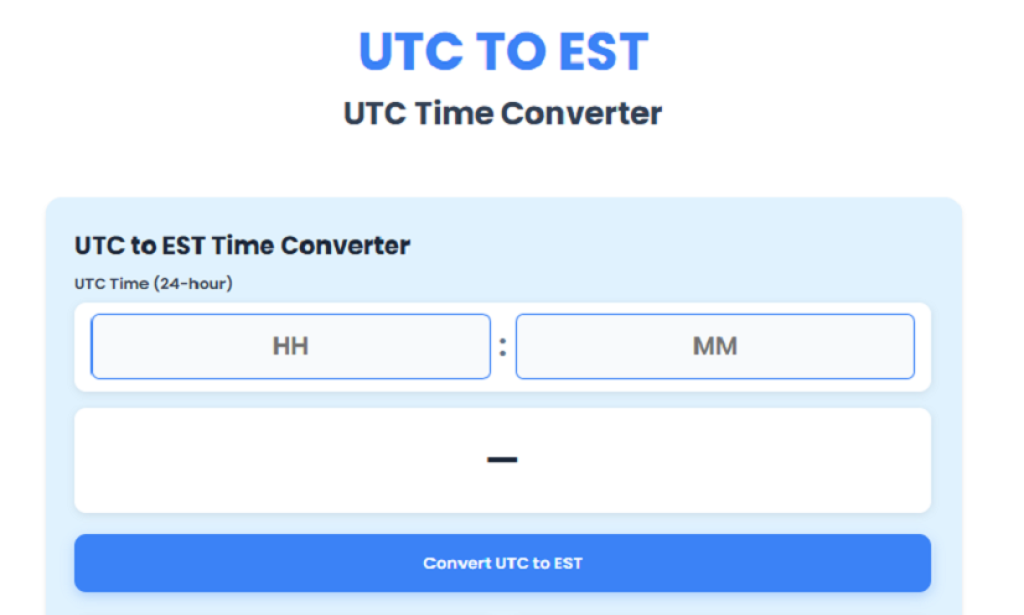
If you need a reliable UTC to EST converter that handles daylight saving automatically, utc to est converterdoes exactly this — enter any UTC time, get the correct Eastern result with the right EST/EDT label.
Daylight Saving Time 2025 and 2026: Key Dates
For those planning ahead or checking historical conversions:
2025 Daylight Saving Time:
- Start (spring forward): Sunday, March 9, 2025 at 2:00 AM
- End (fall back): Sunday, November 2, 2025 at 2:00 AM
2026 Daylight Saving Time:
- Start (spring forward): Sunday, March 8, 2026 at 2:00 AM (clocks moved forward — EDT began)
- End (fall back): Sunday, November 1, 2026 at 2:00 AM (EST resumes)
During the spring transition, 2:00 AM EST jumps to 3:00 AM EDT — an hour disappears. During the fall transition, 2:00 AM EDT repeats as 1:00 AM EST — an hour is gained.
This matters for anyone doing historical timestamp analysis or scheduling events across the transition windows. A meeting scheduled for "2:30 AM Eastern" on March 8, 2026 technically doesn't exist — the clocks jump from 2:00 AM to 3:00 AM.
UTC to EST for Global Remote Teams: Practical Scheduling
One of the most common real-world uses of UTC to EST conversion is scheduling meetings across global teams. Here's what actually works:
The golden overlap window for UTC + Eastern US:
- UTC 14:00–17:00 = EST 9:00 AM–12:00 PM / EDT 10:00 AM–1:00 PM
- This is the sweet spot: morning New York, afternoon London/Berlin
Working with Asia-Pacific teams (UTC+8):
- UTC 01:00 = EST 8:00 PM (prev day) / UTC+8 9:00 AM
- You're basically looking at end-of-New-York-day handoffs
Time zone labels to watch: People in different roles use different terminology for the same zone: "Eastern Time," "ET," "EST," "EDT," "New York time," "US Eastern." They all refer to the same zone — just double-check the season to know whether it's UTC-5 or UTC-4.
A practical tip: when scheduling international meetings, always anchor to UTC. Say "14:00 UTC" rather than "9 AM EST" — especially in winter/summer transition months when some regions have already changed clocks and others haven't.
UTC to EST for Jamaica, Bahamas, and Turks & Caicos
This catches people out: Jamaica, the Bahamas, Haiti, and the Turks and Caicos Islands all observe Eastern Standard Time — but not all of them observe daylight saving time.
- Jamaica is permanently UTC-5. It doesn't change clocks. So during US summer, Jamaica is one hour behind the US East Coast (which is on EDT/UTC-4).
- Bahamas observes daylight saving time, so it stays in sync with the US East Coast year-round.
- Turks and Caicos also observes daylight saving, aligning with US Eastern Time.
- Haiti observes daylight saving as well.
- Panama is permanently UTC-5 (no daylight saving).
- Cayman Islands observes daylight saving.
So if you're coordinating with someone in Kingston, Jamaica vs Miami, Florida — in summer they're an hour apart even though both are nominally "EST."
EST vs UTC: Side-by-Side Summary
| Feature | UTC | EST |
|---|---|---|
| Full name | Coordinated Universal Time | Eastern Standard Time |
| Offset | UTC+0 | UTC-5 |
| Daylight saving | Never observed | Switches to EDT in summer (UTC-4) |
| Also known as | Zulu time, GMT (casual) | Eastern Time (winter) |
| Primary use | Servers, APIs, aviation, science | US/Canada East Coast |
| Major cities | — | New York, Toronto, Miami, Atlanta |
| Current offset from each other | 5 hours (EST) / 4 hours (EDT) | — |
Frequently Asked Questions
How do I convert UTC to EST?
Subtract 5 hours from UTC to get EST. For example, 15:00 UTC becomes 10:00 AM EST. During daylight saving time (mid-March to early November), the US East Coast is on EDT, so subtract only 4 hours instead. Always check whether the date falls in EST or EDT season before converting. If the math takes you below midnight (00:00), the Eastern time falls on the previous calendar day — for example, 02:00 UTC becomes 9:00 PM EST the night before.
What's the difference between EST and EDT?
EST (Eastern Standard Time) is UTC-5, observed from early November through mid-March. EDT (Eastern Daylight Time) is UTC-4, observed from mid-March through early November. The difference is exactly one hour. During daylight saving time, the Eastern time zone is called EDT, not EST. Many people use "EST" year-round informally, but technically it's only correct in winter. Right now in May 2026, the Eastern US is observing EDT.
Is UTC the same as GMT?
For practical purposes, UTC and GMT are interchangeable — both have zero offset from each other. Converting GMT to EST uses the same formula as UTC to EST: subtract 5 hours in winter, 4 in summer. The technical distinction is that UTC is maintained by atomic clocks, while GMT is defined astronomically. For anyone doing time zone conversions, treat them as identical.
Why does the date sometimes change when converting UTC to EST?
Because EST is 5 hours behind UTC, early UTC hours (00:00 through 04:59 UTC) convert to the previous evening in Eastern time. For example, 03:00 UTC is 10:00 PM EST the day before. Always account for the date, not just the time, when converting UTC values before 05:00 to EST. This is one of the most common sources of confusion in log analysis, scheduling, and timestamp handling.
What is 14:00 UTC in EST?
14:00 UTC is 9:00 AM EST (during winter standard time). During summer EDT, 14:00 UTC = 10:00 AM EDT. 14:00 UTC is one of the most commonly searched conversions because it's just 30 minutes before the NYSE opens at 9:30 AM ET — making it a critical timestamp for traders and financial professionals.
What is 1900 UTC in EST?
1900 UTC (7:00 PM UTC) converts to 2:00 PM EST in winter, or 3:00 PM EDT in summer. This is mid-afternoon in New York — a common time for European close-of-business handoffs to US teams.
How do I convert EST to UTC?
To convert EST to UTC, add 5 hours. For example, 9:00 AM EST becomes 14:00 UTC. If you're in EDT (summer), add 4 hours instead: 9:00 AM EDT = 13:00 UTC. The EST to UTC converter handles this automatically in both directions.
What UTC offset is UTC+8 to EST?
UTC+8 (China, Singapore, Philippines, Hong Kong, etc.) is 13 hours ahead of EST in winter. So to convert UTC+8 to EST, subtract 13 hours. For example, 10:00 PM UTC+8 = 9:00 AM EST. During EDT (summer), the difference is 12 hours. This large gap makes real-time collaboration between Asia-Pacific and the US East Coast genuinely challenging — there's typically no workday overlap at all.
Final Thoughts: Getting UTC to EST Right Every Time
The UTC to EST conversion seems simple until it isn't. The 5-hour subtraction is easy to remember — but daylight saving transitions, date rollovers at midnight, UTC variants like UTC+8 or UTC-4, and the EST vs EDT distinction all crete real-world errors when people aren't paying attention.
Here's what to keep in mind:
- Winter (November–March): UTC − 5 = EST
- Summer (March–November): UTC − 4 = EDT
- UTC never changes — only the Eastern side of the equation shifts
- Early UTC hours (before 05:00) convert to the previous day in EST
- UTC+8 to EST = subtract 13 hours (winter) or 12 hours (summer)
- EST to UTC = add 5 hours (winter) or add 4 hours (summer EDT)
For instant, accurate conversions that handle daylight saving automatically, bookmark utc to est— it covers UTC to EST, EST to UTC, and Eastern time in both standard and daylight variants with zero manual calculation required.
Whether you're a developer reading server logs at odd hours, a trader watching market opens, a project manager scheduling global standups, or just trying to figure out what time a Zoom call starts — getting this conversion right saves real time and real mistakes.
All time conversions in this article reflect standard UTC-to-EST/EDT offset rules. Daylight saving time dates are based on current US federal guidelines, which are subject to change by Congress.

You must be logged in to post a comment.