
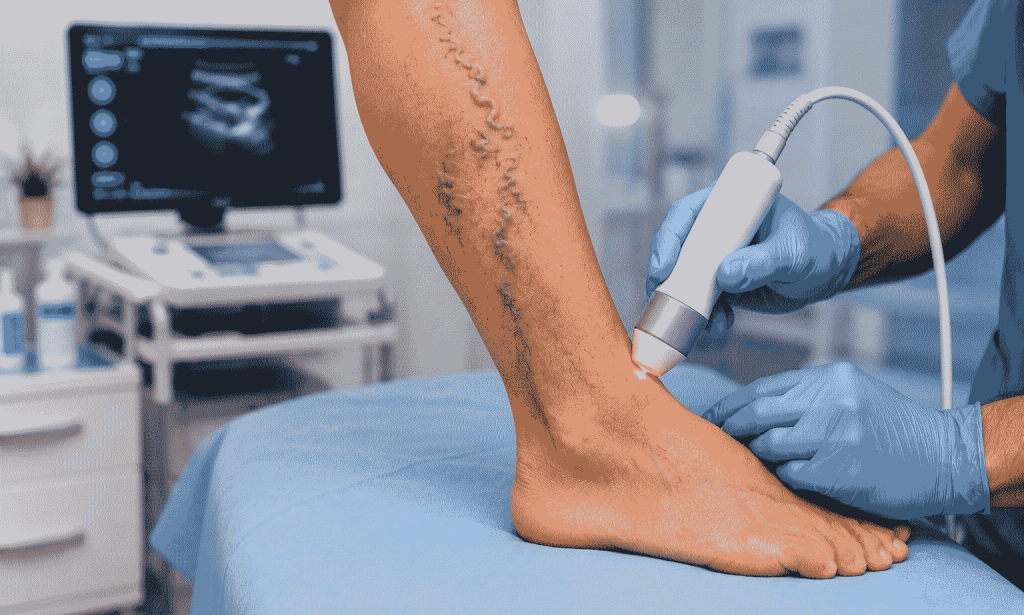
Someone told you that you need surgery for your varicose veins. Maybe a GP said it. Maybe a surgeon confirmed it. And now you are sitting with that information, wondering whether it is actually true.
For the vast majority of varicose vein patients, surgery is not necessary. It has not been the standard of care for over a decade.
Minimally invasive varicose veins treatment options done through a needle, under local anaesthesia, with same-day discharge now produce equivalent or better long-term results than surgical stripping. The evidence is not new. NICE guidelines updated in 2023 recommend endovenous thermal ablation as first-line treatment over surgery for eligible patients.
According to the Society of Interventional Radiology, over 80% of varicose vein patients are suitable for non-surgical treatment.
This article explains when surgery is genuinely needed, when it is not, and what the alternatives actually involve.
What Varicose Veins Actually Are And Why Treatment Is Needed at All
Varicose veins are not simply a cosmetic problem. They are a sign that the one-way valves inside the leg veins have failed.
When those valves stop working, blood flows backward instead of upward toward the heart. It pools in the superficial veins, which stretch under the pressure and become the twisted, bulging vessels visible under the skin.
Definition: Varicose veins are permanently dilated superficial leg veins caused by incompetent venous valves that allow retrograde blood flow, a progressive condition that worsens over time without treatment and can lead to skin damage, swelling, and venous ulceration.
Left untreated, the venous pressure keeps building. Symptoms worsen. Skin near the ankle begins to change, darkening, thickening, and eventually breaking down into ulcers that are extremely difficult to heal.
This progression is predictable and well-documented. It is also largely preventable if the underlying reflux is treated before skin changes become permanent.
The most common mistake patients make: assuming varicose veins are cosmetic and waiting years before seeking assessment. By Stage 4, skin changes, some damage is already irreversible, even after successful treatment.
Bottom line: Varicose veins are a progressive vascular condition. Treatment prevents the complications it does not just improve appearance.
Why Surgical Stripping Is Largely Retired: What Replaced It
Surgical vein stripping involved making incisions and physically pulling the great saphenous vein out of the leg. It worked, but recovery took 2 to 4 weeks, complications included nerve injury in 5 to 10% of cases, and recurrence rates were significant.
Three minimally invasive techniques have replaced it for the overwhelming majority of patients:
Endovenous Laser Ablation - EVLA A laser fibre is inserted into the faulty vein through a needle under ultrasound guidance. Laser energy heats and seals the vein from the inside. No incision, no stitches, local anaesthesia, home the same afternoon.
Radiofrequency Ablation - RFA Same mechanism, different energy source. Radiofrequency waves close the vein wall gradually. Marginally more comfortable for some patients during the procedure. Long-term results equivalent to EVLA.
Ultrasound-Guided Foam Sclerotherapy - UGFS A chemical foam injected under ultrasound guidance closes tributary and branch veins. Used alongside EVLA or RFA for a complete treatment result, or alone for smaller varicosities without trunk incompetence.
A 2022 Cochrane review comparing EVLA to surgical stripping found no significant difference in recurrence at 5 years but significantly lower rates of wound complications, nerve injury, and haematoma with EVLA.
RFA and EVLA are not experimental alternatives to surgery. They are endorsed as first-line treatment by NICE, the European Venous Forum, and the Society of Interventional Radiology. Surgery is now the fallback, not the default.
Bottom line: Non-surgical options replaced surgical stripping as standard care. Most patients who are offered surgery without being told about EVLA or RFA are not receiving a complete picture of their options.
When Surgery Is Still Genuinely Necessary
Surgery is the right answer in specific situations, and being honest about that matters.
Situations where surgery may still be appropriate:
- Very large varicosities with significant skin tethering, where thermal ablation cannot achieve adequate vein closure
- Phlebectomy small incisions to remove individual bulging varicosities, is used alongside EVLA as an adjunct, not instead of it
- Recurrent varicose veins after multiple previous thermal ablation attempts, where anatomy has become too complex for catheter-based access
- Centres without EVLA or RFA capability where surgery is the only available option
What surgery is not appropriate for is as a first-line treatment when the patient has straightforward great saphenous vein incompetence and no contraindication to thermal ablation. That combination, the most common presentation, is precisely what EVLA and RFA were designed for.
Interventional radiology practices that offer the full spectrum of varicose vein treatment, like Dr Ravindran's endovascular and interventional radiology team in Chennai, use duplex venous ultrasound mapping to determine which technique is appropriate for each patient before any treatment is planned. That assessment identifies whether the great saphenous, small saphenous, or both trunks are incompetent, which tributaries are involved, and whether any anatomy makes thermal ablation technically unsuitable. The treatment plan follows the ultrasound, not the other way around.
If a surgeon recommends varicose vein surgery without first performing a standing duplex ultrasound, the recommendation is not adequately informed. The ultrasound is the foundation of every treatment decision. Without it, no specialist, surgical or non-surgical, knows what they are treating.
Bottom line: Surgery has a role in specific, limited situations. For the majority of patients with varicose veins, it is not that situation.
How to Know Which Treatment Is Right for You
The answer to this question comes from one test, a standing duplex venous ultrasound.
This 30 to 45-minute scan maps your venous anatomy while you are standing in the position in which reflux is most accurately assessed. It shows which valves have failed, how far the reflux extends, whether the deep venous system is involved, and which veins need treatment.
What the duplex ultrasound determines:
- Whether the great saphenous vein, the small saphenous vein, or both are incompetent
- The diameter of the refluxing trunk relevant for treatment energy settings
- Whether tributary veins feed directly from the trunk or independently
- Whether any perforator veins are incompetent, requiring separate treatment
- Whether deep vein thrombosis or deep venous reflux is present changes management significantly
From that information, a complete treatment plan is built. In most cases:
- EVLA or RFA closes the main trunk
- Foam sclerotherapy treats residual tributary veins 4 to 6 weeks later
- A follow-up duplex at 6 weeks confirms complete closure
Signs that your treatment plan is thorough:
- Standing duplex performed before any recommendation is made
- Specific treatment matched to specific vein anatomy, not one approach for everyone
- Follow-up imaging was scheduled as part of the plan from the start
- The compression stocking protocol is explained before the procedure
Signs to be cautious about:
- Sclerotherapy is offered for large varicose veins without duplex assessment
- Surgery is recommended without thermal ablation being discussed
- No follow-up imaging planned after treatment
- Multiple sessions of the same treatment without reassessing what is being treated
Ask your specialist directly: Will you perform a standing duplex ultrasound before deciding on my treatment? A yes answer means the plan will be built on accurate information. A no answer means it will not.
Bottom line: The standing duplex ultrasound is the only reliable basis for a varicose vein treatment plan. Everything else follows from what it shows.
What Recovery Looks Like: Honest Timeline for Non-Surgical Treatment
Patients who choose EVLA or RFA often expect a recovery similar to surgery. The reality is considerably easier.
Day of procedure: You walk out. Compression stockings go on immediately and stay on continuously for the first 48 hours. The leg feels bruised and tight along the treated vein, both expected and normal.
Days 1 to 3: Most patients with desk jobs return to work the following day. Walking is actively encouraged, as calf muscle movement helps the treated vein close properly and reduces clot risk. Driving is fine after 24 hours once any sedation has cleared.
Week 1 to 2: Avoid the gym, swimming, and long-haul travel. The treated vein sometimes feels like a firm cord under the skin. This is it, closing down and fading over the weeks.
Week 4 to 6: Follow-up duplex ultrasound confirms the treated vein is closed. Any residual tributaries are treated with foam sclerotherapy at this appointment.
After sclerotherapy alone, recovery is measured in hours. Mild lumpiness and tenderness along injected veins are normal and settle within 1 to 3 weeks.
Walk at least 30 minutes every day from day one after EVLA or RFA. It is not optional advice it is the most effective single thing you can do to reduce complication risk and help the treated vein close completely.
Bottom line: EVLA and RFA recovery is 1 to 2 days to normal activity. Two weeks to exercise. One follow-up scan. That is the complete picture for most patients.
Frequently Asked Questions
How do I know if my varicose veins are serious enough to treat?
Any varicose vein causing aching, heaviness, swelling, or skin changes warrants assessment, not just monitoring. Cosmetic concern alone is also a valid reason to seek treatment. The severity that matters clinically is not how the veins look but whether they are causing symptoms, affecting quality of life, or showing signs of progressive venous disease on duplex ultrasound.
What happens if varicose veins are left untreated for years?
They progress in predictable stages from visible bulging to aching and swelling, then to skin darkening and thickening near the ankle, and eventually to venous ulceration. Venous ulcers are painful, slow to heal, and frequently recur. Some skin changes at Stage 4 do not fully reverse even after the veins are treated. Treating at Stage 2 or 3 prevents the complications of Stage 4 and 5.
Why do some doctors still recommend surgery for varicose veins?
Surgical varicose vein treatment is still performed in centres without EVLA or RFA capability. Some surgeons are also more familiar with the surgical approach and may recommend what they know best. NICE guidelines, since 2013 updated in 2023, have recommended thermal ablation over surgery as first-line treatment for eligible patients. If surgery is recommended without thermal ablation being discussed, asking specifically about EVLA or RFA is entirely reasonable.
When is foam sclerotherapy used instead of laser treatment?
Foam sclerotherapy treats tributary and branch varicose veins, typically 3 to 8mm in diameter, that feed from a saphenous trunk that has already been treated with EVLA or RFA. It is also used as the primary treatment when the saphenous trunks are competent on duplex and only branch varicosities are present. It is not appropriate as the sole treatment when great saphenous vein incompetence is confirmed on duplex.
Which varicose vein treatment produces the best long-term results in Chennai?
Combined treatment EVLA or RFA for the incompetent trunk, followed by foam sclerotherapy for tributary veins at 4 to 6 weeks, produces the lowest recurrence rates. Five-year trunk closure rates of 85 to 95% are consistently reported with thermal ablation in published series. Accurate pre-treatment duplex mapping and follow-up imaging at 6 weeks are the two factors that most reliably determine whether results are durable.
Conclusion
The short answer to the question in this article's title is: probably not.
For most patients with varicose veins, including patients with significant, symptomatic, bulging varicose veins, surgery is not necessary. EVLA, RFA, and foam sclerotherapy treat the same problem through a needle, under local anaesthesia, with recovery measured in days rather than weeks.
The longer answer is: it depends on what your duplex ultrasound shows, and whether you have been fully informed about what all your options are.
If you have been told you need surgery and no one has mentioned thermal ablation, or if you have been offered sclerotherapy without a duplex being done first, that conversation deserves a second look.
Speak with a varicose vein specialist at irdoctor get a duplex ultrasound assessment, and find out whether non-surgical treatment is appropriate for your specific veins before agreeing to anything.

You must be logged in to post a comment.