

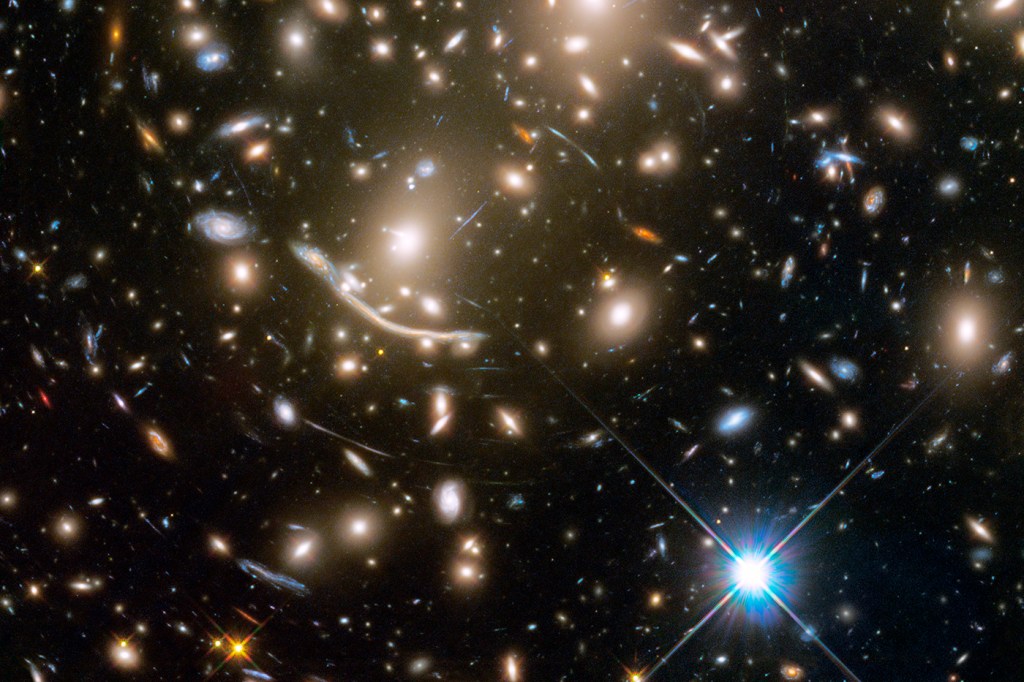
 The new stars are located in a galaxy known as the Dragon Arc, which was obscured and magnified by the Abell 370 galaxy cluster pictured here. Photo by NASA’s James Webb Space Telescope
A group of astronomers have made history by capturing an image of a record number of stars from a time when the universe was half its age.
The astronomers detected 44 stars in the “Dragon Arc” galaxy, located 6.5 billion light years away from our own Milky Way, using NASA’s ultra-powerful James Webb Space Telescope. However, the discovery was also only possible because of a well-known concept in the world of physics: gravitational lensing.
First developed as part of Albert Einstein’s theory of general relativity, its use here could help chart new interstellar territory, says Jacqueline McCleary, an assistant professor of physics at Northeastern University.
“We’re getting a window into what star formation looked like at a much earlier time in the universe’s history to which we would otherwise not have access,” McCleary says. “This is like a magical time machine allowing us to see what even individual stars look like at this early period.”
What exactly is gravitational lensing and how did it help capture an image 6.5 billion years in the making?
Gravitational lensing is the distortion effect that massive objects sitting in space-time, like galaxies and even galaxy clusters, have on rays of light, says McCleary, whose work involves creating tools to measure gravitational lensing in distant galaxies.
McCleary uses the analogy of a large, stretched out rubber sheet. If a heavy object is placed on the sheet, it creates a dip or a well, distorting the surface. If you try to roll an object like a marble from one end of the sheet to another, it can still make it to the other side but it will be deflected from its normal path.
“That’s exactly what’s happening but with light rays instead of marbles,” McCleary says. “It’s called gravitational lensing because in this case gravity … is acting as a lens distorting light, or focusing beams of light, in the same way that glass alters the path of light from the sun or a light bulb and leads it to focus differently on your retina.”
 A double gravitational lensing effect helped astronomers detect a host of new stars, says Jacqueline McCleary, assistant professor at Northeastern University. Photo by Matthew Modoono/Northeastern University
In general, the farther away a galaxy is, the harder it is to capture it with any level of fine detail. Astronomers have been observing individual stars in our own Milky Way and in nearby galaxies like Andromeda and the Magellanic Clouds. But “anything beyond our little cosmic backyard, the galaxies are too far away for us to distinguish individual stars,” McCleary says.
However, in this case, the astronomers were able to detect the light from 44 stars in the distant Dragon Arc galaxy using the distortion caused by the massive galaxy cluster Abell 370. The cluster essentially served as a massive magnifying glass, sitting between Earth and the Dragon Arc.
McCleary says there was also a double layer of gravitational lensing. Serendipitously, smaller objects –– free-floating stars that had been set loose by the forces of the galaxy cluster –– just so happened to be moving past the light coming from these stars. This phenomenon of smaller, moving objects causing a small gravitational lensing effect is known as microlensing.
“When those stars pass in front of the image of this background Dragon Arc galaxy, they introduce an additional lensing effect and then magnify the galaxy even more and allow us to discern individual stars toward the edge of the disc of this galaxy,” McCleary says.

You must be logged in to post a comment.