

Not every sleeping position is good for you!
Everyone sleeps differently, there are loads of positions in bed to sleep in. Some people like sleeping on their sides on a waterbed, others prefer sleeping on their backs on a hard mattress, but we all do it. We spend about a third of our lives asleep, which is a lot!
Health
Sleeping is very important for your body and mind; in a way, you’re charging yourself. That’s why sleep deprivation can have negative consequences; it can affect your memory, your concentration, your reaction time, your decisiveness, your emotions and your physical well-being. So, sleeping is good for you. But not just that, your sleeping position can also have a positive or negative influence on your body.
Rest
Try to get at least six hours of sleep every night. Research has shown that sleeping less than six hours is just as bad for you as skipping a whole night’s sleep. It’s okay if this happens once in a while, but even after two weeks of sleeping too little, you will notice a difference in your mind and body. You might think that you function normally after a rough night, but this is actually not the case.
Sleeping position
All people can be divided into roughly three categories: those who sleep on their stomach, those who sleep on their back and those who sleep on their side. Your sleeping position can be good for your mind and body, but it can also cause ailments.
On your back
Do you sleep on your back? Then you’re in luck, because this is the most healthy position to sleep in! Sleeping on your back is good for your spine, as it will be aligned nicely. This position causes little strain on the muscles in your back and neck. Moreover, this position is the best for your skin. Your face won’t develop wrinkles and spots as quickly as those who sleep on their side or on their stomach. This position is also good for women, as sleeping on their back will prevent chest wrinkles as well as sagging breasts. The only disadvantage is that it worsens snoring.
On your side
Do you sleep on your side? You’re definitely not the only one, because this is the most common sleeping position. When you sleep on your side, you can develop pain in your arms and legs because you’re constantly lying on one side. Sleeping on your right side is also disadvantageous for your digestion and heartburn. An upside: sleeping on your side improves circulation and lessens snoring.
On your stomach
We have bad news for people who sleep on their stomachs. This position is the most unhealthy. You’ll develop neck complaints, since your head is completely turned, and back issues. Your spine has to take on an awkward position, which will also cause you to toss and turn more. Because of this, your sleep will be disrupted more. Also, try sleeping on a full stomach, it won’t be pleasant! It does lessen snoring, though, so you’ve got that going for you.
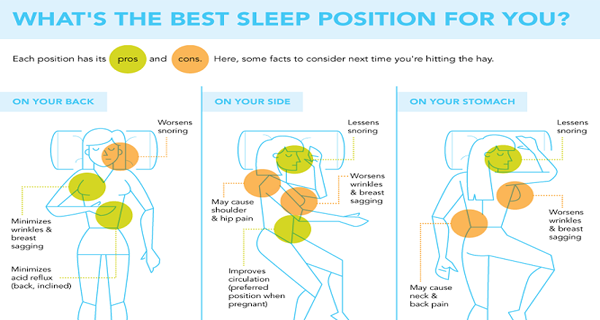
What’s the Best Sleep Position?
Do you sleep on your back, side, or belly? You may have a favorite sleeping position, or you may change it up now and then. And if you become pregnant, or have certain health problems, the way you sleep can sometimes change. In those cases, getting your sleeping posture right can make a big difference in the way you feel when you wake up. Are you choosing the best sleeping position for your situation?
Sleeping in the wrong way can cause or aggravate neck or back pain. It may also obstruct the airways to your lungs, leading to problems like obstructive sleep apnea.
Some research even suggests that the wrong sleeping position may cause toxins to filter out of your brain more slowly.
Approximately 7% of people sleep on their stomach. This is sometimes called the prone position. It may help ease snoring by shifting fleshy obstructions from your airway. But sleeping in this position may aggravate other medical conditions.
Your neck and spine are not in a neutral position when you sleep on your stomach. This may cause neck and back pain. Stomach sleeping can put pressure on nerves and cause numbness, tingling, and nerve pain.
It's best to choose another sleep position if you are a stomach sleeper. If you can't break the habit, prop your forehead up on a pillow so your head and spine remain in a neutral position and you have room to breathe.
The Freefall Position
About 7% of people sleep on their stomachs with their heads turned to the side. People who sleep this way have their arms wrapped around a pillow or tucked under a pillow.
Do You Sleep on Your Back?
Back-sleeping has its advantages and disadvantages, too. Sleep experts refer to this as the supine position.
Let's start with the bad news. Some people who sleep on their backs may experience low back pain. It can also make existing back pain worse, so this is not the best sleep position for lower back pain. If you suffer from snoring or sleep apnea, sleeping on your back may aggravate these conditions as well. Women should avoid this position during late pregnancy.
There are health benefits to sleeping on your back, too. Your head, neck, and spine are in a neutral position so you're less likely to experience neck pain. Sleeping on your back with your head slightly elevated with a small pillow is considered the best sleeping position for heartburn.
The Soldier Position
In this position, the sleepers lie on their backs and their arms are down and close to the body. Approximately 8% of people sleep like this.
This one is a poor choice for snoring and may prevent you from getting a restful night's sleep. Talk to your doctor if snoring keeps you from getting enough rest.
The Starfish Position
People who sleep in a starfish position sleep on their backs with their arms up over their heads. Approximately 5% of people sleep this way.
As all those who sleep on their backs, people who sleep in the starfish position may be prone to snoring and sleep problems.
Do you sleep on your side?
The side sleeping position is the most popular by far. It's also known as lateral sleeping position by sleep scientists.
This position may be good for those who snore. If you have some forms of arthritis, sleeping in the side position may make you sore, though. Curling up may also prevent you from breathing deeply because doing so may restrict your diaphragm.
Side-Sleeping and Brain Waste
It's possible that sleeping on your side could be good for your brain. Scientists recently learned that our brains clear out waste more quickly while we sleep.
Whether or not the position you sleep in influences this waste removal is unclear. But one study performed on rats suggests side-sleeping might clear brain waste more efficiently than other postures.
Wrinkle Worries
Although side-sleepers enjoy many advantages, one disadvantage may appear as you age. Because you press down on your face in the lateral position, this posture may both cause facial wrinkles and cause the skin on your face to expand over time.
Sagging Breasts
Side-sleeping women may find that their breast ligament (the Coopers Ligament) slowly stretches over time, causing breast sag. This hasn't been proven scientifically, yet continues to be a concern for many. If this concerns you, a simple solution is to support your breasts with a pillow. Women with larger breasts may find it more comfortable to sleep with a bra for additional support.
The Fetal Position
Approximately 41% of people sleep using a specific side position by curling up on their sides with their knees bent. Side sleepers who sleep with their legs bent and curled toward their torsos are sleeping in the fetal position.
Some studies suggest that more women than men sleep in this position, although other research disputes this. It may be a good choice for pregnant women because this posture improves circulation for both the mother and fetus.
If sleeping this way hurts your hips, placing a pillow between your knees may help relieve pressure.
Side-Sleeping and Heart Failure
People with congestive heart failure avoid sleeping on their backs and their left sides. Their heartbeats may disturb their sleep in these postures. These patients tend to prefer sleeping on their right side. In fact, sleeping on the right side may protect people with heart failure from further health damage.
Best Sleeping Positions for Back, Shoulder, and Neck Pain
If you have back pain, sleeping on your stomach or back may aggravate your pain. Switch to side sleeping to minimize your risk of back pain.
For further relief, put a pillow between your knees to keep your hips in alignment. If you must sleep on your back, placing a pillow under your knees will take some strain off of your back.
Shoulder, Neck, and Upper Back Pain
Arthritis and other painful conditions along your upper spine can worsen or improve while you sleep. Studies seem to disagree, though, on what positions are ideal.
One large study found that people had less shoulder pain who slept in the starfish position—on their backs, with hands up near their chest or head. But it couldn't explain if those people had less shoulder pain because of the way they slept, or if they slept that way because they had less pain.
A later study found that people who slept on their backs with their arms at their sides—the soldier position—activated their shoulder muscles less, and thus may experience less shoulder pain.

You must be logged in to post a comment.