

German Christmas taste cookies 🍪 platter in every year
It was my first Christmas Eve away from home. My new boyfriend had invited me to travel to Detroit to meet his family—a pretty serious step in a burgeoning romance—and I had already conjured up images of a storybook German Christmas, knowing that Rick's parents had each emigrated from Germany in the early 1950s before marrying and raising a family in the United States. My mind's eye saw fresh greenery draping every surface, wax candles flickering on the windowsills, and, of course, platters piled high with freshly baked Weihnachtsbäckerei—traditional German Christmas cookies.
The reality did not quite match the Nutcracker-esque pictures in my head. The people who would become my in-laws were welcoming, but I learned over the years that Lotte and Waldemar, who had grown up, respectively, in German enclaves in Poland and what is now Ukraine, were textbook examples of many immigrants, eager to embrace and assimilate to their new culture. I would also come to understand that growing up in war-torn Eastern Europe, which frequently required crisscrossing the continent by horse and wagon to find safe shelter, did not leave a lot of opportunity to learn the finer points of pastry making.
HISTORY ABOUT COOKIES.
In America, a cookie is described as a thin, sweet, usually small cake. By definition, a cookie can be any of a variety of hand-held, flour-based sweet cakes, either crisp or soft. Each country has its own word for “cookie.” We know as cookies are called biscuits in England and Australia, in Spain they’re galletas. Germans call them keks or Plzchen for Christmas cookies, and in Italy there are several names to identify various forms of cookies including amaretti and biscotti, and so on. The name cookie is derived from the Dutch word koekje, meaning “small or little cake.” Biscuit comes from the Latin word bis coctum, which means, “twice baked.”
According to culinary historians, the first historic record of cookies was their use as test cakes. A small amount of cake batter was baked to test the oven temperature.
7th Century A.D. – The earliest cookie-style cakes are thought to date back to 7th century Persia A.D. (now Iran), one of the first countries to cultivate sugar (luxurious cakes and pastries in large and small versions were well known in the Persian empire). According to historians, sugar originated either in the lowlands of Bengal or elsewhere in Southeast Asia. Sugar spread to Persia and then to the Eastern Mediterranean. With the Muslim invasion of Spain, then the Crusades and the developing spice trade, the cooking techniques and ingredients of Arabia spread into Northern Europe.
From the web site, How Sweet It Was: Cane Sugar from the Ancient World to the Elizabethian Period, by Brandy and Courtney Powers:
In 510 BC , hungry soldiers of the Emperor Darius were near the river Indus, when they discovered some “reeds which produce honey without bees.” Evidently this early contact with the Asian sources of sugar cane made no great impression, so it was left to be re-discovered in 327 BC by Alexander the Great, who spread it’s culture through Persia and introduced it in the Mediterranean. This was the beginning of one of the best documented products of the Middle Ages.
By the end of the 14th century, one could buy little filled wafers on the streets of Paris. Renaissance cookbooks were rich in cookie recipes.
1596 – From the 1596 cookbook called Goode Huswife’s Jewel by Thomas Dawson. One of the earliest cookery books for the growing middle classes in Elizabethan England. This is a square short-cookie enriched with egg yolks and spices, baked on parchment paper.
To make Fine Cakes.- Take fine flowre and good Damaske water you must have no other liqeur but that, then take sweet butter, two or three yolkes of eggs and a good quantity of Suger, and a few cloves, and mace, as your Cookes mouth shall serve him, and a lyttle saffron, and a little Gods good about a spoonful if you put in too much they shall arise, cutte them in squares lyke unto trenchers, and pricke them well, and let your oven be well swept and lay them uppon papers and so set them into the oven. Do not burne them if they be three or foure days olde they bee the better.
As people started to explore the globe, biscuits (hardtack) became the ideal traveling food, because they stayed fresh for long periods Hardtack proved a portable food that had a long storage life and was perfect for traveling. For centuries, a ship’s biscuit, an iron-like cracker, was aboard any ship that left port because it could last for months (even years under the right conditions).
During the 17th and 18th centuries in Europe, baking was a carefully controlled profession, managed through a series of Guilds or professional associations. To become a baker, people had to complete years of an apprenticeship – working through the ranks of apprentice, journeyman, and finally master baker. By having guilds, authorities could easily regulate the amount and quality of goods baked. As technology improved during the Industrial Revolution in the 19th century, so did the ability of bakers to make a wide range of sweet and savory biscuits for commercial consumption. Despite more varieties becoming available, the essential ingredients of biscuits didn’t change. These ingredients are ‘soft’ wheat flour, which contains less protein than the flour used to bake bread, sugar, and fats, such as butter and oil.
1615 – The English Hus-wife, by Gervase Markham, has two recipes for Jumbles:
To make the best jumbles, take the whites of three eggs and beat them well, and take off the veil; then take a little milk and a pound of fine wheat flour and sugar together finely sifted, and a few aniseeds well rubbed and dried; and then work all together as stiff as you can work it, and so make them in what forms you please, and bake them in a soft oven upon white papers.
To make jumbles more fine and curious than the former, and near to the taste of the macaroon; take a pound of sugar, beat it fine; then take as much fine wheat flour and mix them together, then take two whites and one yolk of an egg, half a quarter of a pound of blanched almonds; then beat them very fine all together with half a dish of sweet butter, and a spoonful of rose-water, and so work it with a little cream till it come to a very stiff paste, then roll them forth as you please: and hereto you shall also, if you please, add a few dried aniseeds finely rubbed and strewed into the paste, and also coriander seed.
1671– In the 1671 edition of The Closet of the Eminently Learned Sir Kenelme Digbie Kt Opened: Whereby is Discovered Several ways for making of Metheglin, Sider, Cherry-Wine, & together with Excellent Directions for Cookery: As also for Preserving, Conserving, Candying, &c., by Sir Kenelme Digbie (NOTE: Actual Quote):
Excellent Small Cakes – Take three pound of very find flower well dryed by the fire, and put to it a pound and a half of loaf Sugar sifted in a very fine sieve and dryed; Three pounds of Currnats well washed and dryed in a cloth and set by the fire; When you flower is well mixed with the Sugar and Currants, you must put in it a pound and a half of unmelted butter, ten spoonfuls of Cream, with the yolks of three new-laid Eggs beat with it, one Nutmeg; and if you please, three spoonfuls of Sack. When you have wrought your paste well, you must put it in a cloth, and set it in a dish before the fire, til it be through warm. Then make then up in little cakes, and prick them full of holes; you muct bake them in a wuick oven unclosed. Afterwards Ice them over with Sugar. The Cakes should be about the bigness of a hand-breadth and thin: of the cise of the Sugar Cakes sold at Barnet.
The English, Scotch, and Dutch immigrants originally brought the first cookies to the United States. Our simple butter cookies strongly resemble the English teacakes and the Scotch shortbread. The Southern colonial housewife of America took great pride in her cookies, almost always called simply tea cakes. These were often flavored with nothing more than the finest butter, sometimes with the addition of a few drops of rose water.
In earlier American cookbooks, cookies were given no space of their own but were listed at the end of the cake chapter. They were called by such names as Jumbles, Plunkets, and Cry Babies. The names were extremely puzzling and whimsical
1796 – In the 1796 cookbook American Cookery: or, The Art of Dressing Viands, Fish, Poultry and Vegetables, and the Best Modes of Making Puff-pastes, Pies, Tarts, Puddings, Custards and Preserves, and all kinds of Cakes, from the Imperial Plumb to plain Cake by Amelia Simmons, she includes two recipes for cookies. One simply called “Cookies” and the other called “Chriftmas Cookey.” This was the first cookbook authored by an American and published in the United States(NOTE: Actual Quotes).
Cookies – One pound fugar boiled flowly in half pint of water, fcum well and cool, add 1 tea fpoon perlafh, diffolved in milk, then two and a half pounds of four, rub in 4 ounces of butter, and two large fpoons of finely powdered coriander feed, wet with above; make rolls half an inch thick and cut to the fhape of pleafe; bake fifteen or twenty minutes in a flack oven – good three weeks.
Christmas Cookery – To three pound of flour, fprinkle a tea cup of fine powdered coriander feef, rub in one pound of butter, and one and half pound fugar, diffolve one tea fpoonful of pearlath in a tea cup of milk, kneed all together well, roll three quarter of an inch thick, and cut or ftamp into fhape and fize you pleafe, bake flowly fifteen or twenty minutes; tho’ hard and dry at firft, if put in an earthern pot, and dry cellar, or damp room, they will be finer, fofter and better when fix months old.
There are hundreds upon hundreds of cookie recipes in the United States. The geographic development of the United States was reflected in popular cookie recipes. The railroad’s expansion in the early 1800s gave cooks access to coconuts from the South. Later in the century, oranges from the West were included in many recipes. Around the turn of the century, the Kellogg brothers in Michigan invented cornflakes and cookies were made with cereal products. In the 1930s, with the advent of electric refrigerators, icebox cookies reached new heights of popularity. Today there are hundreds upon hundreds of cookie recipes in the United States. No one book could hold the recipes for all of the various types of cookies.
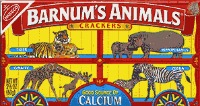 Animal Crackers or Animal Cookies – Information on history of Animal Crackers is from Out of the Cracker Barrel: From Animal Crackers to ZuZu’s, by William Cahn [Simon & Schuster: New York] 1969:
Animal crackers were created and achieved fame many years before the advent of NBC. In the beginning they were just called “Animals.” They were imported from England when “fancy” baked goods first began to be in demand here. In the latter part of the nineteenth century they were manufactured domestically by Herfield & Ducker in Brooklyn as well as Vandeveer & Holmes Biscuit Company in New York. Both firms eventually became pare of the New York Biscuit Company and “Animals” were on of their staples.
When “Animals” were adopted by NBC, their name was changed to “Barnum’s Animals Crackers,” named after P. T. Barnum, showman and circus owner who was so famous during this era. Barnum’s Animals Crackers provided the nation with a new type of animal cracker, produced in a small square box resembling a circus cage with a tape at the top for easy carrying. . . Soon Animal (the s was dropped) Crackers became part of the American scent and of almost very American household.
In total there have been 37 different varieties of animal crackers since 1902. The current 17 varieties of crackers are tigers, cougars, camels, rhinoceros, kangaroos, hippopotami, bison, lions, hyenas, zebras, elephants, sheep, bears, gorillas, monkeys, seals, and giraffes. There are 22 crackers per box.
Animal Crackers became such a part of American life that Christopher Morley (1890-1957), American humorist, playwright, poet, essayist, and editor, wrote the following poem:
Animal Crackers
by Christopher Morley
Animal crackers and cocoa to drink,
That is the finest of suppers I think;
When I’m grown up and can have what I please
I think I shall always insist upon these.
What do YOU choose when you’re offered a treat?
When Mother says, “What would you like best to eat?”
Is it waffles and syrup, or cinnamon toast?
It’s cocoa and animals that I love most!
The kitchen’s the coziest place that I know;
The kettle is singing, the stove is aglow,
And there in the twilight, how jolly to see
The cocoa and animals waiting for me.
Daddy and Mother dine later in state,
With Mary to cook for them, Susan to wait;
But they don’t have nearly as much fun as I
Who eat in the kitchen with Nurse standing by;
And Daddy once said, he would like to be me
Having cocoa and animals once more for tea!
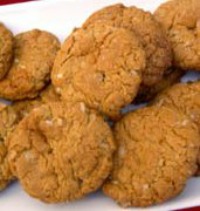 Anzac Biscuit – This is an Australian army biscuit, also known as an Anzac Wafer or an Anzac Tile. They are essentially a hardtack biscuit (see hardtack biscuit below) with a long shelf-life and a substitute for bread. The biscuits are very hard, and soldiers preferred to grind them up and use them as porridge. Today, they are known as Australia’s National Biscuit. ANZAC day is celebrated in Australia and New Zealand on April 25. Around ANZAC Day, these biscuits are also often used by veterans’ organizations to raise funds for the care and welfare of aged war veterans.
1815-1832 – The recipe for these biscuits can be traced back to Scotland and the traditional Scottish Oat cakes, also know as bannocks which are thin, flat unleavened oat cakes that are baked on a griddle. During the Scottish immigration to Australia and New Zealand in the early 1800s, it was only natural that the Scottish women brought their recipes for oat cakes with them. They probably had a supply with them on the ships they came in.|
1914-1918 – During World War 1 (1914-1918), the wives, mothers and girlfriends of the Australian and New Zealand soldiers were concerned for the nutritional value of the food being supplied to their men. A food was needed that would survive the long journey by mail to the war front to ANZAC troops serving overseas. The biscuits took two months by sea, with no refrigeration, to reach the soldiers at Gallipoli. On April 25, 1915, the ANZACs (Australian and New Zealand Army Corps) landed at Gallipoli, and suffered the worst defeat in Australian military history. At first the biscuits were called Soldiers’ Biscuits, but after the landing on Gallipoli, they were renamed ANZAC Biscuits. To keep them fresh and crisp they were packed, in old airtight tins.
Biscotti (bee-SKAWT-tee) – In Italian, biscotti means, “twice cooked.” The word biscotto is derived from bis (twice) and cotto (cooked). Biscotti is also the generic term for cookies in Italian. The dough is formed into logs and baked until golden brown. The logs are then sliced, and the individual biscotti are baked again to give them their characteristic dryness. The shelf life of biscotti are three to four months without preservatives or additives. Other countries have their version of this cookie – Dutch rusk, French biscotte, and the German zwieback.
According to the Arnott Biscuit Company:
One of the earliest records dates biscuits back to second century Rome. Biscuit comes from the Latin word ‘bis coctum’ which means, ‘twice baked’. Back then, ‘biscuits’ were unleavened, hard, thin wafers, which had a low water content. As they contained very little moisture they were the ideal food to store, as they wouldn’t become mouldy quickly.
Early Seaman’s biscuits, also known as hard tack, probably were the first version of biscotti. They were the perfect food for sailors who were at sea for months at a time on long ocean voyages. The biscuits were thoroughly baked to draw out the moisture, becoming a cracker-like food that that was resistant to mold. Biscotti were a favorite of Christopher Columbus who relied on them on his long sea voyage in the 15th century. Historians believe that the first Italian biscotti were first baked in 13th century Tuscany in the in a city called Prato.
1596 – Recipe for a biscuit that is similar to biscotti from the 1596 cookbook called Goode Huswife’s Jewel by Thomas Dawson. This is a recipe for an anise seed biscotti-type confection that gets a drying in the oven, just as modern biscotti (NOTE: Actual Quote):
To make fine bisket bread – Take a pound of fine flower, and a pound of sugar, and mingle it together, a quarter of a pound of Annis-seedes, foure eggs, two or three spoonfulls of rosewater put all these into an earthen panne. And, with a slyce of wood beat it the space of two houres, then fill your moulds half full, your moulds be of tinne, and then lette it into your oven, being so whot as it were for cheat bread and let it stande one houre and an halfe: you must annoint your moulds with butter before you put in your stuffe, and when you will occupie of it, slice it thinne and dry it in the oven, your oven beeing no whotter than you may abide your hand in the bottom
Brownies – A chocolate bar cookie. The name comes from the deep-brown color of the cookie.
The origins of the chocolate brownies is uncertain but it is felt that it was probably created by accident, the result of a forgetful cook neglecting to add baking powder to chocolate cake batter. Sears, Roebuck catalog in 1897 published the first known recipe for the brownies, and it quickly became very popular (so popular that a brownie mix was even sold in the catalog). According to some sources, this was a recipe for a molasses candy merely called brownies. The name honored the elfin characters featured in popular books, stories, cartoons and verses at the time by Palmer Cox; the Eastman Kodak Brownie camera was also named after these elves.
According to cookbook author and culinary historian, Jean Anderson, in The American Century Cookbook: The Most Popular Recipes Of The 20th Century, the two earliest published recipes for chocolate brownies appear in Boston-based cookbooks – the first in a 1906 edition of The Boston Cooking-School Cook Book edited by Fannie Merritt Farmer.
The second recipe, appearing in the 1907 Lowney’s Cook Book, written by Maria Willet Howard. Ms. Howard was a protof Fannie Farmer. She added an extra egg and an extra square of chocolate to the Boston Cooking-School recipe, creating a richer, more chocolate brownie. She named the recipe Bangor Brownies.
Chocolate Chip Cookie – Today the chocolate chip cookie remains a favorite choice among cookie connoisseurs. The term “toll house” has become a part of the American language.
1937 – The first chocolate chip cookies was invented in 1937 by Ruth Graves Wakefield (1905-1977), of Whitman, Massachusetts, who ran the Toll House Restaurant. The Toll House Restaurant site was once a real toll house built in 1709, where stage coach passengers ate a meal while horses were changed and a toll was taken for use of the highway between Boston and New Bedford, a prosperous whaling town. The Wakefields sold the restaurant in 1966. It burned down on New Year’s Eve in 1984.
One of Ruth’s favorite recipes was an old recipe for “Butter Drop Do” cookies that dated back to colonial times. The recipe called for the use of baker’s chocolate. One day Ruth found herself without a needed ingredient. Having a bar of semisweet chocolate on hand, she chopped it into pieces and stirred the chunks of chocolate into the cookie dough. She assumed that the chocolate would melt and spread throughout each cookie. Instead the chocolate bits held their shape and created a sensation. She called her new creation the Toll House Crunch Cookies. The Toll House Crunch Cookies became very popular with guests at the inn, and soon her recipe was published in a Boston newspaper, as well as other papers in the New England area. Word of the cookie spread and it became popular.
1939 – This cookie became known nationally when Betty Crocker used it in her radio series on “Famous Foods From Famous Eating Places.” Ruth approached the Nestle company and together, they reached an agreement that allowed Nestle to print what would become the Toll House Cookie recipe on the wrapper of the Semi-Sweet Chocolate Bar. The company developed a scored semisweet chocolate bar with a small cutting implement so that making the chocolate chunks would be easier. According to the story, part of this agreement included supplying Ruth with all of the chocolate she could use to make her delicious cookies for the rest of her life.
1940s – Ruth sold all legal rights to the use of the Toll House trademark to Nestle. On August 25, 1983, the Nestle Company lost its exclusive right to the trademark in federal court. Toll house is now a descriptive term for a cookie.
1997 – A third grade class from Somerset, Massachusetts proposed that the chocolate chip cookie be designated the official cookie of the Commonwealth. The chocolate chip cookie was designated the official cookie of the Commonwealth on July 9, 1997 under the General Laws of Massachusetts.
1996, 1999, and 2003 –
- A group of fourth-grade students at Caln Elementary School in Coatesville introduced a resolution to designate the chocolate chip cookie as the official state cookie of the Commonwealth of Pennsylvania in 1996.
- Senate Bill 271 was introduced on February 1, 1999 to designate and adopt the chocolate chip cookie as the official cookie of the Commonwealth of Pennsylvania. The House is supporting the Nazareth sugar cookie, in a bill sponsored by eight representatives, including Moon Township’s state Rep. and Senator-elect John Pippy.
- Another Senate Bill 320 was introduced by Thompson, Helfrick, M. White, Greenleaf, Rafferty, and C. Williams on February 13, 2003 to designate and adopt the chocolate chip cookie asthe official cookie of the Commonwealth of Pennsylvania. The House and Senate have been in disagreement or debate since these bills were introduced. The bills have been tabled.
Fig Newton – There are two claims on who invented the Fig Newton Cookies:
1892 – The Nabisco Company has maintained that the Fig Newton was invented in 1891 by Philadelphia inventor, James Henry Mitchell. Mitchell is said to have invented the duplex dough-sheeting machines and funnels that made the jam-filled cookies possible. This machine was patented in January of 1892. The cookies were named for Newton, MA. Information on history of Animal Crackers is from Out of the Cracker Barrel: From Animal Crackers to ZuZu’s, by William Cahn [Simon & Schuster: New York] 1969:
In 1892 Mitchell applied for a patent for his new machine, which was granted. Although he had no name for his ‘pie,’ he thought the idea might be of value in commercial baking. So in 1892 he persuaded officials of the Kennedy Biscuit Works, which had recently become affiliated with the New York Biscuit Company, to try out his new machine, which he shipped to Cambridgeport. Mitchell personally installed the machine and supervised its functioning. The professional bakers tasted the final result, found it good and went away impressed. But promotion could not start until a name was selected. The exciting new product of the Mitchell machine needed some such name. Later an assistant to James Hazen, manager of the Cambridgeport bakery, recalled, “The name was taken from the name of the town Newton-a suburb of Boston.” When the name was selected for this new product, it reflected a practice–by Mr. Hazen, who was manager of this plant–of using the names of towns and cities in the vicinity of Boston.
1899 – The website of Historic Roser Park, located inSt Petersburg, Florida claims that Charles Martin Roser (1864-1937), also known as C. M. Roser had a cookie and candy manufacturing company that made Fig Newton Cookies. Legend has it that Roser sold Nabisco the rights to his fig cookies for 1 million dollars, the modern equivalent of about 19 million. To this date, no information has been found to back up this claim.

You must be logged in to post a comment.