

HISTORY OF Earth

The history of Earth concerns the development of planet Earth from its formation to the present day.[1][2] Nearly all branches of natural science have contributed to the understanding of the main events of Earth's past, characterized by constant geological change and biological evolution.
The Hadean eon represents the time before a reliable (fossil) record of life; it began with the formation of the planet and ended 4.0 billion years ago. The following Archean and Proterozoic eons produced the beginnings of life on Earth and its earliest evolution. The succeeding eon is the Phanerozoic, divided into three eras: the Paleozoic, an era of arthropods, fishes, and the first life on land; the Mesozoic, which spanned the rise, reign, and climactic extinction of the non-avian dinosaurs; and the Cenozoic, which saw the rise of mammals. Recognizable humans emerged at most 2 million years ago, a vanishings small period on the geological scale.
Origin of Universe
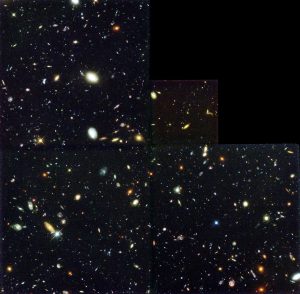
The universe appears to have an infinite number of galaxies and solar systems and our solar systems, occupies a small section of this vast entirety. The origins of the universe and solar system set the context for conceptualizing the Earth’s origin and early history.
Big Bang Theory
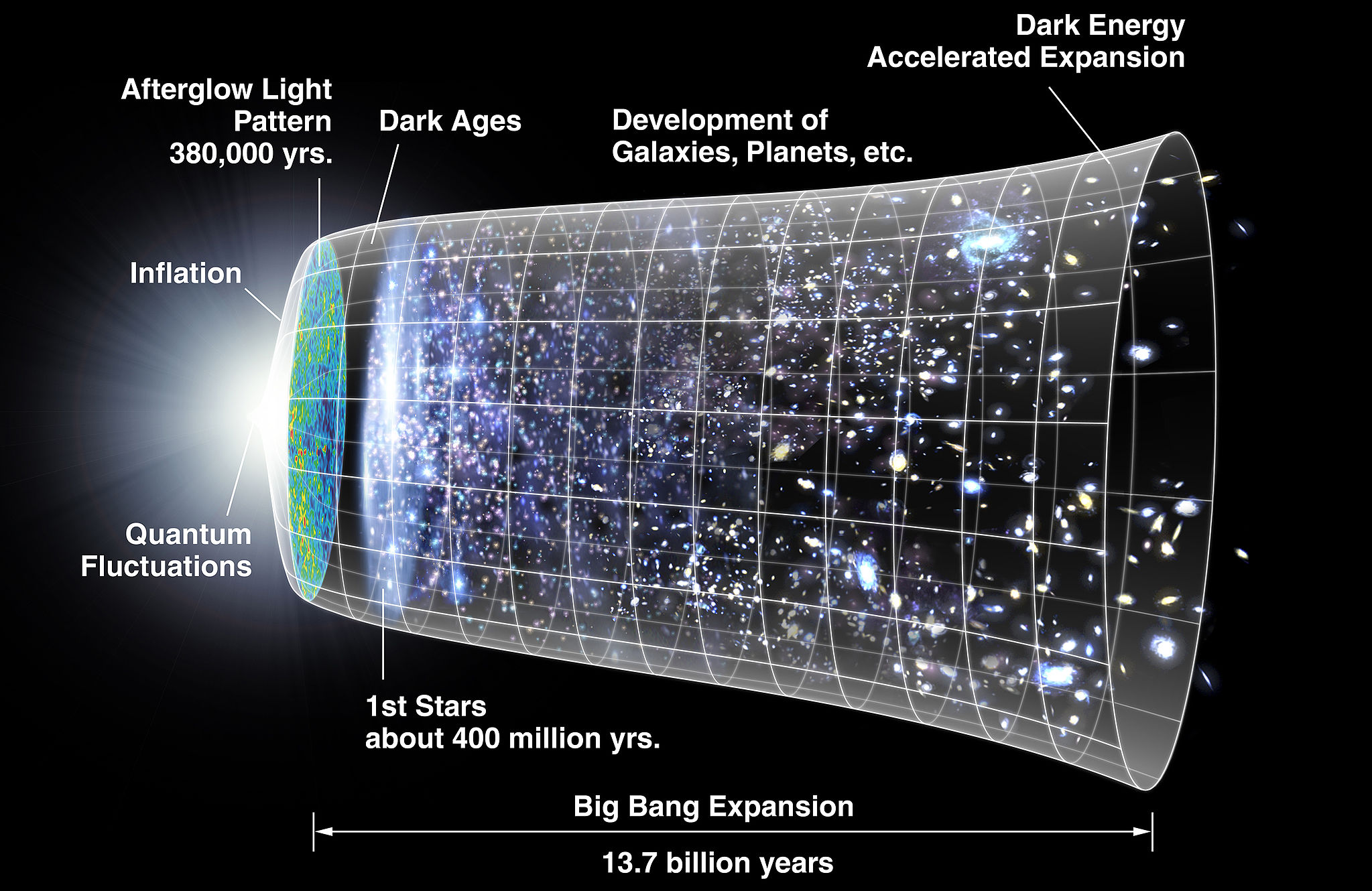
The mysterious details of events prior to and during the origin of the universe are subject to great scientific debate. The prevailing idea about how the universe was created is called the big-bang theory. Although the ideas behind the big-bang theory feel almost mystical, they are supported by Einstein’s theory of general relativity. Other scientific evidence, grounded in empirical observations, supports the big-bang theory.
The big-bang theory proposes the universe was formed from an infinitely dense and hot core of material. The bang in the title suggests there was an explosive, outward expansion of all matter and space that created atoms. Spectroscopy confirms that hydrogen makes up about 74% of all matter in the universe. Since its creation, the universe has been expanding for 13.8 billion years, and recent observations suggest the rate of this expansion is increasing.
Spectroscopy
Spectroscopy is the investigation and measurement of spectra produced when materials interacts with or emits electromagnetic radiation. Spectra is the plural for spectrum, which is a particular wavelength from the electromagnetic spectrum. Common spectra include the different colors of visible light, X-rays, ultraviolet waves, microwaves, and radio waves. Each beam of light is a unique mixture of wavelengths that combine across the spectrum to make the color we see. The light wavelengths are created or absorbed inside atoms, and each wavelength signature matches a specific element. Even white light from the Sun, which seems like an uninterrupted continuum of wavelengths, has gaps in some wavelengths. The gaps correspond to elements present in the Earth’s. Spectroscopy shows that the Sun is mostly made of hydrogen and helium. Applying this process to light from distant stars, scientists can calculate the abundance of elements in a specific star and the visible universe as a whole. Also, this spectroscopic information can be used as an interstellar speedometer.
REDSHIFT
 The Doppler effect is the same process that changes the pitch of the sound of an approaching car or ambulance from high to low as it passes. When an object emits waves, such as light or sound, while moving toward an observer, the wavelengths get compressed. In sound, this results in a shift to a higher pitch. When an object moves away from an observer, the wavelengths are extended, producing a lower pitched sound. Because the light wavelengths of receding objects are extended, visible light is shifted toward the red end of the spectrum, called a redshift. In addition, Hubble noticed that galaxies that were farther away from Earth also had the greater amount of redshift, and thus, the faster they are traveling away from us. The only way to reconcile this information is to deduce the universe is still expanding. Hubble’s observation forms the basis of big-bang theory.
Birth of Star
Stars start their lives as elements floating in cold, spinning clouds of gas and dust known as nebulas. Gravitational attraction or perhaps a nearby stellar explosion causes the elements to condense and spin into disk shape. In the center of this disk shape, a new star is born under the force of gravity. The spinning whirlpool concentrates material in the center, and the increasing gravitational forces collect even more mass. Eventually, the immensely concentrated mass of material reaches a critical point of such intense heat and pressure it initiates fusion.
Fusion is not a chemical reaction. Fusion is a nuclear reaction in which two or more nuclei, the centers of atoms, are forced together and combine, creating a new larger atom. This reaction gives off a tremendous amount of energy, usually as light and solar radiation. An element such as hydrogen combines or fuses with other hydrogen atoms in the core of a star to become a new element, in this case, helium. Another product of this process is energy, such as solar radiation, that leaves the Sun .

Good 👍👍 Good 💯💯
Aisay hi articles writting karna
very good
SO SWEET
You must be logged in to post a comment.