
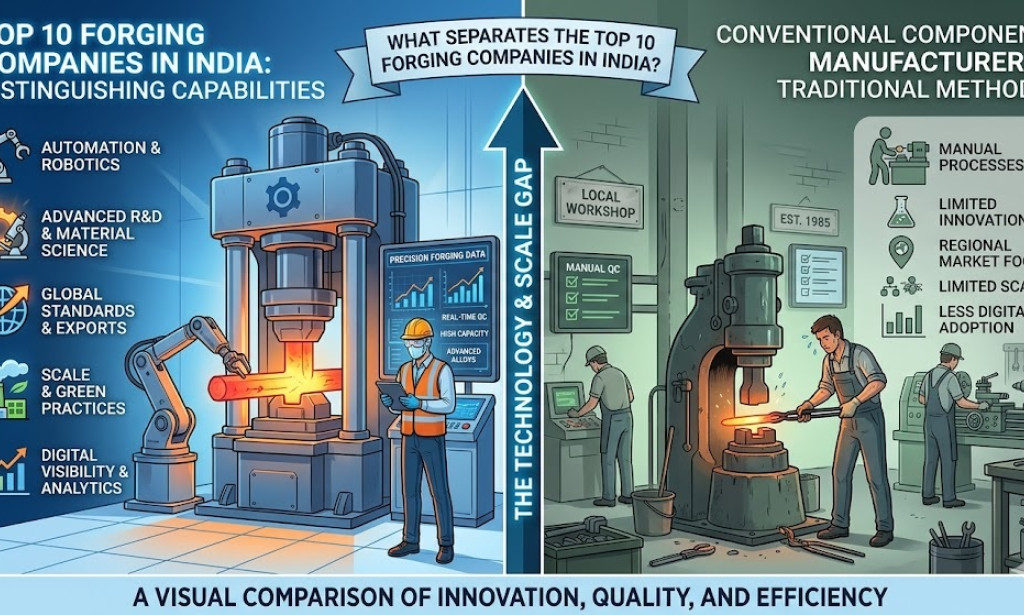
The gap between ordinary metal component manufacturing and high-performance forging has become much wider than it was fifteen or twenty years ago. Earlier, many industries viewed forged parts mainly as stronger replacements for cast or machined components. Today, the entire engineering mindset has changed because industrial systems themselves have become more demanding. Modern heavy vehicles, railway systems, mining equipment, oilfield machinery, power transmission systems, and industrial automation assemblies now operate under far higher cyclic stress, torque fluctuation, thermal loading, and continuous operational pressure than older mechanical systems ever handled.
Under these conditions, component failure rarely starts with dramatic cracking. The actual problem usually begins much earlier through microstructural inconsistency, grain flow interruption, internal fatigue concentration, or improper heat-treatment behavior that slowly weakens the component during continuous operation. That is why industries searching for the top 10 forging company in India are no longer evaluating suppliers only through production capacity or pricing. Buyers are studying metallurgical control, die engineering capability, thermal processing consistency, grain orientation behavior, and long-term fatigue resistance with far greater seriousness.
The companies leading the forging sector today are not simply shaping steel into usable forms. They are controlling how the internal structure of the metal behaves under extreme mechanical stress over thousands of operational cycles.
Forging Changes Internal Grain Structure in Ways Conventional Manufacturing Cannot
One of the biggest differences between forged and conventionally machined components lies inside the grain flow structure of the metal itself.
In standard machining operations, material is removed from a larger metal block without improving internal directional strength. Casting operations create another limitation because molten metal solidifies independently inside the mold cavity, often producing random grain orientation along with possible shrinkage defects or porosity zones.
Forging behaves differently.
During forging, compressive force restructures the grain flow along the shape of the component. This directional grain alignment improves impact resistance, fatigue strength, and load-bearing capability significantly compared to conventional manufacturing approaches.
This is one major reason industries working under high-load conditions increasingly depend on manufacturers from the top 10 forging company in India category for critical rotating and load-transmitting components.
The strength improvement is not merely external. The internal metallurgical structure itself becomes mechanically more stable.
Controlled Deformation Determines Long-Term Mechanical Reliability
Forging quality depends heavily on deformation control during the forming stage. If deformation becomes uneven, internal stress concentration develops across different regions of the component.
For example, excessive localized deformation during forging can create strain hardening imbalance or directional weakness near transition sections. Insufficient deformation, on the other hand, may leave coarse grain zones inside the material structure.
Advanced forging companies monitor deformation ratios very carefully because even small inconsistencies influence fatigue life later during service operation.
This is one area where leading companies separate themselves from smaller conventional manufacturers. High-end forging operations increasingly use controlled press loads exceeding 2,000 to 8,000 tons depending on component geometry and alloy requirements. These massive controlled forces ensure proper grain consolidation and internal density across the entire forging profile.
The result is much better structural integrity under repeated stress cycling.
Die Engineering Has Become a Highly Technical Discipline
Modern forging is no longer simply about hammering heated metal into shape. Die engineering itself has become a major technical specialization.
Poor die design creates uneven material flow during forging. When the metal does not flow uniformly, stress concentration develops internally. Flash formation becomes unstable. Dimensional repeatability weakens. Surface tearing and fold defects may also appear.
This is why companies competing among the top 10 forging company in India invest heavily in die simulation software, thermal modeling systems, and finite element analysis before production begins.
Modern forging simulations now predict:
- Metal flow behavior
- Temperature distribution
- Flash formation
- Stress concentration zones
- Die wear patterns
- Grain flow direction
This predictive engineering reduces internal defects significantly while improving repeatability across large production batches.
Heat Treatment Often Determines Final Component Performance
Forging alone does not guarantee mechanical superiority. Heat treatment plays an equally important role in determining final strength and durability.
Improper heat-treatment cycles create uneven hardness distribution and unstable residual stress inside forged components. A part may initially pass inspection while still carrying metallurgical instability internally.
Advanced forging manufacturers use tightly monitored furnace systems capable of maintaining controlled temperature variation within very narrow ranges, often within ±5°C depending on alloy specifications.
Controlled quenching and tempering improve:
- Fatigue resistance
- Impact toughness
- Tensile stability
- Wear resistance
- Dimensional consistency
This level of thermal discipline is one major reason industries increasingly rely on suppliers from the top 10 forging company in India segment for safety-critical components used in railways, heavy transport, mining equipment, and industrial power systems.
Automotive And Railway Industries Have Raised Forging Standards Dramatically
The growth of automotive and railway manufacturing has transformed the Indian forging industry over the last two decades.
Modern drivetrain systems, axle assemblies, crankshafts, connecting rods, steering systems, transmission gears, and suspension components operate under enormous cyclic loading conditions. Even minor metallurgical inconsistency eventually becomes visible through fatigue cracking or wear instability during long operational cycles.
Because of this, advanced forging manufacturers now maintain extremely tight process control across:
- Billet heating
- Deformation rate
- Die temperature
- Cooling cycles
- Surface finish quality
- Dimensional tolerance
Some heavy commercial vehicle crankshafts, for example, experience millions of stress cycles during operational life. A small grain interruption inside the forging can eventually become the starting point for catastrophic fatigue failure.
This is why forging quality has become central to modern industrial reliability.
Surface Integrity Matters More Than Many Buyers Realize
The external surface of a forged component affects much more than appearance.
Surface defects such as laps, folds, scale pits, and micro-cracks often become fatigue initiation points once the component enters cyclic loading conditions. Under continuous stress, these small imperfections gradually propagate deeper into the material structure.
Advanced manufacturers therefore focus heavily on surface integrity after forging.
Modern finishing systems now include:
|
Process Stage |
Purpose |
Impact On Component Performance |
|
Shot blasting |
Scale removal |
Improves surface cleanliness |
|
Magnetic particle inspection |
Crack detection |
Prevents fatigue failure |
|
Ultrasonic testing |
Internal defect analysis |
Enhances structural reliability |
|
CNC machining |
Dimensional precision |
Improves assembly stability |
|
Hardness mapping |
Thermal consistency verification |
Ensures uniform performance |
This level of inspection discipline separates advanced forging operations from ordinary component manufacturing facilities.
Export Markets Are Demanding Much Higher Consistency
International buyers today are far stricter than they were earlier regarding forging quality.
A decade ago, many procurement decisions emphasized cost reduction heavily. Modern industrial systems have become too expensive and too precision-dependent for inconsistent components. A failed forged part inside a mining gearbox, locomotive assembly, or industrial transmission system can shut down entire operations.
Because of this, companies competing globally from the top 10 forging company in India category now maintain tighter production monitoring throughout the entire manufacturing cycle rather than relying only on final inspection.
Export-focused forging companies increasingly monitor:
- Grain refinement consistency
- Inclusion control
- Thermal uniformity
- Surface stress behavior
- Microstructural stability
- Dimensional repeatability
The objective is not simply producing forged parts. The objective is delivering predictable mechanical behavior during long operational service life.
Automation And Digital Monitoring Are Improving Precision
Modern forging facilities are becoming far more data-driven than earlier operations.
Advanced press systems now use digital load monitoring and automated thermal tracking to maintain better process stability during forging cycles. Infrared temperature systems monitor billet conditions continuously before deformation begins.
Some large forging facilities also integrate robotic material handling systems to reduce thermal variation caused by delayed transfer between heating and pressing stages.
This improvement in operational precision has strengthened the competitiveness of Indian forging manufacturers significantly.
One example of companies participating in this increasingly advanced industrial environment is Sendura Forge, where forging capability is aligned with modern heavy engineering expectations rather than basic volume manufacturing alone.
Material Selection Has Become Increasingly Specialized
Forging performance depends strongly on alloy selection as well.
Different applications require different combinations of:
- Toughness
- Fatigue strength
- Impact resistance
- Wear stability
- Thermal resistance
For example, chromium-molybdenum steels may be selected for high-temperature applications, while nickel-chromium alloys may be preferred where impact toughness becomes critical.
The strongest forging manufacturers increasingly work closely with metallurgical specifications instead of producing generic components from standard steel grades alone.
This specialization is becoming essential for industries operating under difficult service conditions.
Why Forging Continues Dominating Heavy Engineering Applications
Despite advances in casting and machining technologies, forging continues dominating many heavy-load industrial sectors because the mechanical advantages remain extremely difficult to replace.
Forged components typically provide:
- Better fatigue resistance
- Higher impact strength
- Improved grain orientation
- Lower internal porosity
- Stronger structural integrity
- Greater operational reliability
This is why forged components remain widely preferred across oil and gas systems, railway assemblies, mining equipment, aerospace structures, industrial transmissions, and high-load automotive applications.
The long-term operational stability simply outweighs the higher production complexity.
Final Perspective
The companies leading the Indian forging sector today are separating themselves through metallurgical discipline, process precision, advanced die engineering, thermal control, and structural reliability rather than through production scale alone.
The growing global preference for the top 10 forging company in India segment reflects how significantly Indian forging capability has evolved across heavy engineering and industrial manufacturing sectors.
As industrial machinery continues operating under higher loads, faster rotational speeds, and longer operational cycles, buyers are placing greater importance on forged components capable of maintaining structural integrity under continuous stress conditions.
The manufacturers gaining long-term trust are the ones quietly improving grain flow consistency, reducing internal stress concentration, refining thermal processing stability, and delivering forged components that continue performing reliably long after production is complete.

You must be logged in to post a comment.