

North Korea has passed a law declaring itself to be a nuclear weapons state, according to state news agency KCNA.
The country's leader Kim Jong-un called the decision "irreversible" and ruled out the possibility of any talks on denuclearisation, it said.
The law also enshrines the country's right to use a pre-emptive nuclear strike to protect itself.
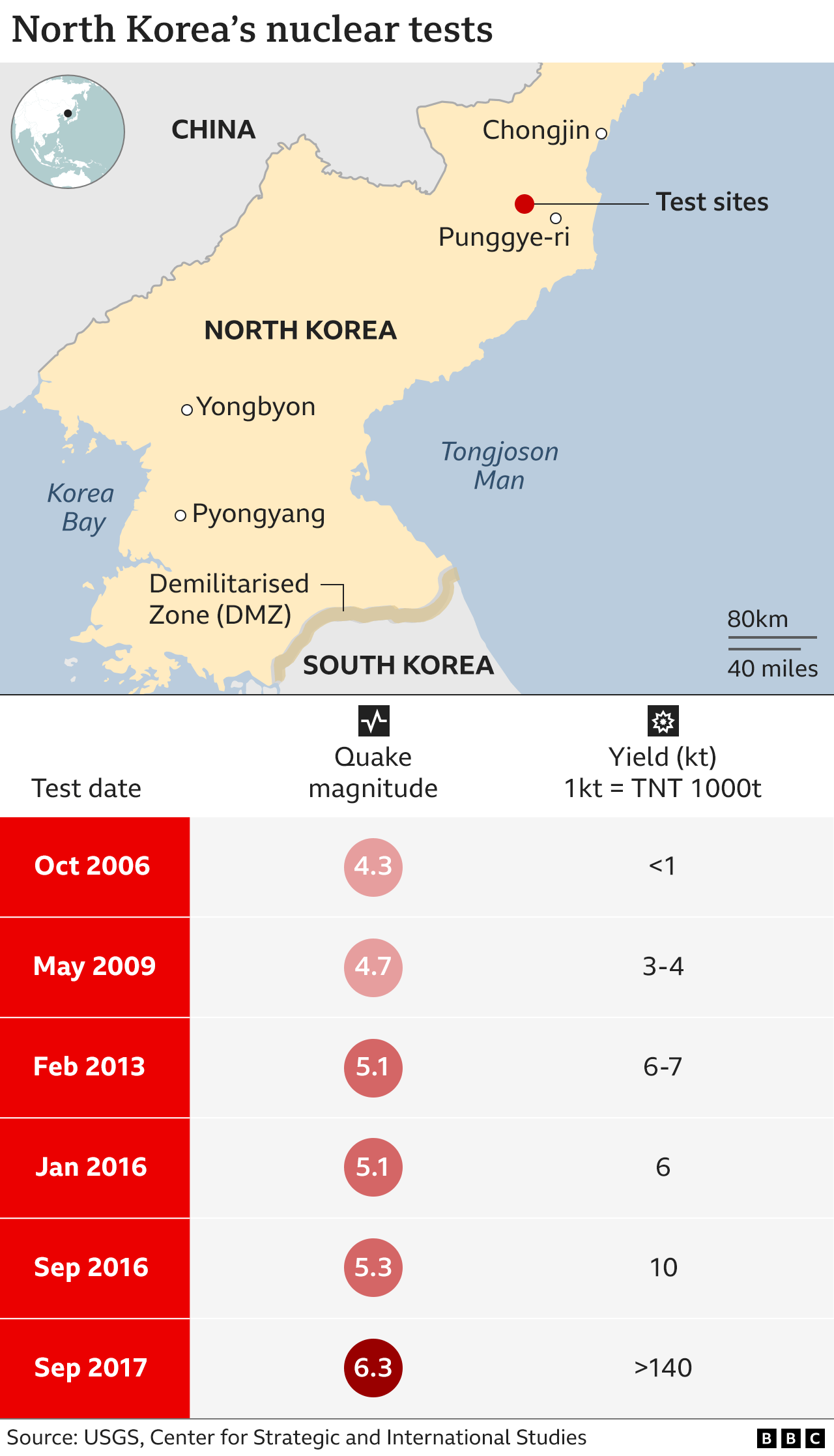
Despite crippling sanctions, Pyongyang has conducted six nuclear tests between 2006 and 2017.
It has continued to advance its military capability - in breach of United Nations Security Council resolutions - to threaten its neighbours and potentially even bring the US mainland within striking range.
Mr Kim carried out long-range launches and nuclear tests in 2019 following two headline-grabbing but inconclusive summits with then US president Donald Trump.
- What we know about N Korea's missile and nuclear programme
- Wargaming a North Korean attack
But talks between the countries have since stalled. Although the Biden administration has indicated it's willing to talk to Pyongyang, it hasn't said whether President Joe Biden would meet Mr Kim.
The White House also said its attempts to contact Pyongyang and overtures of help over its Covid outbreak had gone unanswered so far.
The US reviewed its North Korea policy last year and reiterated that "complete denuclearisation" of the Korean peninsula was the goal. Mr Biden said he would pursue it with a mix of diplomacy and "stern deterrence". Mr Kim responded by saying his country must prepare for both "dialogue and confrontation".
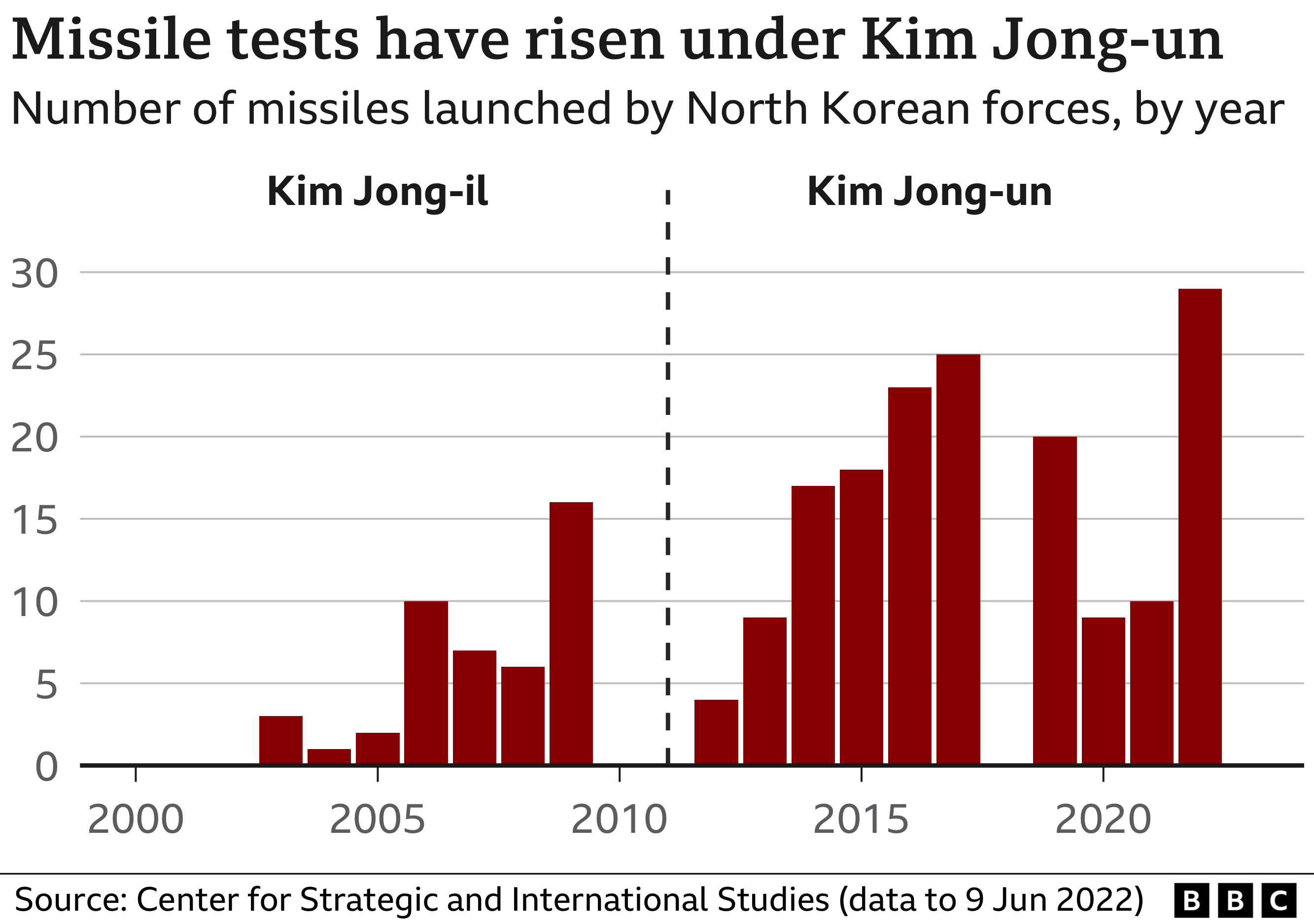
Meanwhile, tensions on the Korean peninsula have spiked this year with Pyongyang firing a record number of ballistic missiles.
South Korea and the US have responded with a volley of missiles and the largest joint military exercises on the peninsula in years.
What nuclear weapons does North Korea have?
The last time North Korea tested a nuclear bomb was in 2017. The explosion at its Punggye-ri test site had a force, or "yield", of between 100-370 kilotons.
A 100 kiloton bomb is six times more powerful than the one the US dropped on Hiroshima in 1945.
North Korea claimed this was its first thermonuclear device - the most powerful of all types of atomic weapon.
However, North Korea may now be aiming to test a smaller type of nuclear warhead with similar explosive force, according to Joseph Byrne, a research fellow at Chatham House.
"It seems they are now testing a new capability - a miniaturised warhead that can be fitted onto a range of missiles, including short-range missiles" he says.

Where could nuclear testing take place?
Six underground tests have previously been carried out at Punggye-ri. However, in 2018 North Korea said it would shut the site down, because it had "verified" its nuclear capabilities.
Some of the tunnels into the site were subsequently blown up in the presence of foreign journalists. However, North Korea did not invite international experts to verify if it had been put beyond use.
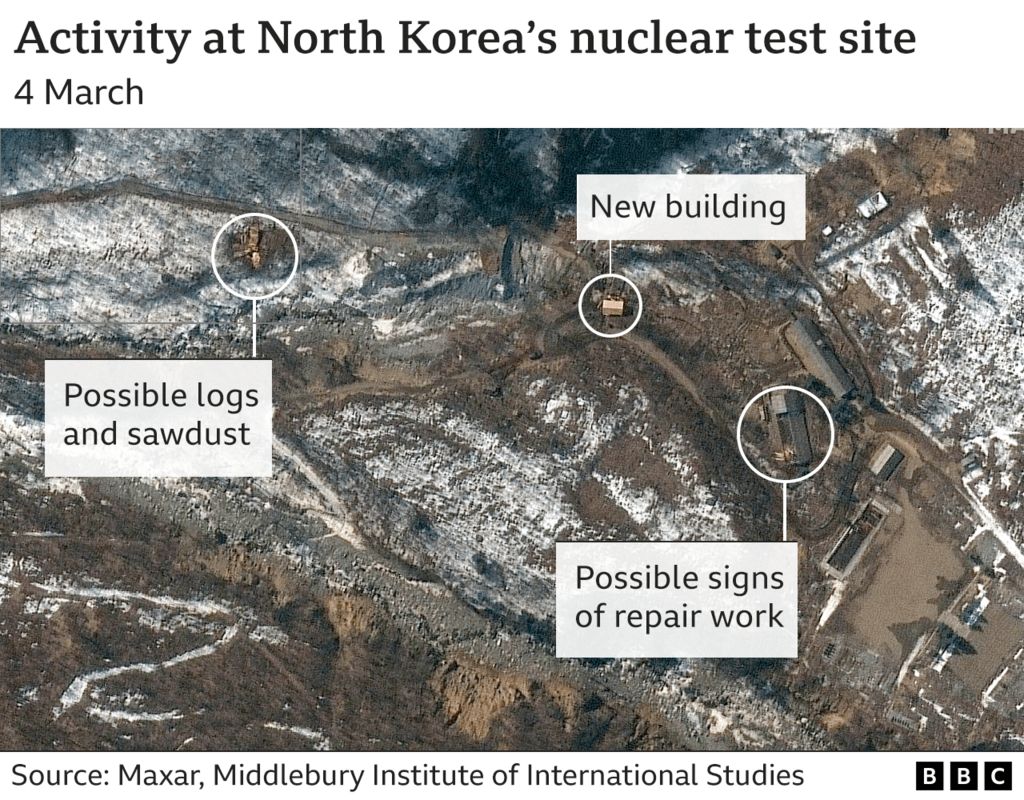
Satellite images released earlier this year suggest work to renovate Punggye-ri had started.
Any future nuclear testing at the site would breach resolutions from the United Nations Security Council.

Restarting North Korea's nuclear reactor
In 2018, North Korean leader Kim Jong-un made a promise to then-US president Donald Trump that North Korea would destroy all its nuclear material enrichment facilities.
However, the UN's atomic agency says satellite images suggest that North Korea had restarted the reactor which makes its weapons-grade plutonium.
The International Atomic Energy Agency (IAEA) has also said that North Korea's nuclear programme is going "full steam ahead," with work on plutonium separation, uranium enrichment and other activities.
What missiles has North Korea been testing?
North Korea has carried out more than 30 missile tests this year - using missiles with a long enough range to hit anywhere in the US.
These include ballistic missiles, cruise missiles and hypersonic missiles.
Hypersonic missiles fly at several times the speed of sound and at low-altitude, to escape radar detection.
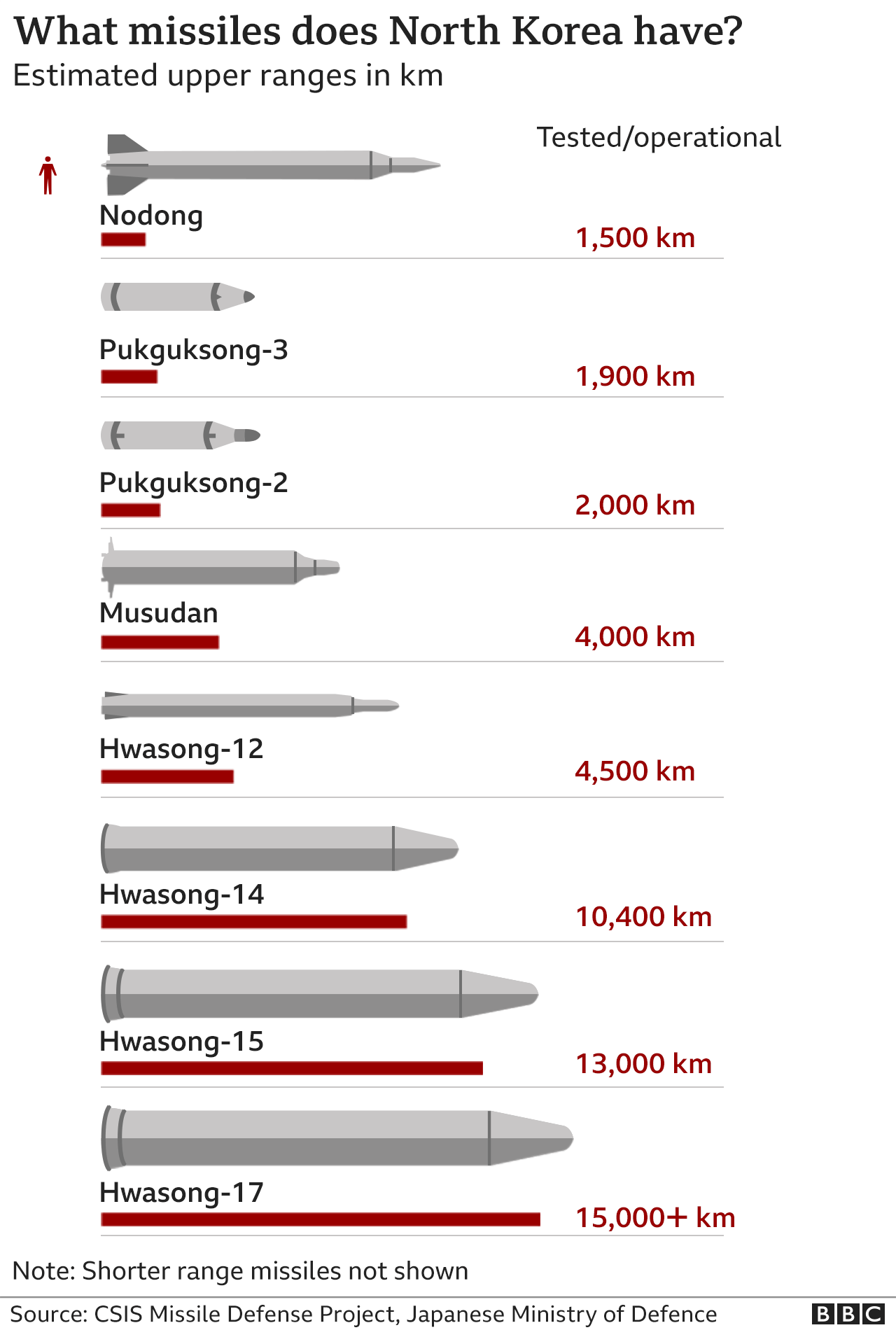
The ballistic missiles that North Korea has been testing include the Hwasong-14.
It has a range of 8,000km - although some studies have suggested it could travel as far as 10,000km, making it capable of reaching New York.
It is the first of North Korea's intercontinental ballistic missiles (ICBMs).
 Image source, Getty Images
The more recent Hwasong-15 missile is believed to have a range of 13,000km, putting all of the continental US in its sights.
In October 2020, North Korea unveiled the latest of its ballistic missile - the Hwasong-17.
It is believed to have a range of 15,000km or more, meaning it could deliver a nuclear warhead to anywhere in the US.
It could possibly carry three or four warheads, rather than only one - making it harder for a nation to defend itself.
The unveiling of the new missiles appeared to be a message to the Biden administration of the North's growing military prowess, say experts.
In March 2021, it carried out a launch of what it called a "new-type tactical guided projectile", which it said was able to carry a payload of 2.5 tons - so capable of in theory of carrying a nuclear warhead.
Analysts at the James Martin Center for Nonproliferation Studies told Reuters that it appeared to be "an improved variant" of a previously tested missile, the KN-23.

You must be logged in to post a comment.