
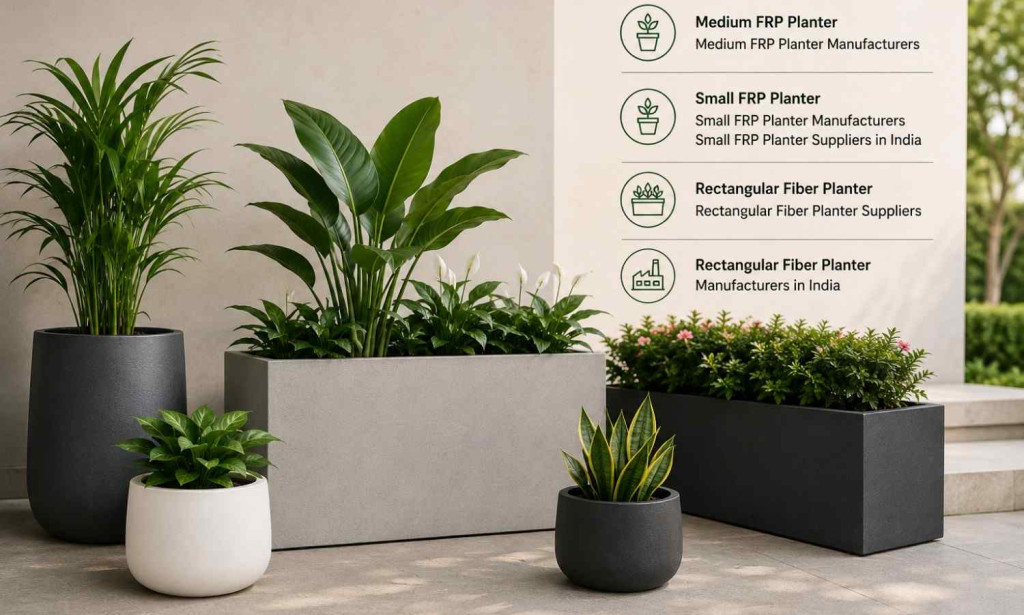
A procurement manager in Pune rejected an entire shipment of outdoor planters last year because the base thickness varied by barely 2.8 mm. That sounds minor until 140 units start cracking near drainage holes during installation. This is exactly why buyers sourcing a Medium FRP Planter, Small FRP Planter, or Rectangular Fiber Planter now spend more time evaluating manufacturing discipline than catalog pricing.
And yet, many buyers still compare suppliers using only FOB quotes.
That mistake gets expensive fast.
Across hospitality projects, commercial landscaping contracts, and export consignments, Indian manufacturers have become the preferred source because they balance mold precision, freight efficiency, and scalable production better than many low-cost alternatives. Especially in rectangular designs, where structural weakness shows quickly if resin ratios or curing cycles are inconsistent, experienced Indian factories have a measurable advantage.
Most buyers notice finish quality first. Experienced buyers check edge reinforcement, stacking safety, and UV resistance reports before asking for color charts.
Why Rectangular Fiber Planter Production Is Harder Than Buyers Expect
Rectangular designs look simple on paper. They are not.
A round planter distributes pressure naturally. A Rectangular Fiber Planter has stress concentration near corners, particularly in larger balcony or commercial installations. Poorly engineered molds create warping after exposure to direct heat. Worse, some suppliers reduce fiberglass layering near the base to cut resin consumption by 9–12%.
That's where reliable Rectangular Fiber Planter Manufacturers in India separate themselves from traders pretending to be factories.
Material Composition That Actually Matters
Most commercial-grade FRP planters use:
-
Fiberglass reinforcement mats
-
Polyester or vinyl ester resin
-
UV-resistant gel coating
-
Internal steel or wooden reinforcement for larger units
-
Multi-layer surface finishing
Which means resin quality matters as much as aesthetics.
A supplier using recycled filler-heavy resin may still produce glossy samples. Six months later, fading and hairline cracks begin appearing in outdoor installations.
Nobody tells you this during quotation discussions.
Standard Sizes Used in Commercial Orders
Small FRP Planter Specifications
-
Height: 12–18 inches
-
Width: 10–16 inches
-
Average weight: 3.5–7 kg
-
Common use: cafés, balconies, office interiors
-
Typical wall thickness: 3–5 mm
Medium FRP Planter Specifications
-
Height: 18–30 inches
-
Width: 18–36 inches
-
Average weight: 8–18 kg
-
Common use: hotels, retail spaces, landscaping projects
-
Typical wall thickness: 5–8 mm
Rectangular Fiber Planter Dimensions
-
Length range: 24–72 inches
-
Reinforced bottom support recommended after 48 inches
-
Drainage slope calibration required for outdoor use
Here's the specification detail buyers routinely skip: bottom flex testing.
A planter can pass visual inspection and still fail after soil loading. Factories serious about exports usually conduct load-bearing checks at 1.5x expected usage weight. Suppliers avoiding that discussion often know their weakness already.
The Supplier Evaluation Questions That Reveal Problems Early
Choosing among Medium FRP Planter Manufacturers or Small FRP Planter Manufacturers is less about brochures and more about uncomfortable questions.
1. Ask About Resin Source Consistency
Good answer:
They use batch-controlled resin procurement with documented suppliers.
Bad answer:
"We use different materials depending on customer budget."
That usually means inconsistent durability between shipments.
2. Verify Mold Ownership
Good answer:
The factory owns and maintains in-house molds.
Bad answer:
"We arrange molds externally."
Which means production timelines shift whenever subcontractors get overloaded.
3. Check UV Protection Standards
Good answer:
UV-stabilized coatings tested for prolonged outdoor exposure.
Bad answer:
"Our products are suitable for all climates."
That sentence means absolutely nothing without testing data.
4. Ask About Replacement Policy
A supplier who says, "We'll handle damages case by case," doesn't have a policy. That's a negotiation you'll lose after the shipment lands.
Good manufacturers define replacement percentages clearly before dispatch.
5. Evaluate Packaging Method
Good answer:
Corner-protected corrugated packing with pallet support for exports.
Bad answer:
"Packaging depends on transport."
That's how rectangular corners get chipped before the truck even crosses state borders.
How Small and Medium FRP Planters Protect Buyer Margins
Price matters. Margin leakage matters more.
Lower Breakage During Transport
FRP weighs substantially less than concrete alternatives. A standard Small FRP Planter shipment can reduce freight load by 28–34% compared to stone-based decorative containers.
That affects both domestic logistics and export container optimization.
Better Repeat Order Consistency
Reliable Medium FRP Planter Manufacturers maintain dimensional consistency across batches. That's critical for retail chains and hotel projects where visual alignment matters.
Even a 1-inch variation becomes obvious in lobby installations.
Reduced Maintenance Complaints
Powder-coated metal planters rust. Cheap plastic fades unevenly.
Quality FRP units maintain finish stability longer, especially with UV-resistant coating systems.
Easier Large-Scale Installation
Landscape contractors prefer lighter planters because installation crews move faster and require less equipment handling.
Which means lower project labor costs.
Better Design Flexibility
Rectangular designs fit commercial spaces more efficiently than circular units. Restaurants, rooftop projects, and office walkways maximize usable floor area using linear planter layouts.
That's a practical advantage, not a styling trend.
Longer Outdoor Performance
A properly manufactured Rectangular Fiber Planter can remain structurally stable for 7–10 years in standard Indian outdoor conditions. Poor-quality imports sometimes begin deforming within two monsoon cycles.
And yes, buyers usually discover that after warranty discussions become impossible.
Why Indian Manufacturers Dominate the FRP Planter Supply Chain
India's advantage isn't only labor cost.
It's manufacturing ecosystem density.
States like Gujarat, Rajasthan, Haryana, and Maharashtra already support fiberglass fabrication industries tied to automotive, infrastructure, and industrial molding sectors. That current supply chain minimizes raw material hold-ups for “Rectangular Fiber Planter Manufacturers in India”.
This means there is increased ability to predict production timelines during bulky orders.
Numerous “Small FRP Planter Suppliers in India” are located near the main freight corridors of the Nhava Sheva, Mundra and ICD export hubs. Freight coordination becomes easier for overseas buyers managing mixed container loads.
A buyer sourcing from three disconnected vendors in different countries often spends more managing delays than saving on unit pricing.
About Terre Pure
At Terre Pure, we work directly with wholesalers, procurement teams, commercial landscapers, and project buyers looking for scalable FRP planter manufacturing in India. We don't outsource production to rotating subcontractors after sampling approval. Our manufacturing process stays controlled from mold preparation to final finishing.
We learned this the tough way in 2021 after constant export feedback from high-UV areas in the Middle East. A polyester blend which we had used for years began showing surface fading early when subjected to extreme exposure. We replaced the formulation instead of arguing with buyers over climate conditions.
That's factory experience talking, not marketing copy.
Our team handles custom dimensions, finish matching, bulk dispatch planning, and export-grade packaging for small and medium commercial orders.
Most quotation delays happen because buyers send only reference images.
Here's what we need instead:
-
Required dimensions
-
Indoor or outdoor usage
-
Quantity split by size
-
Finish preference
-
Drainage requirements
-
Delivery location
-
Target dispatch timeline
At Terre Pure, we typically respond to serious B2B inquiries within one business day. MOQ depends on mold requirements and finish selection, though standard designs usually start from 25–50 units per size.
And if a requested specification risks structural weakness, we'll say it directly instead of approving a design that fails six months later.
Conclusion
There is continually heightened interest and purchases for "Medium FRP Planter," "Small FRP Planter," and the "Rectangular Fiber Planter." Their lightweight nature and ability to sustain long periods of use, without the need of a replacement, adds to their market appeal. Indian producers are quite skilled in both large scale manufacturing and the export of said goods, allowing them to takeover and dominate this market. Buyers who evaluate mold quality, resin consistency, and packaging discipline usually avoid the expensive problems that surface after delivery. The next few years will likely reward suppliers who focus less on catalog expansion and more on manufacturing control.
Here is another blog you might be interested in
A Complete Guide to Small FRP Planter Manufacturers and Rectangular Fiber Planter Suppliers in India
FAQs
Why are Rectangular Fiber Planter Manufacturers in India preferred for exports?
Factories in India tend to have better flexibility for customizing products, better freight-to-product weight ratios, and better commercial production capabilities. Many seasoned exporters, in addition to their production capabilities, have a better understanding of pallet optimization and container loading than small scale regional suppliers.
What’s the best way to compare “Medium FRP Planter Manufacturers”?
Compare the technical specifications first; the price should be the last consideration. Request the wall thickness, packaging images, UV protection, and references for previous commercial projects. A supplier avoiding these discussions is usually hiding production inconsistency.
Are Small FRP Planter Manufacturers suitable for low MOQ orders?
Some are.Some people only focus on large bulk hospitality or infrastructure requests. Always check the MOQ before approving any samples. The smaller runs often inflate the costs of mold preparation.
What should buyers send before requesting quotations from Rectangular Fiber Planter Suppliers?
Dimensions, finish preference, usage environment, quantity, and delivery location. Without that information, most quotes are just rough estimates and often change later during technical discussions.

You must be logged in to post a comment.