
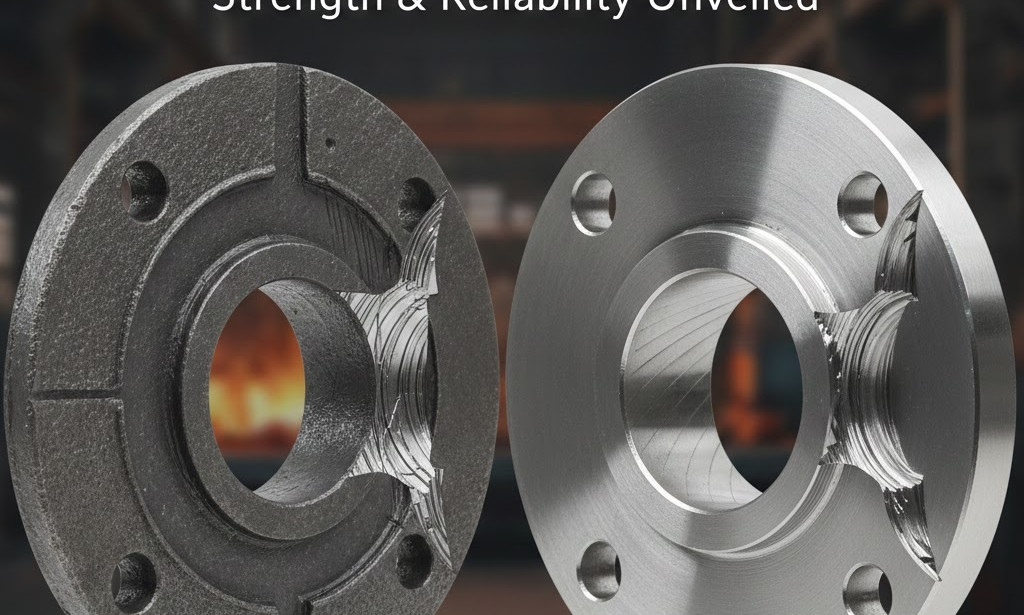
Flanges aren't really parts that add beauty to a system. They endure pressure, vibration, heat and even misalignment for years and still they are not allowed to fail. After a flange has been installed, it is supposed to become a part of the system no leaks, no deformation, no surprise behavior. Whether or not that happens depends less on drawings and more on the way the metal was formed initially. It is in this aspect that forged flanges always demonstrate their superiority to cast ones.
The difference is noticeable in the actual use and not in the brochures.
Metal Is Not Neutral: How the Forming Route Changes Everything
Metal remembers how it was shaped. That memory lives inside the grain structure.
Forging reshapes solid metal under compressive force. The material flows, stretches, and consolidates into the flange profile. Internal grains elongate and follow the geometry of the hub, bore, and flange face. Nothing is poured. Nothing is frozen in place randomly.
Casting solidifies liquid metal inside a mold. Cooling happens unevenly. Shrinkage, micro-voids, and non-uniform grain zones are part of the process, not exceptions. Even when surface quality looks acceptable, internal inconsistency remains.
This is the first reason forged flanges behave differently once pressure enters the system.
Grain Flow and Why Load Stops Breaking Things
Flanges deal with multiple forces at once: internal pressure pushing outward, bolts pulling inward, and piping loads trying to bend the joint.
In forged construction, grain flow aligns with these forces. Stress moves through the metal instead of stopping abruptly. Corners, hubs, and transition zones are reinforced internally, not just dimensionally.
Cast flanges lack directional reinforcement. Stress meets random grain boundaries and internal discontinuities. Over time, those locations become crack initiation points.
This internal load continuity is why forged flanges survive conditions that slowly destroy cast parts without warning.
Fatigue Is the Real Enemy in Piping Systems
Most flange failures do not come from pressure spikes. They come from repetition.
Pressure cycles. Pumps vibrate. Temperatures rise and fall. Each cycle adds microscopic damage. Forged metal resists this damage longer because cracks struggle to start. Grain refinement and density uniformity remove easy failure paths.
Cast flanges often contain porosity invisible to the eye. Those voids behave like pre-existing cracks. Under cyclic loading, failure is only a matter of time.
In fatigue-driven environments, forged flanges are chosen because uncertainty is removed from the equation.
Sealing Reliability Is Not Only About Gaskets
Leaks are flange failures, even when the metal stays intact.
Forged flanges provide uniform contact pressure across the gasket face. Bolt preload distributes evenly because density and stiffness are consistent. This stability prevents relaxation and micro-movement over time.
Cast flanges may show uneven compression due to internal density variation. Bolts lose preload unevenly. Gaskets creep. Leaks begin quietly.
This is why forged flanges dominate systems where leakage is unacceptable, not merely inconvenient.
Strength Without Excess Metal
Adding thickness is the easiest way to hide weakness—and the most expensive over time.
Forging improves mechanical properties at the structural level. Higher yield strength and impact resistance allow optimized wall sections without sacrificing safety. Weight stays controlled. Handling stays practical.
Cast flanges often rely on excess material to compensate for lower fatigue and toughness. That extra mass increases stress on supports and complicates installation.
In space-restricted or load-sensitive systems, forged flanges deliver strength without unnecessary weight.
Heat Exposure Separates Good Metal from Weak Metal
Thermal cycles punish poor structure.
Forged microstructures remain stable under prolonged heat. Expansion happens uniformly. Creep resistance improves. Dimensional stability holds.
Cast flanges respond unevenly to temperature gradients. Internal defects expand differently than surrounding material. Over time, distortion and leakage follow.
For high-temperature lines and cyclic heat exposure, forged flanges maintain integrity when cast flanges slowly degrade.
Process Control and Repeatability in Real Production
Consistency matters more than peak performance.
Forging operates within tight control windows—temperature, deformation rate, die pressure. Once set, results repeat. Mechanical properties remain predictable across batches.
Casting outcomes vary with melt condition, cooling rate, and mold behavior. Inspection increases, uncertainty remains.
Sendura Forge Pvt. Ltd focus on this process stability, producing forged flanges that behave the same way every time they enter service—not just on paper.
Lifecycle Cost Is Where the Difference Becomes Obvious
Purchase price is immediate. Failure cost arrives later.
Forged flanges reduce inspection frequency, leakage risk, and replacement cycles. Systems run longer without intervention. Shutdown risk drops.
Cast flanges often demand closer monitoring and earlier replacement. Maintenance costs quietly exceed initial savings.
Across long service life, forged flanges protect operations from hidden cost escalation.
Where Design Margins Actually Matter
Forging supports controlled grain flow around hubs, bores, and bolt circles. Designs can reduce unnecessary safety margins without increasing risk. Performance becomes predictable.
Cast designs must assume worst-case internal defects. Margins grow. Weight grows. Confidence drops.
This is why engineers return to forged flanges when operating windows narrow and tolerance for failure disappears.
Inspection Reality, Failure Visibility, and Field Confidence
Not every weakness announces itself during testing. Many flange problems surface only after installation, once pressure, temperature, and time begin working together. At that stage, inspection clarity matters as much as strength itself.
Forged structures offer cleaner internal geometry. Ultrasonic and radiographic inspections produce clearer signals because density is uniform and predictable. When an indication appears, it is easier to interpret and easier to trust. Cast flanges complicate inspection. Porosity, shrinkage cavities, and non-uniform sections create background noise that masks real defects or triggers unnecessary rejection.
In the field, this difference translates into confidence. Operators trust forged flanges to behave consistently because both manufacturing and inspection remove ambiguity before installation.
|
Evaluation Aspect |
Forged Flanges |
Cast Flanges |
|
Internal density uniformity |
High and consistent |
Variable across sections |
|
NDT signal clarity |
Clean, interpretable |
Noisy, harder to assess |
|
Hidden defect probability |
Low when process-controlled |
Higher due to inherent porosity |
|
Inspection rejection rates |
Stable and predictable |
Often inconsistent |
|
Field failure visibility |
Progressive and detectable |
Can be sudden and localized |
|
Operator confidence post-installation |
High |
Cautious |
This inspection transparency reduces decision risk. Problems are either present and visible or not present at all. That clarity is a quiet advantage of forged flanges, especially in systems where rework or replacement after commissioning is not an option.
Conclusion
Flange reliability is decided inside the metal, not on the surface. Grain flow, density uniformity, fatigue resistance, and thermal stability shape long-term performance more than any specification table.
Across pressure containment, sealing stability, and service life, forged flanges consistently outperform cast alternatives because the metal itself is engineered to carry load, not merely contain it. This reliability is not added later—it is formed under force, heat, and control, where failure has no place to hide.

You must be logged in to post a comment.