
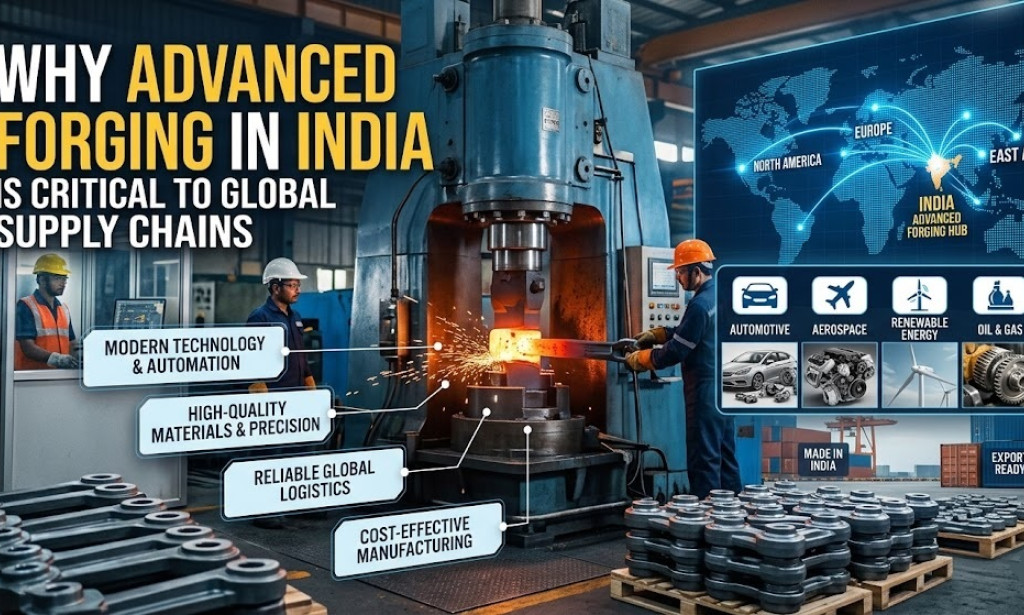
The existing global industrial supply chains are going through a major shift due to growing engineering complexities, geographical diversifications, higher quality demands, and greater emphasis on manufacturers to ensure production continuity. The automotive industry today demands forged drivetrains which should be able to bear heavy torque levels while also having a light vehicle structure. Forged parts which are able to resist cyclical loading for millions of times within their operational cycles have become crucial for railways construction activities. The heavy industries like mining, oil and gas, power generation, and automation rely on forged assemblies with high resistance capacity against constant vibrations and heating/cooling cycles.
Against this backdrop, the significance of a forging company in India has gone up dramatically within international industrial markets. In the past, most international procurement systems perceived the forging manufacturers as volume-driven producers with sole concern for minimizing costs. Currently, forging suppliers are assessed on the basis of process stability, metallurgical quality, precise dimensions, traceability mechanisms, heat treatment procedures, and operational dependability.
This shift is gradually positioning advanced Indian forging manufacturers as strategically important contributors within global engineering supply chains.
The reason is not limited to production capacity alone. Modern Indian forging operations are increasingly combining thermal-process control, precision machining capability, inspection infrastructure, automation systems, and export-level compliance standards within integrated manufacturing environments capable of supporting large international engineering programs.
As industrial systems become more technically demanding, the ability to maintain repeatable forged-component quality across large production volumes has become one of the most valuable capabilities in global manufacturing.
Industrial Demand Has Shifted Toward High-Reliability Forged Components
Modern engineering systems now operate under far more aggressive mechanical conditions than earlier industrial generations.
Commercial vehicles function under increased axle loads while maintaining lower vibration thresholds. Wind-energy systems experience fluctuating cyclic stress for extended operational durations. Railway assemblies work continuously under repetitive impact loading while maintaining strict alignment tolerances. Heavy industrial transmissions operate under stronger torque conditions with reduced dimensional allowance for vibration or imbalance.
Under such conditions, forged components are expected to maintain:
- Stable grain structure
- High fatigue resistance
- Dimensional repeatability
- Impact toughness
- Controlled hardness distribution
- Long-term structural integrity
This growing industrial dependence on reliable forged systems has increased the global importance of advanced forging company in India operations capable of meeting international engineering standards consistently.
Many industrial sectors now prefer forged components over cast alternatives because controlled grain flow during forging significantly improves structural continuity under repeated operational stress.
The focus has therefore shifted toward metallurgical reliability rather than simple component production.
Material Traceability Has Become Essential Across Global Supply Chains
International engineering industries now require much higher manufacturing accountability compared to earlier decades.
Automotive manufacturers, railway infrastructure companies, heavy equipment producers, and energy-sector suppliers increasingly request complete traceability documentation covering every stage of forged-component production.
Modern forging company in India facilities therefore maintain traceability systems connected with:
- Raw-material heat numbers
- Billet identification
- Furnace records
- Forging parameters
- Heat-treatment cycles
- Machining verification
- Inspection documentation
- Dispatch tracking
This traceability discipline has become especially important in sectors where operational failure investigations require complete production-history analysis.
Global industrial buyers increasingly prefer suppliers capable of maintaining documented manufacturing consistency because supply-chain reliability now carries major strategic importance across engineering industries.
Heat Treatment Capability Is Influencing Supplier Selection
Heat treatment has become one of the most technically important differentiators within modern forging manufacturing.
Forged components continue carrying residual internal stress after deformation finishes. Without properly controlled thermal stabilization, these stresses may later affect dimensional stability, fatigue resistance, and operational reliability.
Advanced forging company in India operations increasingly use programmable thermal-processing systems capable of maintaining highly controlled furnace environments throughout production cycles.
Modern heat-treatment systems monitor:
|
Thermal-Control Parameter |
Operational Importance |
|
Furnace atmosphere |
Surface stability |
|
Heating rate |
Grain refinement |
|
Cooling sequence |
Hardness control |
|
Soaking duration |
Structural consistency |
|
Temperature uniformity |
Repeatable metallurgy |
Typical thermal processes include normalizing, quenching, tempering, and annealing depending on alloy composition and engineering application.
Industrial buyers increasingly evaluate suppliers according to thermal-processing discipline because hardness consistency directly influences fatigue life and wear stability under long-term operational loading.
Precision Machining and Tolerance Control Are Becoming Critical
Global engineering sectors now operate under tighter dimensional tolerances than earlier manufacturing environments.
Transmission systems, hydraulic assemblies, railway couplings, industrial gear systems, and heavy rotating equipment require forged components with extremely accurate geometry because even relatively small dimensional variation may influence vibration behavior, alignment stability, sealing pressure, or rotational balance.
Modern forging company in India facilities increasingly integrate CNC machining, coordinate measurement systems, and digital dimensional verification directly into forging operations.
Precision-control systems commonly evaluate:
- Concentricity
- Flatness
- Surface roughness
- Parallelism
- Geometric alignment
- Dimensional repeatability
In many engineering applications, tolerances are maintained within fractions of a millimeter because operational efficiency depends heavily on dimensional consistency.
This shift toward high-precision manufacturing is one reason advanced Indian forging companies are becoming more deeply integrated into global industrial supply chains.
Automation Is Improving Manufacturing Stability
Manufacturing automation is playing a major role in strengthening forging reliability across large production volumes.
Earlier forging environments depended heavily on manual timing and operator judgment during heating, deformation, machining, and cooling stages. Modern forging operations increasingly rely on digitally monitored systems capable of maintaining stable production parameters continuously.
Advanced forging company in India facilities now monitor:
- Billet temperature consistency
- Press-load behavior
- Cycle timing
- Die wear progression
- Cooling stability
- Dimensional repeatability
Automation significantly reduces process variation while improving repeatability across long manufacturing schedules.
This consistency becomes especially valuable for international buyers operating under just-in-time production systems where supply interruptions or component inconsistency may affect entire manufacturing programs.
Export Capability Depends on Inspection Infrastructure
Global industrial markets now expect forging suppliers to maintain advanced inspection capability alongside manufacturing strength.
Many structural discontinuities remain invisible externally while still affecting long-term operational reliability. Modern forging manufacturers therefore increasingly integrate inspection systems throughout the production cycle rather than only at dispatch stage.
Inspection systems commonly used inside advanced forging company in India operations include:
- Ultrasonic examination
- Magnetic particle inspection
- Spectrochemical analysis
- Hardness mapping
- Coordinate dimensional verification
- Microstructure evaluation
Ultrasonic inspection has become particularly important in heavy engineering applications because internal discontinuities gradually become fatigue-sensitive regions under cyclic loading conditions.
The strongest manufacturers increasingly use inspection data not only for certification but also for improving process repeatability and manufacturing stability.
One example of companies operating within this increasingly precision-focused manufacturing environment is Sendura Forge, where forged-component production aligns closely with modern metallurgical discipline, dimensional accuracy, and international reliability expectations.
Supply-Chain Diversification Is Increasing India’s Strategic Importance
Global manufacturers are actively diversifying sourcing networks to reduce dependency on concentrated supply regions.
Industrial buyers now prioritize suppliers capable of maintaining:
- Stable export logistics
- Large-scale production continuity
- Compliance documentation
- Technical responsiveness
- Quality repeatability
- Long-term manufacturing reliability
India’s forging sector is benefiting from this shift because advanced manufacturing infrastructure, skilled metallurgical capability, and growing export-oriented production systems are strengthening the country’s industrial position within international supply chains.
Modern Indian forging facilities increasingly support sectors such as:
|
Industry Sector |
Forged Components Commonly Used |
|
Automotive |
Shafts, gears, hubs |
|
Railways |
Couplings, axle parts |
|
Oil & Gas |
Flanges, connectors |
|
Power Generation |
Turbine assemblies |
|
Heavy Engineering |
Structural forged systems |
|
Mining Equipment |
High-load mechanical parts |
As global engineering industries continue seeking stable long-term manufacturing partnerships, advanced forging suppliers capable of maintaining both scale and consistency are becoming increasingly valuable.
Engineering Complexity Is Raising Supplier Expectations
Industrial procurement standards are becoming far more technical than earlier manufacturing generations.
Buyers increasingly request:
- Material traceability records
- Mechanical test certification
- Ultrasonic inspection reports
- Heat-treatment documentation
- Chemical composition analysis
- Dimensional verification records
This reflects a broader industrial shift toward predictable operational reliability rather than simple component procurement.
As engineering systems continue operating under stronger loads, tighter tolerances, and more demanding service conditions, forging manufacturers are being evaluated increasingly on process discipline and structural consistency throughout the manufacturing cycle.
Final Perspective
The growing global importance of advanced forging company in India operations reflects the increasing industrial demand for forged components capable of maintaining structural reliability under highly demanding operating conditions.
Modern forging manufacturing now depends heavily on thermal stability, grain-flow control, dimensional precision, inspection integration, traceability discipline, and digitally monitored production systems throughout every stage of manufacturing.
As international engineering sectors continue demanding stronger fatigue resistance, tighter dimensional accuracy, and uninterrupted supply continuity, Indian forging manufacturers are becoming increasingly important contributors within global industrial supply chains.
The companies strengthening their international position are the ones quietly improving process repeatability, metallurgical consistency, inspection discipline, and manufacturing accountability while producing forged components capable of performing reliably under years of demanding industrial service.

You must be logged in to post a comment.