

Yoga is essentially a spiritual discipline based on an extremely subtle science, which focuses on bringing harmony between mind and body. It is an art and science of healthy living. The word 'Yoga' is derived from the Sanskrit root Yuj meaning 'to join' 'to yoke', or 'to unite'.
Yoga originated in Ancient India and has become a worldwide phenomenon now. This form of exercise, postures, and meditation has immense physical and mental health benefits.
The main goal of yoga is the attainment of physical, mental, and spiritual well-being—expansion and raising of consciousness to bring co-existence with everything and everyone.
Yoga means union, join, yoke, bind, attach, or connect. It also means the unification of the physical, mental, intellectual, and spiritual aspects of the human being.
3af33a1a-233c-4616-93a5-09ed07134a9f.jpg)
IMPORTANCE OF YOGA: Yoga is useful for promoting health and vitality and treating many diseases. It not only brings fitness and vigor to the physical body but also harnesses our will and emotions to improve our power of analysis, insight, and vision.
The following definitions can be beneficial to understand the meaning of yoga:
MEANING OF YOGA:
“Checking the impulses of mind is Yoga.” Patanjali. “Yoga is attaining the pose.” Maharishi Veda Vyas. “Yoga is spiritual Kamdhenu.” Swami Sampurnanand.
Yoga refers to the spiritual discipline that includes meditation, exercises, physical postures, and breathing techniques. It is done to improve the physical health, mental health, relaxation, and overall well-being of the individual.
Yoga is a Sanskrit word, which means ‘connection’ or ‘union’. It can be used to mean any type of connection. For example, it could be a connection with self, with other people, or with the divine.
There is another meaning to the word yoga, however. This is ‘to discipline’ or ‘to control’. The practice of yoga is, indeed, very much about disciplining the body and mind. Those who practice yoga regularly find that they are in greater control of their thoughts and emotions. Yoga paves way for a healthier life and is considered an easy way to stay fit, than other forms of exercise. You can easily practice it at home, it needs no tutor and no machines as well. Yoga includes:
- Meditation: Yoga encompasses meditation as well. Concentrating and counting your breath helps you meditate simultaneously while humming “Om” under your breath.
- Physical postures: Various physical postures are there for every part of our internal and external body parts that should be practiced according to the needs of a person.
- Breathing techniques: To regulate and controlling breathing is one of the primary techniques that should be practiced while doing yoga.
- Mind control: The breathing techniques and meditation helps you gain complete control over your mind and improve your concentration and productivity, along with giving you mental peace.
So, in sum, the word yoga means a discipline that is also a union. Yoga helps us to discipline ourselves, and as a result of this discipline we feel a stronger union with the divine, and that includes the divine in ourselves and in those who also follow this discipline.
Within the Western world, Yoga mostly denotes 'Hatha yoga'. Which refers to the physical practice of postures termed Asana.
The following points clearly show the importance of Yoga :
(i) Physical purity: Internal organs of our body can be cleaned by various yogic exercises. There are three substances in our body i.e., Vaat, Pitt, and aur Kaph. There should be a proper balance between these to remain healthy. Jal Neti, Dhauti Neti, Nauli, and Kapalbhati keep the internal organs of our body in a clean state.
(ii) Reduces mental tension: The modern age has disturbed a person’s peace and happiness because of stress and tension. Yogic exercises like Pratyahara, Dharana, and Dhyana play an important role in getting peace of mind. Shavasana, Padmasna, Vajrasana, Siddhasana, etc., are beneficial for releasing stress and tension in the mind and body.
(iii) Cure and prevention of diseases: Regular practice of Yoga can prevent many diseases like constipation, cold, cough, insomnia, asthma, high blood pressure, arthritis, acidity, heart attack, leprosy, menstrual disorder, and back pain. It is highly effective to cure many disorders. Various Yogic exercises increase the immunity power of an individual.
(iv) Postural deformity: If you are not having proper posture. You are not able to perform your work efficiently. We usually put more energy even into simple work. Yogic Asana helps, in correcting body deformities if we perform them regularly Dhanurasana is good for stimulating posture for back limbs, nerves, and muscles. Sarvangasana, Vajrasana, Mayurasana, Bhujangasana, etc., are best to remove postural deformity.
(v) Provides relaxation: To remove fatigue from the body, rest is essential. Anyone who involves herself/ himself in a long duration of work gets tired. Shavasana and Makarasana are beneficial for relaxation and also reduce mental fatigue.
(vi) Beautification of the body: Beautiful body is appreciated by everyone. Everybody wants to be slim, overweight people do not feel comfortable. Obesity is the most common problem nowadays. Obese people fall prey to various diseases. Obesity can be reduced by yogic exercises and Pranayama. Yoga brightens the face, adds glow to the face, removes wrinkles, and makes the body strong and flexible. Mayurasana is helpful for facial beauty.
(vii) Increases willpower and confidence: Regularity plays an important, as it takes time to develop this major quality. All these yogic Asana aim at purification, nervous control and coordination, and attention increases which help in building up confidence at work.
(viii) Improves health and reduces obesity: Everyday yoga practice for about 30 minutes leads to perfect health and a fruitful life. Only yoga can bring peace and happiness to life. Reducing weight is not a day’s work, it needs a lot of effort and strong will. Yoga Asana and Pranayama, if practiced regularly, reduce obesity and make the person flexible and healthy.
(ix) Spiritual development: Through yoga, efforts can be made to attain spiritual development. An individual constantly pays attention to God, forgets about himself, and has good control over the mind. Padmasana, and Siddhasana, are best for spiritual development. Pranayama is also helpful in spiritual development that brings peace to life.
BENEFITS OF YOGA:
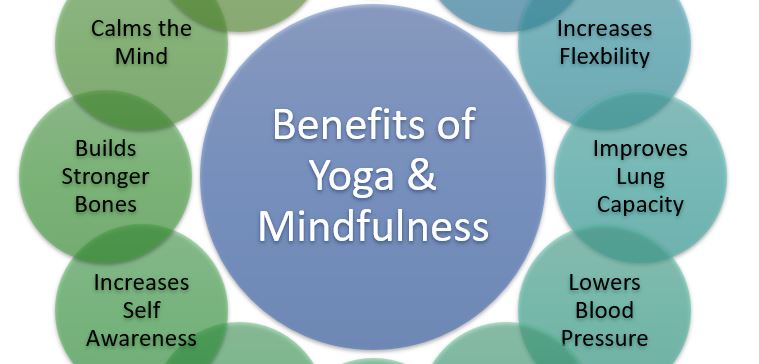
Practicing yoga has benefits for your mind, body, and soul. The main benefits are listed below.
- Inner Peace: A sense of inner peace and harmony pervades your life when you practice yoga. Even simply concentrating on your breathing will bring you a moment of calm.
- Various health benefits: Our circulatory system gets a brilliant boost from yoga. It improves body strength and balance. It ensures better health in terms of the lungs, heart, muscles as well as digestive organs. It also gives you better sleep.
- Improves concentration: It improves control over the mind. Your powers of concentration increase considerably.
- Mindfulness: It enhances mindfulness and generates happy emotions and increased self-esteem.
- Flexibility: Your body becomes more flexible and less stiff.
- De-stressing: Nothing de-stresses us like a delightful session of yoga.
- Respect: Yoga teaches us to respect others. Yoga sessions often end with a salute to the divine light in others, and a recognition that we possess a divine light too.
- Well-being: Yoga can fill us with joy. It improves physical, mental, emotional, and spiritual well-being.
- Perspective: Practicing yoga gives us perspective on the world.
- Easy: Yoga can be done by one and all. It is easy to practice and learn.
Conclusion:
The world now also celebrates an ‘International yoga day’ every year to promote its awareness. It makes sense to work some yoga into your daily routine.

hi
Thank you
nice
Nice
You must be logged in to post a comment.