

The utility ship of tomorrow is a robot that will follow the laws of the sea, autonomously plot its own path, and take on a range of payloads to serve the Navy over the course of its life.
As reported by Inside Defense last week, the US Navy’s new Medium Unmanned Surface Vessel will “feature a broad payload area where the Navy can ‘pick and choose’ the platform’s capabilities.”
Another way to look at this tidbit is that the Navy wants a new kind of robotic boat, knows the rough size of the vessel it wants, and does not yet know exactly how that robot will be used for war. Designing a boat that can take on a range of payloads, and as such perform a wide range of missions, lets the Navy figure out how to best incorporate robotic boats into normal operations first, and then fine-tune how it wants to use those machines in the future.
The Medium Unmanned Surface Vessel is part of an ongoing program to deliver a range of robotic vehicles for the Navy. It is being built by defense giant L3Harris, and what is most immediately notable about the ship are all the features it will not have.
“One of the most common requests we used to see was for a bridge—I need a bridge on my ship,” Regan Campbell, the General Manager of Autonomous and Advanced Naval Platforms at L3 Harris, told the Tech Unmanned podcast in December 2021.
It’s not hard to understand how human captains started imagining robotic ships as merely automated versions of existing vessels. The bridge is a central node for face-to-face communication between the people managing important ship functions, like steering, mission, and smooth operations. But that is wholly unnecessary on a robotic boat, where those tasks are handled algorithmically or, if the boat needs human involvement, people on land or another vessel can handle it.
Designing a ship without a bridge is only the first part of making a vessel autonomous from the start. Human crews require spaces to eat, sleep, and take care of other biological functions. A robotic vessel has no need for any of that, and can instead devote its space to fuel, sensors, redundant safety systems, and whatever else its operation may require.
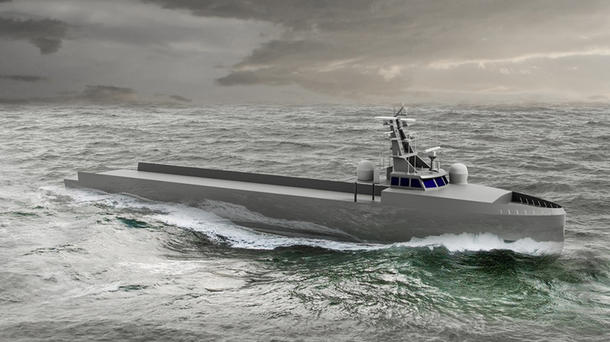 A concept rendering of The Medium Unmanned Surface Vessel L3Harris
Without a human crew on board, The Medium Unmanned Surface Vessel will instead need automated systems to sustain it for missions lasting between 30 and 45 days, or possibly longer. Redundant safety systems, as well as sensors to detect damage and initiate repair, will be essential in ensuring the long-term viability of a robot without human tenders on board doing routine maintenance.
The US Navy launched a missile from a ghost ship. Wait, what?
“Medium” is a relative term, and the Navy’s definition for the vehicle is between 45 and 190 feet long. That size range encompasses the size of existing patrol boats, or smaller vessels used by navies and coast guards to operate in rivers, harbors, and along coasts. Ocean Hunter, the autonomous boat originally developed for a DARPA project, is 132 feet long.
The Sea Hunter had a displacement of 140 tons, which is on the lower end of what can be expected for The Medium Unmanned Surface Vessel. The Navy requirements could see vessels as massive as 500 tons in displacement. That mass of ship will be taken up by a variable range of tools for missions, from scouting to jamming enemy signals to transportation, at least at the start. The ability to select configurations of sensors and other tools could let The Medium Unmanned Surface Vessel be a flexible part of Navy operations.

You must be logged in to post a comment.