

With Reference to Vedas / Bhoomi-Dundubhi :
There is an instrument called bhoomi-dundubhi, bhumi means earth and dundubhi means percussion. People in ancient times attempted to stretch animal skin on earth and hit it with sticks or danced on it to produce sounds, which may be the origin of all percussion instruments including tabla....

Tabla, although relatively young compared to the history of Indian Classical Music, has gone through various phases of development in the past few hundred years. Even though it is new, we don't have enough evidence and proper documents to confidently pinpoint its origin or how it was invented. There are many theories regarding the origin of tabla...
There are two tabla drums used to create music. The smaller drum is termed dayan and is made of wood. It is played with the right hand. The larger deeper-pitched drum is made of metal and is known as bayan. Both drums have goat or cow skin covering. They have a black middle spot made of iron fillings, soot and gum which produces a characteristic bell-like sound when drummed.
 It is rightly said that no North Indian classical music composition can be called complete without the tabla in it. Its distinct and unique sound makes it an integral part of Indian music.
Tabla is the most widely used percussion instrument in North Indian music and is classified under the membranophone family of instruments. It has two main gharana styles namely Dilli Baj and Purbi Baj. Both are different in their techniques and methods of music composition, and each gharana boasts of its own unique identiity...
Musicians also recognise six other gharanas or traditional schools of tabla. These are Delhi, Lucknow, Ajrara, Farukhabad, Benares and Punjab gharanas. Each gharana is unique because of specific bol techniques and tabla positioning.
During the days of royal patronage, it was important to uphold gharana traditions and keep them secret. But today tabla players are more free and combine various aspects of different gharanas to create their own styles.
Some music experts say the gharana tradition has virtually ended as changing lifestyles and training methods have made it almost impossible to maintain lineage purity.
It is not easy to play the tabla. You need to exercise great control over your hand movements. A seasoned tabla player uses his palms and fingers to generate diverse sounds at different pitches thereby creating amazing effects on music compositions.
Playing a tabla solo is a cherished and unique phenomenon in the art of drumming.
The percussive instrument can hold its melodic own for hours and yet not sound boring thanks to the wide repertoire of compositions.
INTRODUCTION TO TINTAAL :
Sometimes called the “master tal”, or the “king of tals”, tintal is by far the most common—and important—tal in classical tabla. Most of the tabla repertoire has been composed in tintal, and it is the most common tal for both instrumental accompaniment and tabla solo.
And with an even 4-4-4-4 structure, tintal is the most accessible tal for new students and listeners, after the light classical tals of KAHARAWA (4-4) and DADRA (3-3).
For tabla students, tintal is where you will do most of your practice. Similarly for listeners, you should spend most of your time listening first to compositions, and then to performances, in tintal.
THE MOST VITAL TAAL ON TABLA :
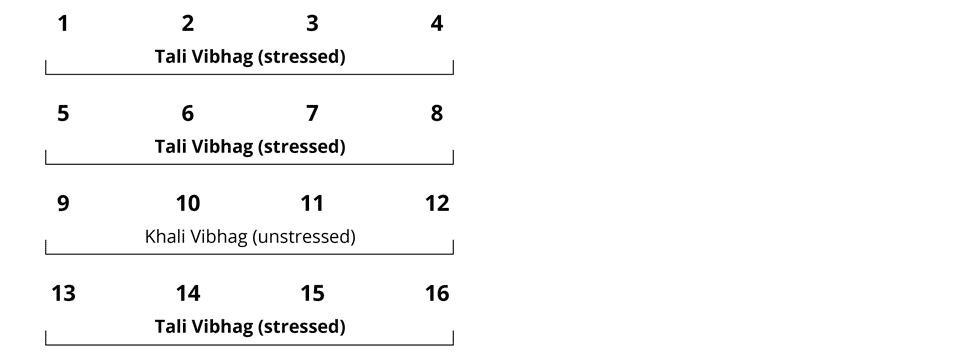
Tintāl – तिनताल
- Beats: 16
- Divisions: 4 (stressed = 3, unstressed = 1)
- Structure: 4-4-4-4 (X-2-0-3)
 |

You must be logged in to post a comment.