
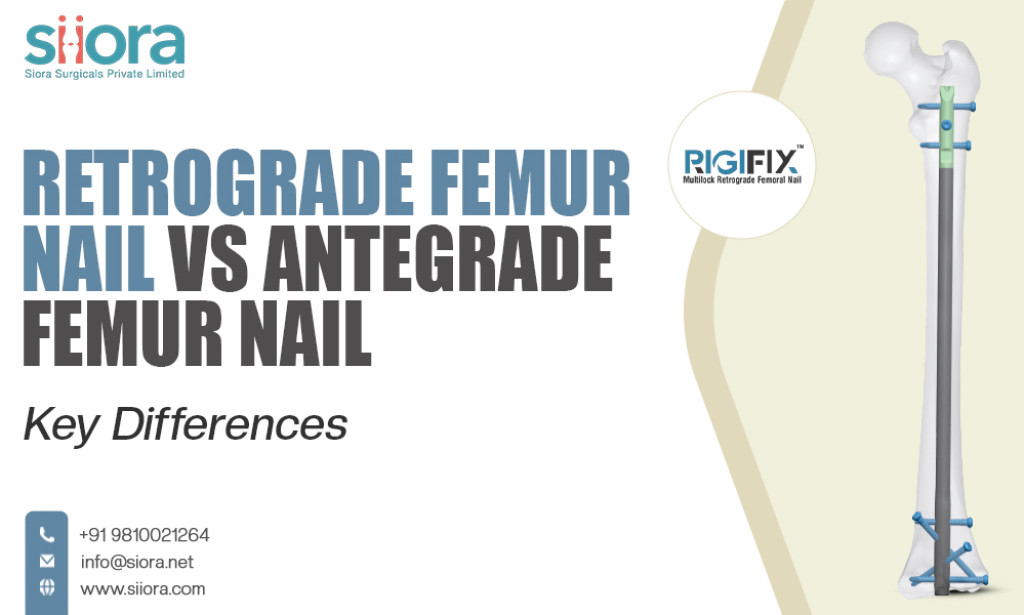
Femoral shaft fractures are commonly treated using intramedullary nailing. It is a dependable method, and most surgeons are comfortable with it. However, the choice between a retrograde and an antegrade femur nail is not always straightforward. Both techniques have their place, and the decision usually depends on the fracture type, patient condition, and surgical preference rather than a fixed rule.
Understanding the Two Approaches
Antegrade femur nailing is performed by inserting the nail from the top of the femur, usually through the hip region near the greater trochanter. This has been the more traditional approach and is widely practiced.
Retrograde femoral nailing, on the other hand, involves inserting the nail from the lower end of the femur through the intercondylar notch at the knee. This approach is often chosen in specific situations where antegrade access is difficult or less suitable.
Entry Point and Surgical Access
One of the main differences lies in the entry point. Antegrade nailing requires access through the proximal femur, which means working around the hip muscles and sometimes the abductor mechanism. In some patients, especially those with obesity or muscular build, this can be technically demanding.
Retrograde nailing provides easier access through the knee. The entry is more direct, and patient positioning is often simpler, especially in trauma settings. This can save time when dealing with multiple injuries.
Indications and Clinical Use
Antegrade nails are generally preferred for mid-shaft and proximal femoral fractures. They offer good alignment and have a long track record of reliable results.
Retrograde nails are often used for distal femur fractures or when the fracture extends toward the lower third of the bone. They are also helpful in cases with associated pelvic injuries, spine trauma, or when the patient cannot be positioned easily for an antegrade approach.
Impact on Hip and Knee
Each approach has its own concerns. Antegrade nailing may sometimes lead to hip pain or irritation around the entry point, especially if soft tissues are affected during surgery.
Retrograde nailing, because it passes through the knee joint, can occasionally result in knee pain or stiffness after surgery. In most cases, this improves with rehabilitation, but it is something to keep in mind while planning treatment.
Alignment and Reduction
Both techniques can achieve good alignment when performed carefully. However, controlling distal fragment alignment may be easier with retrograde nailing, particularly in fractures closer to the knee.
Antegrade nailing provides better control in proximal fractures, where maintaining the correct neck–shaft alignment is important.
Surgeon Preference and Experience
Surgeon’s comfort plays a vital role in selecting the technique. Many surgeons tend to choose the technique they are more familiar with, provided it suits the fracture pattern. There is no single “best” method for all cases. Instead, understanding the strengths and limitations of each approach leads to better decision-making.
Conclusion
Retrograde and antegrade femur nailing are both effective techniques for managing femoral fractures. The choice between the trauma implant types and procedures depends on fracture location, patient factors, and surgical convenience. Rather than viewing one as superior, it is more practical to see them as complementary options. Selecting the right approach for the right case is what ultimately leads to better outcomes.

You must be logged in to post a comment.