
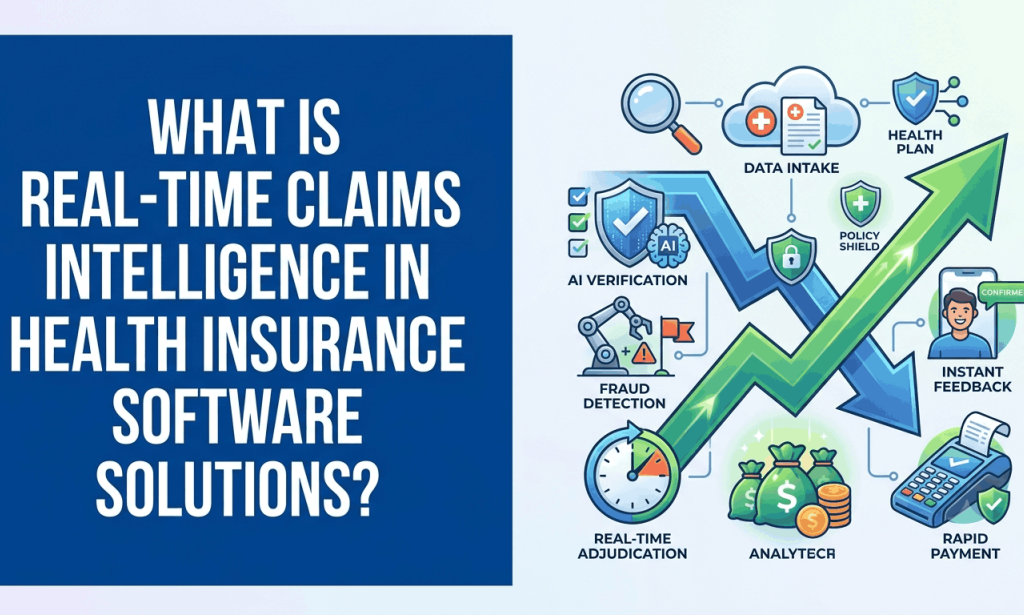
A claim arrives, moves through a queue, and by the time a report flags it as suspicious or misrouted, the check has already cleared. That lag is the quiet tax on most payer operations, and it is the reason real-time claims intelligence has become the sharpest dividing line among health insurance software solutions. The promise sounds simple: score every claim as it lands, surface fraud, eligibility gaps, and policy conflicts in the same breath, and let the adjudication engine act before money moves. The catch is subtler. Real-time analytics bolted onto a batch workflow produces faster reports that no one acts on, because the decision has already been made downstream.
The payoff arrives only when intelligence changes the decision at the point of adjudication. Health insurance software companies that treat "real-time" as a reporting speed upgrade tend to see dashboards refresh more often while denial rates, fraud leakage, and manual rework stay flat. The ones that see measurable gains route the score into auto-adjudication logic, prior authorization checks, and member-facing responses as the claim is processed. Getting that architecture right is what this article walks through, from a working definition to the technologies, regulatory pressure, and design choices that separate a live decision from a slightly quicker read-out.
Real-time claims intelligence is the practice of scoring and enriching a claim at the moment it enters adjudication, using streaming adjudication, real-time fraud and eligibility checks, and decision-point analytics, so the system acts on the insight while the claim is still open, rather than reporting on it after settlement.
What Separates Decision-Point Analytics from Batch Reporting
Batch reporting looks backward. A payer runs claims overnight, generates fraud and denial reports the next morning, and an analyst investigates what already happened. The intelligence is real; the timing is wrong. By the time a pattern surfaces, the payment cycle has often closed and recovery becomes a slow, adversarial chase.
Decision-point analytics inverts that sequence. The moment a claim hits the adjudication pipeline, a streaming engine enriches it with member eligibility, benefit limits, provider history, and fraud signals, then returns a verdict the adjudication rules consume immediately. A claim that would have been paid and later clawed back is instead pended, corrected, or denied with a specific reason before funds move.
The difference is not the model quality. Both approaches can run the same fraud algorithm. The difference is where the output lands. Batch delivers it to a person hours later; real-time delivers it to the decision engine in milliseconds. That single architectural choice determines whether analytics reduces cost or simply describes it.
Three capabilities define the real-time tier:
-
Streaming adjudication: claims are processed as an event stream, each one scored and routed the instant it arrives rather than pooled for a nightly run.
-
Real-time fraud and eligibility scoring: coverage, coordination of benefits, and anomaly checks resolve inside the adjudication window, not in a separate downstream audit.
-
Decision-point analytics: the score feeds the rule that approves, pends, or denies the claim, closing the loop between insight and action.
Where Real-Time Intelligence Changes the Outcome
Auto-adjudication is the clearest case. A clean claim scored as low-risk with valid eligibility can clear without human touch, while an ambiguous one routes to a reviewer with the reasons already attached. Lifting the auto-adjudication rate moves the largest single cost lever in claims operations, because every touched claim carries labor, delay, and error risk.
Fraud, waste, and abuse detection is the second. Post-payment recovery averages pennies on the dollar; a real-time flag that pends a suspicious claim before payment preserves the full amount. McKinsey has estimated that AI-enabled prior authorization can automate 50 to 75 percent of the manual tasks tied to review, which frees clinical staff to focus on the genuinely complex cases that models should not decide alone.
Prior authorization is the third, and it is where regulation now forces the pace. Real-time eligibility and medical-necessity checks let a payer return an authorization decision in minutes instead of days, which matters because the clock is now legally binding. The member experience is the fourth: a subscriber who sees an accurate claim status or an instant coverage answer trusts the plan more than one who waits on a callback that references a report generated last night.
How Health Insurance Software Solutions Build the Real-Time Layer
Sound architecture starts by treating the claim as an event, not a record to be filed. An event-driven pipeline ingests each transaction, enriches it against member, provider, and policy data, scores it, and hands the result to the adjudication engine before the claim advances. The scoring service sits inline, not alongside.
Health insurance software solutions that succeed here share a few design habits. They keep the decision logic explainable, so a pended claim carries a reason a human and a regulator can both read. They version the rules and models together, because a payer rule change and a model drift can produce the same denial for different causes. They design for graceful degradation, so a scoring outage pends claims for review rather than silently approving or blocking them.
The build sequence usually runs in three stages:
-
Instrument the pipeline: capture claims as a stream and expose eligibility, benefit, and provider data through low-latency services the scorer can query in real time.
-
Wire the score into adjudication: connect the intelligence output to the approve, pend, and deny logic so the verdict changes the claim's path, not just a dashboard.
-
Close the feedback loop: feed adjudication outcomes and appeal results back into the models, so the system learns from the decisions it influenced.
Skipping the second stage is the common failure. A payer instruments the stream, stands up a scoring service, builds a live dashboard, and still routes decisions through the old nightly rules. The result is faster reporting and unchanged outcomes, which is the exact trap this technology invites.
The Technologies Behind Streaming Adjudication
A real-time stack rests on a streaming backbone, typically an event platform that carries claims and enrichment events with predictable latency. On top of it sit feature stores that serve member and provider attributes fast enough for inline scoring, and model-serving infrastructure that returns a verdict inside the adjudication window.
Machine learning handles anomaly detection and risk scoring. Rules engines encode payer policy, benefit design, and regulatory logic that must stay deterministic and auditable. The two work together: the model flags what looks unusual, and the rules decide what the plan is contractually and legally allowed to do about it. Generative and large language models increasingly assist with unstructured inputs, reading clinical notes and prior authorization attachments to extract the facts a structured scorer needs.
Interoperability standards tie the stack to the outside world. Fast Healthcare Interoperability Resources (FHIR) application programming interfaces (APIs) let payers exchange eligibility, prior authorization, and clinical data with providers in a common format, which is what makes a genuinely real-time authorization exchange possible rather than a fax-and-wait cycle dressed in new software.
The Hard Parts: Data, HIPAA, Integration, and Payer Rules
Data quality sets the ceiling. A real-time score is only as trustworthy as the eligibility and provider data feeding it, and stale or fragmented records produce confident wrong answers faster than a batch job ever could. Payers that win here invest in the enrichment layer before they invest in the model.
Compliance runs underneath everything. The Health Insurance Portability and Accountability Act (HIPAA) governs how protected health information moves through the scoring pipeline, which means encryption in transit and at rest, tight access controls, and audit trails on every automated decision. When a model contributes to a denial, that decision has to be explainable and logged, both for HIPAA accountability and for the growing body of state rules on automated utilization review.
Integration is the underestimated cost. Core adjudication platforms at many payers were built for batch, and threading a real-time scoring service through them without breaking existing rules takes careful sequencing. Payer rules add their own weight: benefit designs, medical policies, and coordination-of-benefits logic vary by plan and change constantly, so the intelligence layer has to consume rule updates as data rather than as code rewrites. The 2024 Change Healthcare disruption also reminded the industry that real-time pipelines need resilience planning, because a single outage in a connected system ripples across every claim in flight.
Why the 2025-2026 Regulatory Shift Rewards Real-Time Health Insurance Software Companies
Regulation has turned latency into a compliance problem. Under the CMS Interoperability and Prior Authorization final rule, impacted payers must return prior authorization decisions within 72 hours for urgent requests and seven calendar days for standard ones, with operational requirements beginning January 1, 2026, and the Prior Authorization API required by January 1, 2027. A batch process that meets those windows on paper still leaves no margin for the exceptions that clog every real queue.
The economics point the same direction. The 2025 CAQH Index reported that U.S. healthcare avoided an estimated $258 billion in administrative costs in 2024 through electronic transactions, and that more than half of health plans now use AI tools in administrative workflows, while a multibillion-dollar automation opportunity in medical transactions stays open. Health insurance software companies reading those two signals together see the same conclusion: the remaining savings sit in the transactions that still require a human touch, and only decision-point automation closes that gap.
AI adoption is accelerating into that opening. The 2024 CAQH Index had already flagged roughly $18.4 billion in savings available from fuller medical automation, and the trend line since has bent toward real-time, model-assisted adjudication rather than faster overnight runs. The payers moving first are the ones treating the mandate as a design brief, not a deadline.
What the Next Few Years Ask of Payer Technology
The near future favors systems that decide, not systems that observe. Agentic workflows, where software handles eligibility, authorization, submission, and status end to end and escalates only the exceptions, are moving from concept to pilot at the payers with the cleanest real-time foundations. That model only works when the intelligence sits inside adjudication, because an agent that has to wait for a nightly report is not an agent at all.
Explainability and governance will grow as fast as the automation itself. As models influence more denials and authorizations, regulators and members will demand clear reasons, and the payers with logged, auditable decision points will adapt while others scramble to reconstruct why a claim was denied. The technical groundwork laid now for real-time scoring doubles as the compliance groundwork for what regulators are already signaling.

You must be logged in to post a comment.