
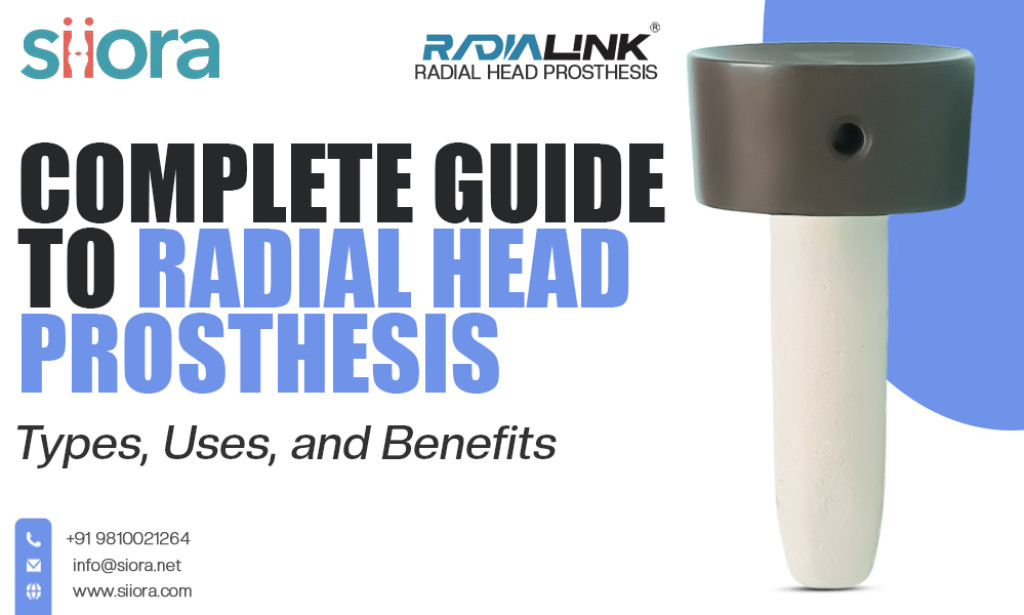
Injuries around the elbow can be tricky to manage, especially when the radial head is badly damaged. In many cases, simple fixation works. But when the fracture is too complex or the bone is shattered into multiple pieces, replacing the radial head becomes a more practical option. This is where a radial head prosthesis comes into the picture. It helps restore elbow stability and allows patients to regain movement without long-term discomfort.
What is a Radial Head Prosthesis?
A radial head prosthesis is an artificial implant used to replace the head of the radius bone near the elbow joint. This part of the bone plays an important role in both elbow movement and forearm rotation. When it cannot be repaired properly, replacing it helps maintain joint alignment and function.
Surgeons usually consider this option when reconstruction is unlikely to give stable results. The goal is not just to fill the gap but to bring the joint back to a working condition.
Types of Radial Head Prosthesis
There are a few common types, and the choice depends on the fracture and the surgeon’s preference.
Monoblock Prosthesis
This type is made as a single piece. It is simple in design and easy to implant. However, it may not offer much flexibility in adjusting size during surgery.
Modular Prosthesis
Modular systems come in separate parts, allowing surgeons to choose the head and stem sizes independently. This helps achieve a better fit and more accurate reconstruction of the joint.
Cemented and Cementless Options
Some prostheses are fixed in place using bone cement, while others rely on a press-fit technique. Cementless designs are often preferred when bone quality allows good fixation.
When Is It Used?
Radial head prosthesis is usually recommended in specific situations. These include:
-
Comminuted radial head fractures that cannot be fixed
-
Elbow instability associated with ligament injuries
-
Fractures combined with a dislocation
-
Failed previous fixation procedures
In such cases, removing the damaged bone without replacement may lead to instability. A prosthesis helps avoid that problem.
What Are the Benefits of Radial Head Replacement?
One clear benefit is improved joint stability. The radial head plays a key role in keeping the elbow aligned, especially during rotation. Replacing it helps maintain that balance.
Another advantage is early movement. Since the joint is stabilized, patients can begin gentle motion sooner, which reduces the risk of stiffness.
Radial head prosthesis also helps in restoring forearm rotation. This is important for everyday activities like turning a doorknob or using tools. Without proper function at the radial head, these simple tasks can become difficult.
In addition, modern implants are designed to match natural anatomy more closely. This improves comfort and reduces the chances of long-term complications.
Points to Keep in Mind
While outcomes are generally good, success depends on the proper sizing and placement of the implant. An oversized or undersized prosthesis can affect joint mechanics. Careful surgical technique and planning are essential.
Like any orthopaedic implant, there can be complications such as loosening or wear over time, but these are not very common when the procedure is done correctly.
Conclusion
Radial head prosthesis offers a reliable solution when fractures are too complex to repair. It helps restore stability, supports early movement, and improves overall elbow function. For many patients, it provides a practical way to return to normal daily activities with minimal limitations.

You must be logged in to post a comment.