
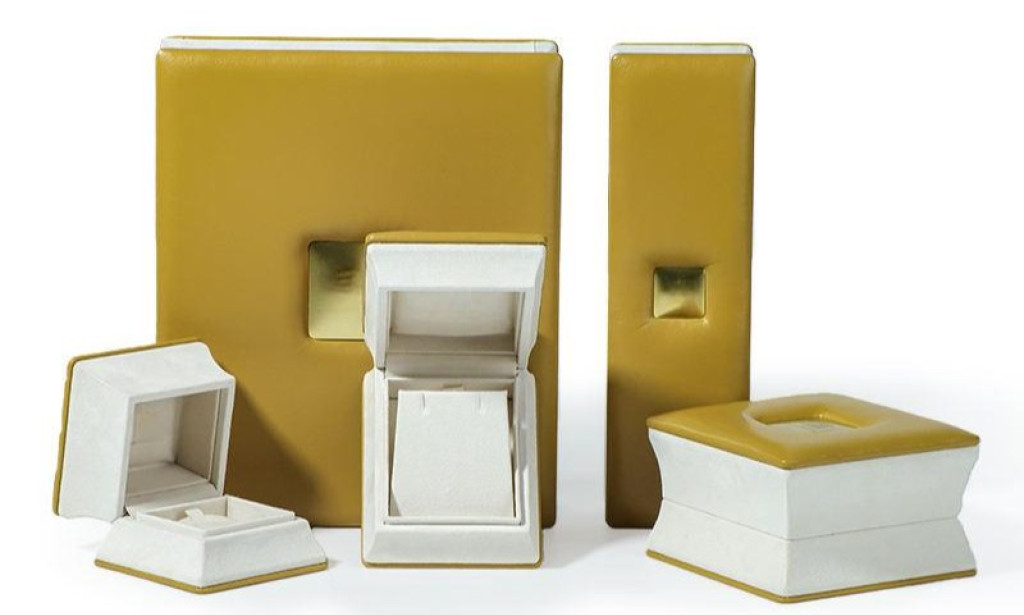
Most people who buy leather goods have only a vague sense of how they're made. The leather comes from somewhere, gets worked somehow, and becomes the finished object — but the specific steps, the decisions made at each stage, and the ways those decisions affect the final product tend to be invisible to buyers.
For leather jewelry boxes specifically, understanding the production process changes how you evaluate what you're buying. The quality signals that matter most — the ones that predict how a box will perform over years of daily use — make considerably more sense when you understand what's behind them.
It Starts With the Leather Selection
Before a single piece of leather jewelry box is cut or assembled, the leather itself has to be selected — and this selection is where a meaningful portion of the quality variation in finished products originates.
Leather for quality jewelry boxes typically comes from cattle hides, selected and processed through tanneries that specialize in producing consistent material for leather goods manufacturing. The tanning process — the chemical treatment that converts raw hide into stable, workable leather — takes weeks for traditional vegetable tanning and considerably less for chrome tanning, which is now more common in commercial production. The tanning approach affects the leather's characteristics: vegetable-tanned leather tends to develop patina differently than chrome-tanned, and the two require different finishing approaches.
The specific hide section used matters too. Leather from the center back of the hide — the butt — is the most consistent in thickness and grain, making it preferable for applications where uniformity matters. Shoulder sections are less consistent but often have interesting natural grain variation. Belly sections are the most inconsistent and least durable, and are typically used for less demanding applications or cut away entirely in quality production.
Manufacturers who specify their leather sourcing precisely — tannery, hide section, tanning method — are demonstrating knowledge of and control over their material that distinguishes them from those who simply source the most cost-effective leather available without these specifications.
Pattern Making and Cutting
Once the leather is selected and prepared, it needs to be cut into the panels that will form the exterior of the box. This sounds straightforward but involves decisions that significantly affect the finished product.
Pattern making — the design of the specific shapes to be cut — determines how efficiently the leather is used and how the natural grain of the hide will appear on the finished box. Experienced pattern makers orient cuts to make the most of the hide's natural characteristics — aligning grain direction consistently across panels, placing any natural marks or variations in locations where they'll be less visible or contribute positively to the piece's character.
The cutting itself can be done by hand, using steel rule dies on a press, or with computer-controlled cutting systems. Hand cutting by experienced craftspeople allows the most responsiveness to the specific characteristics of each hide section but requires significant skill and time. Die cutting and computer cutting produce more consistent results across production runs but require upfront tooling investment and less flexibility for responding to individual hide variation.
For custom production — where the specific requirements of an individual piece need to be accommodated — hand cutting or flexible cutting approaches tend to be more appropriate than fully automated systems optimized for production consistency.
Substrate Preparation
While the leather is being prepared, the substrate — the structural core of the box — is being cut and assembled separately. This is the component that most directly determines the structural integrity of the finished box and yet receives the least attention in most product descriptions.
Quality jewelry box substrates are typically cut from dense fiberboard or wood-based materials, with different densities and thicknesses used for different components — the base, the lid, and the interior walls each have different structural requirements. The cuts need to be precise, because imprecision in the substrate translates directly into imprecision in the finished box — lids that don't sit correctly, corners that aren't square, hinges that can't be positioned consistently.
The assembly of substrate components — joining the base, walls, and lid frames into the structural skeleton of the box — uses both adhesive and mechanical joining methods in quality production. Adhesive alone, without mechanical reinforcement at stress points, produces joints that can separate over time under the repeated stresses of regular use. Proper mechanical joining at corners and attachment points adds structural integrity that adhesive alone doesn't provide.
Leather Application
Applying the leather to the prepared substrate is where the surface appearance of the finished box is largely determined — and where the skill of the craftsperson has the most visible influence on the result.
The leather is adhered to the substrate using contact cement or similar adhesives, worked carefully to eliminate air bubbles and ensure consistent adhesion across the entire surface. Corners require particular attention — the leather needs to be folded or mitred cleanly without creating bulk that affects how the corner looks or how the lid fits. Inconsistent corner treatment is one of the most common visible signs of production that's been rushed or done by less skilled workers.
Edge finishing happens at this stage as well — the exposed edges of the leather panels being treated to prevent fraying and create clean finished lines. The specific approach — burnished edges, painted edges, turned and stitched edges — affects both appearance and durability. Burnished and painted edges require less material but need to be done carefully to seal the leather fibers completely. Turned and stitched edges use more material and more time but create the most durable edge treatment.
Hardware Installation
Hinges, clasps, and other hardware are installed after the leather application — typically through the leather and substrate together, with hardware anchored into the substrate rather than just into the leather surface.
The quality of the hardware itself — the weight, the smoothness of movement, the finish consistency — determines the immediate experience of using the box. But the quality of the installation determines how that experience holds up over time. Hinges anchored into substantial substrate maintain their alignment and feel across thousands of use cycles. Hinges attached to thin or soft substrate shift and loosen progressively.
Hinge positioning — specifically, the precise placement of both halves of the hinge relative to each other and to the box geometry — determines whether the lid closes precisely and sits correctly when closed. Small errors in positioning accumulate into visible misalignment that affects both appearance and function. Consistent precise positioning requires either careful measurement and marking or jigs that ensure consistent placement across production.
Interior Assembly and Finishing
The interior fittings — ring rolls, necklace hooks, compartment dividers, lining — are typically assembled separately and installed as units rather than being built in place. This approach allows the interior configuration to be adjusted or replaced independently of the exterior, which is relevant for custom production where interior configurations vary between pieces.
Ring rolls are covered in the same or complementary lining material as the rest of the interior, with filling density determining how firmly they hold rings. Properly dense filling requires more material than underfilled rolls — which is one of the specific places where cost reduction at the production stage produces inferior functional results that aren't visible until the box is in use.
The lining itself — typically velvet, suede, or felt — needs to be cut precisely and adhered securely. The most common interior failure in lower-quality boxes is lining that lifts at edges — a consequence of either imprecise cutting that leaves the lining under tension, inadequate adhesion, or both. Properly installed lining sits flat under the minor disturbances of regular use and remains flat for the life of the box.
Quality Control
The final stage before a finished box leaves production is quality inspection — the assessment of whether the finished piece meets the standards it was produced to. What this looks like varies enormously between manufacturers.
At the minimum, quality control involves visual inspection of the finished piece — checking for obvious defects in the leather surface, inconsistencies in the hardware installation, and visible problems with the interior. More thorough quality control includes functional testing — operating the hinges through multiple cycles, verifying that the lid seats correctly, checking that interior fittings hold pieces correctly.
The quality control process of an establishedCustom Leather Jewelry Box Supplier producing pieces to individual specification needs to verify not just general quality standards but conformance to the specific requirements of each custom piece — dimensions, configuration, hardware, and any personalization elements all need to match the specification the piece was produced to.
What This Means for Buyers
Understanding the production process translates into more specific quality assessment questions. Rather than asking generally whether a box is well-made, buyers can ask specifically: what tannery does the leather come from, and what grade? What is the substrate material and density? How are the edges finished? How is the lining attached?
These questions surface the production decisions that determine quality in ways that general quality language doesn't. And the answers — their specificity, their confidence, their willingness to provide detail — are themselves indicators of manufacturer quality that predicts the finished product more reliably than any photograph.
An establishedLeather Jewelry Box Manufacturer with consistent production standards tends to welcome these questions because the answers demonstrate the quality of their process. Manufacturers whose products would compare unfavorably under detailed scrutiny tend to provide vague or general answers that don't survive the comparison.
Final Thoughts
The production process behind a quality leather jewelry box involves a series of decisions — material selection, substrate preparation, leather application, hardware installation, interior assembly — each of which affects the finished product's quality in specific and predictable ways. Understanding these decisions doesn't require becoming a leather goods expert, but it does allow buyers to ask more specific and more revealing questions than visual assessment alone permits. Those questions, and the quality of the answers they produce, tend to predict purchasing outcomes more reliably than photographs, price points, or general quality claims.

You must be logged in to post a comment.