
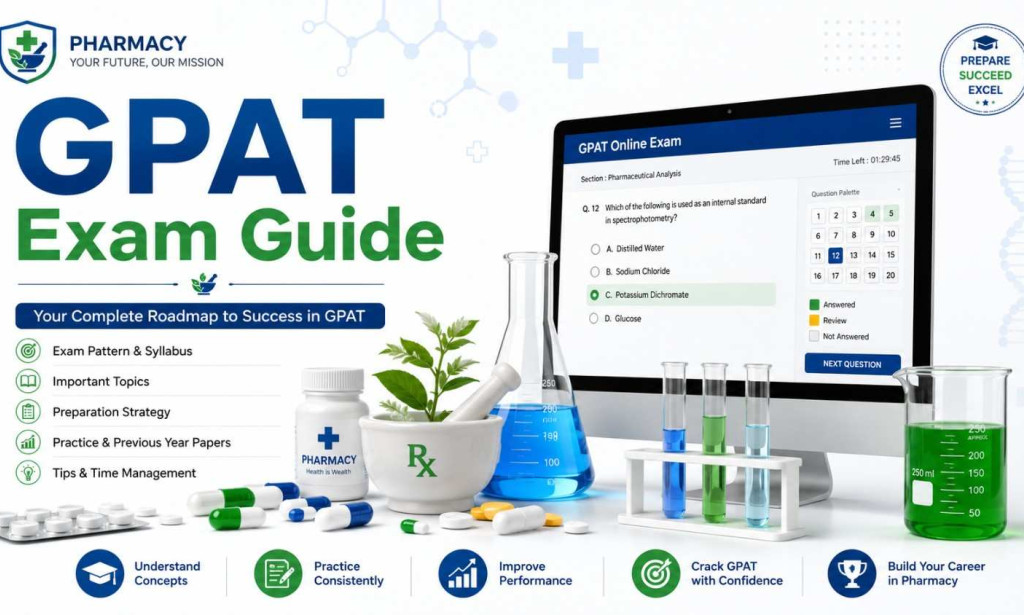
What Is GPAT 2026? Exam Pattern, Eligibility, Colleges and M.Pharm Admission
The Graduate Pharmacy Aptitude Test, commonly known as GPAT, is a national-level entrance examination used by participating institutions for admission to postgraduate pharmacy programmes.
It provides pharmacy graduates with a common examination score that may be used while applying to multiple colleges offering M.Pharm and related programmes.
Who Conducts GPAT?
GPAT 2026 was conducted by the National Board of Examinations in Medical Sciences.
The examination authority is responsible for:
-
Releasing the official information bulletin
-
Managing online registrations
-
Conducting the examination
-
Issuing admit cards
-
Publishing answer keys and results
-
Maintaining a standardised evaluation process
Candidates should rely on the official examination bulletin for confirmed dates, eligibility requirements and examination rules.
GPAT Exam Overview
GPAT is generally conducted as a Computer-Based Test and assesses the candidate’s understanding of core pharmacy subjects.
Important features include:
-
Exam level: National
-
Exam mode: Computer-Based Test
-
Question format: Multiple-choice questions
-
Primary course: M.Pharm
-
Coverage: Core subjects studied during the pharmacy degree
-
Score use: Admission to participating pharmacy institutions
The precise number of questions, duration and marking scheme may be revised, so candidates should check the relevant information bulletin.
GPAT Eligibility
Candidates planning to appear for GPAT generally need an undergraduate qualification in pharmacy from a recognised institution.
Applicants should verify:
-
Required pharmacy qualification
-
Final-year candidate eligibility
-
Documentary requirements
-
Registration rules
-
Any programme-specific admission conditions
Qualifying for GPAT does not automatically guarantee admission. Candidates must also satisfy the eligibility requirements of the institution where they apply.
Why Is GPAT Important?
GPAT supports postgraduate pharmacy admission by providing:
-
One common examination for multiple institutions
-
A standardised assessment system
-
Merit-based candidate evaluation
-
Wider admission opportunities
-
Reduced dependence on separate entrance tests
Its national reach allows candidates to consider colleges outside their home state while using the same examination score.
Colleges Accepting GPAT Scores
GPAT scores may be accepted by:
-
Government pharmacy colleges
-
Central and state universities
-
Deemed universities
-
Private pharmacy institutions
-
Other participating institutes offering postgraduate pharmacy courses
Acceptance policies, cutoffs and counselling procedures may differ across colleges. Candidates should verify whether their preferred institution accepts the relevant GPAT score before applying.
GPAT Admission Process
The admission process generally includes:
-
Appearing for GPAT
-
Checking the scorecard and qualifying status
-
Applying separately to participating institutions or counselling authorities
-
Meeting the college-specific cutoff
-
Completing document verification
-
Paying the admission fee within the prescribed deadline
Unlike a fully centralised admission system, participating institutions may follow their own application, counselling and selection procedures.
GPAT vs Other Pharmacy Entrance Exams
| Feature | GPAT | Other Pharmacy Exams |
|---|---|---|
| Scope | National | State or institution-specific |
| Main course | M.Pharm | Depends on the examination |
| Score acceptance | Multiple institutions | Often limited institutions |
| Mode | Generally computer-based | Varies |
| Admission process | Institution-specific | Depends on the exam |
Students may also apply for relevant state or university-level examinations to keep additional admission options available.
Preparation Tips
Candidates can prepare for GPAT by:
-
Reviewing the official syllabus
-
Revising core B.Pharm subjects
-
Solving previous examination papers
-
Taking computer-based mock tests
-
Preparing short revision notes
-
Practising numerical and concept-based questions
-
Analysing mistakes after every mock test
Consistent revision and familiarity with the examination format can improve both speed and accuracy.
Conclusion
GPAT is an important entrance examination for pharmacy graduates planning to pursue M.Pharm and related postgraduate programmes.
It offers a standardised national-level assessment and allows candidates to use one score while exploring admission opportunities at multiple participating institutions.
Candidates should verify the latest eligibility rules, exam pattern, score validity and college-specific admission procedure before applying.
Read the complete GPAT exam details on CollegeNirnay.

You must be logged in to post a comment.