
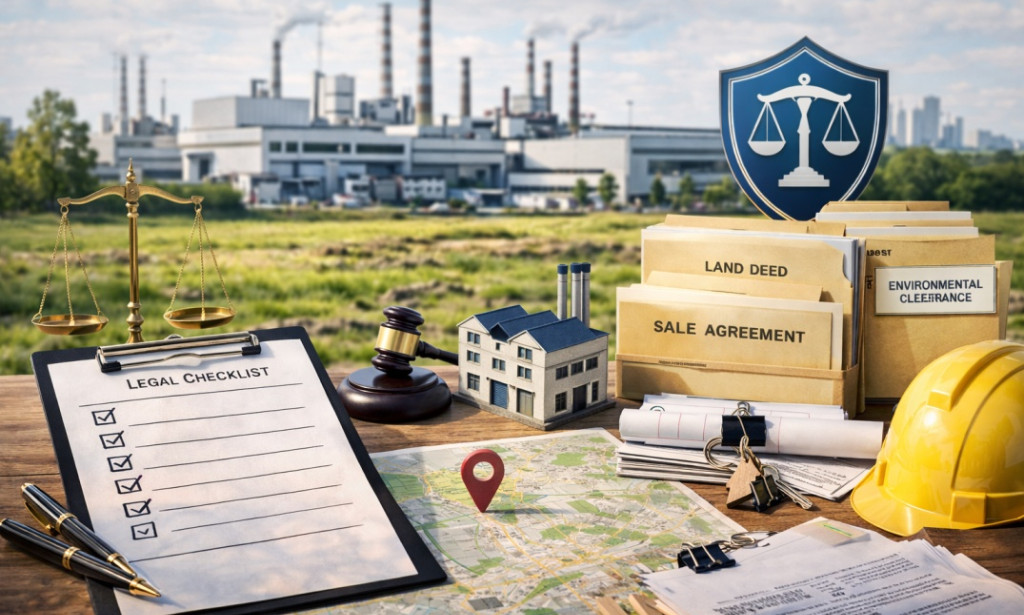
Purchasing factory land is one of the biggest investment decisions for manufacturers, industrial companies, logistics businesses, and infrastructure developers. The right land parcel can support long-term growth, efficient operations, and future expansion. However, the wrong land purchase can create serious legal disputes, project delays, regulatory issues, and financial losses.
In 2026, factory land acquisition in India has become more complex because businesses must comply with land use rules, environmental regulations, zoning approvals, title verification, and state-specific industrial policies. Buyers can no longer rely only on seller claims or basic property documents.
A structured legal checklist helps businesses reduce risk and ensure that the land is legally safe for industrial use.
Verify Ownership and Title Records
The first step in purchasing factory land is confirming that the seller has a clear and marketable ownership title.
Businesses should review:
-
Sale deeds
-
Mother deed
-
Gift deed, if applicable
-
Partition deed
-
Mutation records
-
Revenue records
-
Survey numbers
-
Seller identity documents
The ownership history should ideally be checked for at least 20 to 30 years to confirm that there are no gaps, disputed transfers, or conflicting ownership claims.
Many investors use Land Acquisition and Legal Due Diligence Services during this stage because industrial land transactions often involve complex ownership records, inheritance issues, or old title disputes.
Property disputes continue to account for a major share of civil litigation in India, making title verification one of the most important steps before buying industrial land.
Confirm Industrial Zoning and Land Use Permissions
Before purchasing land, businesses should confirm that the property is legally approved for industrial use.
Important checks include:
-
Industrial zoning classification
-
Master plan restrictions
-
Change of land use requirements
-
Building restrictions
-
Height limitations
-
State industrial policy rules
-
Special economic zone rules, if applicable
If the land is agricultural or residential, the buyer may need conversion approval before using it for industrial purposes.
Buying land without the proper zoning classification can result in penalties, refusal of building permits, or project cancellation. Businesses should also check whether nearby residential zones or protected areas may limit future industrial activity.
Check Encumbrances and Existing Liabilities
A factory land parcel may have hidden financial or legal liabilities that are not immediately visible.
Businesses should verify whether the land has:
-
Existing loans
-
Mortgages
-
Court cases
-
Government acquisition notices
-
Tax dues
-
Lease disputes
-
Utility-related liabilities
-
Pending compensation claims
An Encumbrance Certificate is essential because it shows whether the land has any registered liabilities or claims.
Businesses should also conduct searches in local courts and government departments to identify any pending legal disputes. Hidden encumbrances can delay land registration, increase project risk, and create future legal complications.
Verify Environmental and Regulatory Approvals
Many industrial projects require environmental approvals before construction can begin.
Businesses should check whether the land requires:
-
Environmental clearance
-
Consent to Establish
-
Pollution control approvals
-
Water extraction permission
-
Fire department NOC
-
Waste management approval
-
Hazardous chemical handling permission
Industrial sectors such as chemicals, pharmaceuticals, food processing, mining, metals, and heavy engineering often require more extensive environmental approvals.
Approval timelines can vary significantly depending on the state and the nature of the project. Environmental and pollution-related approvals may take several months, especially for large industrial facilities.
Conduct Physical Site Verification
Legal documents alone are not enough. Businesses should physically inspect the land before finalizing the purchase.
A site visit helps confirm:
-
Actual land boundaries
-
Road connectivity
-
Access to power and water
-
Flood risk
-
Soil condition
-
Encroachments
-
Existing structures
-
Nearby industrial activity
For factory projects, businesses should also assess whether the location has sufficient utility infrastructure, labor availability, and transportation access.
Industrial land that appears suitable on paper may have practical issues such as poor road access, utility shortages, drainage problems, or encroachments that can affect project timelines and costs.
Get expert land due diligence support:https://www.imarcengineering.com/services/land-acquisition-legal-due-diligence
Review Local State Policies and Incentives
Each Indian state has different industrial policies, land regulations, and incentive programs.
Before purchasing land, businesses should check:
-
Stamp duty rates
-
Registration charges
-
State industrial subsidies
-
Power tariff incentives
-
Employment-linked incentives
-
SEZ or industrial park benefits
-
State-level environmental rules
States such as Gujarat, Maharashtra, Tamil Nadu, Uttar Pradesh, Telangana, and Karnataka continue to attract major industrial investments because of stronger infrastructure and industrial support policies.
Check Future Expansion Possibilities
Businesses should not buy land only for their current requirements.
They should also consider:
-
Future production expansion
-
Additional warehouse space
-
New utility connections
-
Employee facilities
-
Parking and logistics space
-
Future environmental compliance needs
Land with expansion potential is often more valuable in the long term because it reduces the need to relocate operations later.
This is especially important for industries that may need larger production lines, new buildings, or additional storage in the future.

You must be logged in to post a comment.