

Enzymatic reaction mechanism
In order for the reaction to occur, any two molecules with the correct orientation and sufficient energy must collide. The energy between these molecules needs to overcome the reaction barriers. This energy is called activation energy.
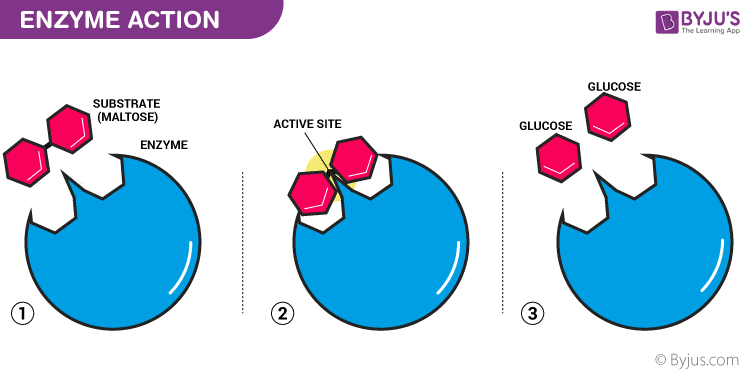
The enzyme requires an active center. The active site is part of a molecule that has a functional group to bind a particular shape to a reactant molecule. Molecules that bind to enzymes are called substrate groups. Substrate and enzyme form an intermediate reaction with low activation energy without catalyst.
Enzyme-Substrate Interactions
Enzymes are biocatalyst, or high molecular weight proteinacous compounds. It enhances the reactions that occur in the body during various life processes. It helps the substrate by providing a surface area for the reaction to take place. This enzyme contains cavities on the outer surface that occupy groups such as SH and COOH. The charged substrate, which is the opposite of the enzyme, fits in these gaps so that the key fits in the lock. This substrate binding site is called the active site of the enzyme (E).
The preferred model of enzyme-substrate interaction is called the induced fit model. This model shows that the interactions between the substrate and the enzyme are weak, and these weak interactions rapidly induce conformational changes, strengthen the binding, and bring the catalytic site close enough to the substrate binding.
There are four main mechanisms of catalysis:
Bond Strain Catalysis
This type of catalytically induced structural rearrangement produces strained substrate bonds that are more likely to reach transition states. The new conformation forces substrate atoms and catalytic groups such as aspartic acid into conformations that emphasize substrate binding.
Covalent Catalysis
In the case of covalent catalysis, the substrate is directed to the site of action of the enzyme so that a covalent intermediate is formed between the enzyme and the substrate. The best example of this is proteolysis by serine proteases, which include both digestive enzymes and various enzymes in the blood coagulation cascade. These proteases have an active serine center in which the hydroxyl group R forms a covalent bond with the carbonyl carbon of the peptide bond, resulting in hydrolysis of the peptide bond.
Acid-base catalysis
Other mechanisms contribute to the completion of catalysis caused by stress mechanisms, such as the use of glutamic acid as a common acid catalyst.
Orientation and Proximity Catalysis
Enzyme-substrate interaction induces reactive groups to be in close proximity to each other
In addition, groups such as aspartic acid are chemically reactive and in close proximity to the substrate, facilitating their involvement in catalysis.
Enzyme action and properties When the
substrate (S) binds to this active site, they form a complex (intermediate ES), which produces the product (P) and the enzyme (E). Substrates that bind to enzymes have a specific structure and are compatible only with specific enzymes. Therefore, the enzyme slows down the activation energy of the reaction by providing a surface to the substrate. The intermediate state in which the substrate binds to the enzyme is called the transition state. By breaking the bond, the substrate binds to the enzyme (without change), is converted to a product, and is later cleaved into the product and the enzyme. The free enzyme then binds to other substrates and the catalytic cycle continues until the reaction is complete.
There are basically two steps in enzymatic action.
Step 1: Combine the enzyme with the reactant / substrate.
E + S → [ES]
Step 2: Decomposition of complex molecules into products.
[ES] → E + P
Therefore, the total catalytic effect of the enzyme can be summarized as follows.
E + S → [ES] → [EP] → E + P
Enzymatic action

Biological catalyst
A substance that plays an important role in catalytic chemical reactions. Catalysis is a phenomenon in which the rate of a chemical reaction changes without change. In a chemical reaction, the catalyst does not change in both quantity and chemistry. Enzymes are one such catalyst and are commonly known as biological catalysts. Enzymes that are present in the body accelerate the rate of reactions that occur in the body.
Biocatalytic enzymes are highly specific and catalyze a single chemical reaction or many closely related reactions.capabilities of Enzymes
The enzymes carry out a number of features in our bodies. those encompass:
Enzymes assist in signal transduction. The most commonplace enzyme used within the procedure includes protein kinase that catalyzes the phosphorylation of proteins.
They destroy down large molecules into smaller substances that may be without difficulty absorbed by way of the frame.
They help in producing energy inside the body. ATP synthase is the enzyme worried within the synthesis of electricity.
Enzymes are answerable for the motion of ions throughout the plasma membrane.
Enzymes carry out a number of biochemical reactions, along with oxidation, reduction, hydrolysis, and many others. to do away with the non-nutritive substances from the body.
They function to reorganize the inner shape of the cellular to regulate mobile activities.
Nearly all enzymes are proteins, so which enzyme is not a protein?
Ribosyme.
Except for ribozymes, all enzymes are protein-based.
Define enzymes.
Enzymes can be defined as organic polymers that catalyze biochemical reactions.
Can an enzyme be referred to as a polymer?
Yes, most enzymes are made up of proteins which are polymers of amino acids.
What are the kinds of enzymes present?
The kinds of enzymes are:
Oxidoreductases
Transferases
Hydrolases
Lyases
Ligases
Isomerases
what's an energetic website online of an enzyme?
The enzyme’s active website is a cleft or a pocket inside the enzyme where the substrate molecule binds and undergoes chemical reactions to be converted into the product.

You must be logged in to post a comment.