

Ashley Madison is one of the most recognized and most controversial names in online dating, but what exactly is it, how does it work, and is it safe to use in 2026?
Most people know the name from headlines rather than facts. The 2015 data breach and the Netflix documentary that followed turned it into a cultural reference point, which means a lot of what people think they know is a mix of memory, rumor, and outdated information.
This guide clears that up. We explain what Ashley Madison actually is, how it works, what it costs, what happened in the breach and what changed afterward, and the real risks to weigh before signing up.
At SpicyRanked, we put this together from verifiable sources rather than marketing claims, so you get an honest, plain-language picture. If you want our hands-on assessment of using it, see our full Ashley Madison Review.
What This Guide Covers
- What Is Ashley Madison?
- A Short History of Ashley Madison
- How Popular Is Ashley Madison?
- How Does Ashley Madison Work?
- Key Features of Ashley Madison
- What Does Ashley Madison Cost?
- The 2015 Data Breach Explained
- Is Ashley Madison Safe and Private?
- What Real Users Say About Ashley Madison
- The Real Risks to Know
- Who Is Ashley Madison For?
- How Ashley Madison Compares
- Frequently Asked Questions
What Is Ashley Madison?
Ashley Madison is an online dating and social networking service built around discretion and privacy. It is a Canadian platform, and for most of its history it marketed itself specifically to married people and those in relationships who were looking for affairs.
Its long-running and deliberately provocative slogan was "Life is short. Have an affair," which is a large part of how the name became so widely known.
In early 2026, the company rebranded, repositioning itself as a discreet dating app and shifting away from its explicit married-dating focus, with a new tagline centered on discretion and desire. The core identity stayed the same, though, which is a platform for private, non-traditional connections where anonymity is the main selling point.
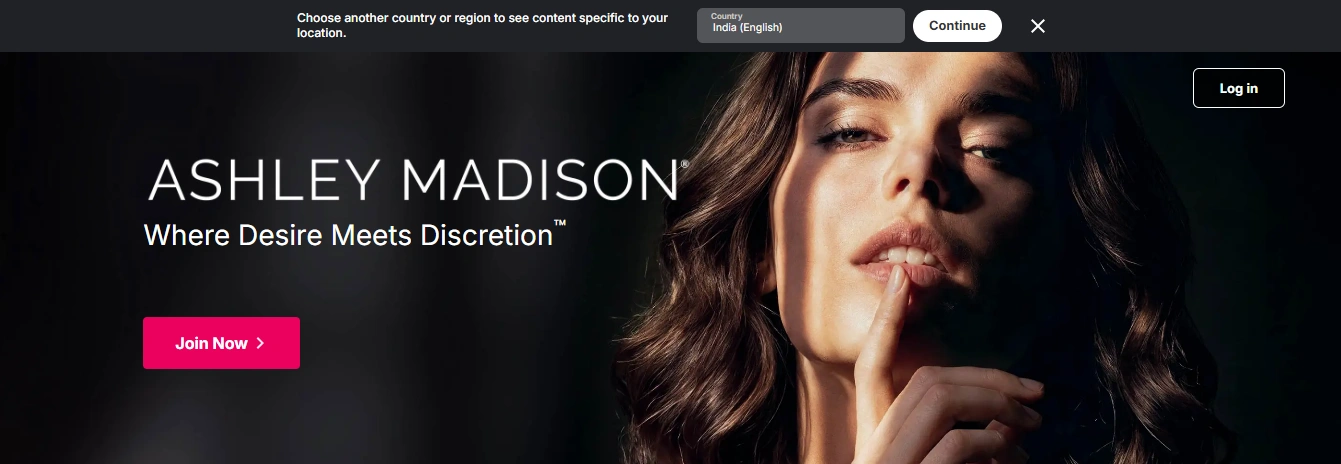 The current Ashley Madison homepage, showing its 2026 discreet-dating positioning and the tagline Where Desire Meets Discretion.
In plain terms, it is a place where adults can create a profile, browse other members, and arrange discreet relationships, with privacy tools and billing designed to keep that activity hidden. It is best understood as a discretion-first dating service rather than a mainstream app like the ones built around public profiles and swiping.
The distinction matters more than it might seem. On a mainstream dating app, the goal is usually public visibility, you want to be seen by as many potential matches as possible. Ashley Madison inverts that. The entire design assumes you want to be selective about who sees you, when, and how much, which is why features like photo blurring and private galleries sit at the center of the product rather than the edges.
It is also worth being clear about what Ashley Madison is not. It is not a free-for-all social network, it is not an escort or sex-work marketplace, and despite its reputation it does not, in its current form, market itself as a sugar-dating platform. It is a dating service whose defining promise is privacy, aimed at adults who want connections outside the conventional, public model.
A Short History of Ashley Madison
Understanding the platform means understanding its past, because its history shaped both its reputation and the way it operates today.
Ashley Madison was launched in 2001 by Canadian entrepreneur Darren Morgenstern. Its niche, people already in relationships seeking affairs, set it apart from sites like Match or eHarmony that focused on finding long-term partners.
Its most public figure was Noel Biderman, who became chief executive of parent company Avid Life Media in 2007 and served as the outspoken face of the brand, defending it in countless media interviews.
The defining event came in 2015, when the platform suffered one of the most notorious data breaches in internet history. We cover that in detail below, because it is central to what the platform became.
In the aftermath, the company restructured. In July 2016 the parent company rebranded from Avid Life Media to Ruby Corp, brought in new leadership, and invested heavily in security. The platform remains operated out of Toronto, Canada.
| Year | Milestone |
|---|---|
| 2001 | Ashley Madison launches, focused on married and attached daters |
| 2007 | Noel Biderman becomes CEO of parent company Avid Life Media |
| 2015 | The major data breach exposes millions of user records |
| 2016 | Parent company rebrands from Avid Life Media to Ruby Corp |
| 2024 | Netflix documentary revisits the breach and its fallout |
| 2026 | Ashley Madison rebrands as a discreet dating app |
Key moments in Ashley Madison's history.
That arc, from provocative affair site to breach-scarred cautionary tale to security-focused discreet dating platform, is the backstory behind everything the service is today.
A few chapters deserve a little more detail, because they explain the platform's character. In its early and middle years, Ashley Madison became famous less for its product than for its marketing.
The brand leaned hard into provocation, with billboard and television campaigns built around the affair concept, and its CEO openly embracing a controversial public persona. That guerrilla-marketing approach is a large part of why the name became a household word long before the breach.
The company also went through a notable identity shift after 2016. Beyond the corporate rename to Ruby, the brand experimented with softening its image, at one point changing its tagline away from the affair slogan before later returning to its married-dating roots, and then, in 2026, pivoting again toward a broader discreet-dating positioning. That back-and-forth reflects a company repeatedly trying to balance its notoriety against a desire for mainstream acceptance.
The 2024 Netflix documentary, which revisited the breach and its human cost, brought the story to a new audience and is part of why interest in the platform spiked again years after the original scandal.
How Popular Is Ashley Madison?
For all the controversy, Ashley Madison remains a heavily trafficked platform, which is part of why it still matters in 2026. Search-visibility data gives a sense of the scale.
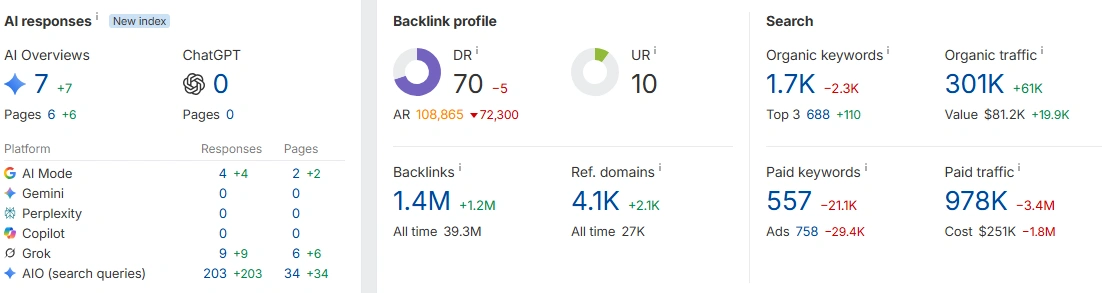 Ashley Madison's search profile in Ahrefs, including domain rating, organic traffic, and backlink data from our analysis.
Based on this Ahrefs data, the domain carries a strong domain rating of around 70 and pulls in roughly 301,000 organic visits a month, ranking for about 1,700 keywords.
Its link profile is substantial too, with more than a million backlinks from over 4,000 referring domains, which reflects how much the brand is written about across the web. For a user, the takeaway is simple. This is an established, heavily visited platform rather than a fly-by-night site, whatever you make of its purpose or its reviews.
How Does Ashley Madison Work?
The platform is built to be simple to join and private to use. The basic journey runs from a free signup through to paid communication, with privacy controls at each step.
The Ashley Madison User Flow
The typical journey on Ashley Madison, from free signup to paid interaction.
Here is what each stage involves in practice.
Signing up is free, and so is creating a profile and browsing other members. You register under a username and decide how much personal detail to reveal, which is where the anonymity begins.
The paywall arrives at communication. The platform runs on a credit system rather than a flat subscription, and men spend credits to send messages and use premium actions, while women generally use the core features for free.
Once contact is made, conversations and photo sharing happen inside the platform, with privacy features like lockable photo galleries that members grant access to by request. Additional paid features, such as priority messaging and visibility boosts, are optional.
The gender dynamic is worth understanding because it shapes the whole experience. Because women use the core features free and men pay per action, the platform deliberately tilts to attract and retain female members, which in turn is what makes it worthwhile for the paying male members.
The practical effect is that women tend to receive a high volume of interest, while men have to be selective and strategic about how they spend credits, since every message and photo-key request has a cost.
This also explains why the platform rewards effort over volume for men. On a free app, sending fifty low-effort messages costs nothing. Here, each interaction has a price, so a thoughtful profile and a targeted, genuine approach are not just good etiquette, they are the difference between credits well spent and money wasted.
Key Features of Ashley Madison
A few features define the experience and explain why the platform appeals to its specific audience. Below is the infographic-style summary, followed by detail on each.
Ashley Madison at a Glance
WHAT IT IS
- Dating platform for discreet relationships
- Focus on privacy and anonymity
- Canadian, operating globally
KEY FEATURES
- Anonymous profile creation
- Private messaging system
- Credit-based communication
- Global user base
PROS
- High privacy and discretion
- Easy, free signup
- Free for women
CONS
- Paid credits required for men
- Controversial reputation
- Costs can add up
A quick visual summary of what Ashley Madison is, its features, and its trade-offs.
Anonymous Profile Creation
You register under a username and choose how much to reveal. Photos can be blurred or masked, and most cautious members keep their face hidden, which makes the platform usable without exposing your identity.
Private Messaging System
Communication happens inside the platform rather than through outside contact details, which keeps conversations contained and moderated. For men, sending messages spends credits.
Credit-Based Communication
Instead of one subscription unlocking everything, most meaningful actions cost credits, which men buy in packages. Women generally message for free, a deliberate design to balance the gender ratio.
Photo Privacy and Private Keys
Members can lock photos into private galleries and share access by request, using what the platform calls private keys. It is one of the strongest privacy controls of any dating service.
Discreet Billing and Global Reach
Charges appear under a non-descriptive descriptor rather than the site name, and the platform operates across many countries with particularly strong user bases in North America, Western Europe, and Australia.
What Does Ashley Madison Cost?
This is where the platform earns its reputation for being expensive, so here is the clear version. There is no single subscription that unlocks everything. You buy credits, and most actions spend them.
Credit packages have been reported starting around $59 for 100 credits and rising to roughly $289 for 1,000 credits, with larger bundles lowering the per-credit price.
| Credit Package | Reported Price | Effective Value |
|---|---|---|
| Entry bundle, about 100 credits | around $59 | Highest cost per credit |
| Mid bundle | scales with size | Lower per-credit cost |
| Large bundle, about 1,000 credits | around $289 | Lowest cost per credit |
Reported credit pricing. Figures vary by region and promotion, so confirm current pricing on the platform before buying.
Two things drive the cost up, and both catch people out. Credits drain quickly because messaging and photo-key requests each cost credits, so a package can disappear in one active session.
There is also a recurring upgrade. A subscription-style add-on can renew monthly, and some users do not realize they have triggered it, so it pays to read the checkout carefully and watch your statements.
The upside is that women use the platform's core features for free, and the billing is genuinely discreet, with charges showing a generic descriptor and payment options that have included cards, PayPal, and gift cards.
The 2015 Data Breach Explained
No explanation of Ashley Madison is complete without the 2015 breach, because it is both the platform's defining scandal and the reason its security looks the way it does today.
In July 2015, a group calling itself "The Impact Team" announced it had stolen the platform's user data and threatened to release it unless the site shut down. When the company did not comply, the attackers published the personal information of tens of millions of users.
The exposed data included names, email addresses, and other identifying details, and the fallout was severe, leading to public shaming, lawsuits, extortion attempts, and reports of tragic personal consequences.
The breach also exposed an uncomfortable truth about the platform at the time. Analysis of the leaked data suggested that a very small share of the registered female accounts were actually active, raising serious questions about fake accounts.
A second controversy involved the platform's "full delete" feature, which charged users a fee to remove their data. The breach revealed that paying did not fully delete the information as promised, which became a major part of the legal fallout.
In 2017, the parent company agreed to settle lawsuits stemming from the breach for $11.2 million. Separately, a settlement with the Federal Trade Commission required the company to undergo independent security assessments every two years for the following two decades, an unusually long accountability mechanism.
After 2015, privacy became a matter of survival for the platform rather than a marketing slogan, which is why the security rebuild was genuine rather than cosmetic.
One detail captures why the breach was so damaging. At the time it happened, the company was reportedly preparing for a major public offering, and the decision not to give in to the attackers' demands, however defensible, was followed by the full release of user data thirty days later. The timing turned a security incident into an existential crisis for the business.
The lasting lesson for users is twofold. First, the breach is permanent proof that no platform holding sensitive data is invulnerable, which is a reason for caution on any such site. Second, and in fairness to the platform, the scale of the consequences is precisely why its post-breach security investment has been more serious than most competitors bother with, since the company genuinely could not survive a repeat. Both things are true at once, and an honest picture holds them together.
Is Ashley Madison Safe and Private?
Yes, far more than it was in 2015, and arguably more than most people assume, though no online service is ever perfectly secure.
Following the breach, the company rebuilt its security program. Independent reporting and the platform's own disclosures describe two-factor authentication, fully encrypted browsing over HTTPS, PCI compliance, and adoption of a recognized cybersecurity framework.
On the privacy side, the discretion tools are among the strongest in dating. You control how much you reveal, you can blur or lock photos, billing is discreet, and the platform encourages the use of aliases and minimal personal information.
The most important protections, though, are the ones in your own hands, and they apply on any platform of this kind.
| Safety Habit | Why It Matters |
|---|---|
| Use a dedicated email | Keeps the account separate from your work and personal identity. |
| Set a strong, unique password | Limits the damage if any single service is ever compromised. |
| Use photo blurring or private keys | Controls who can see your face and identifying images. |
| Share identifying details slowly | Avoid revealing your address, workplace, or full name early. |
| Confirm your billing descriptor | Some banks can override discreet labels, so check how charges appear. |
The platform provides privacy tools, but your own habits decide how protected you actually are.
What Real Users Say About Ashley Madison
Here is where an honest guide has to be direct. Ashley Madison's public review scores are mostly poor, and the picture is worth seeing in full rather than cherry-picking. The ratings vary widely by platform, and the gap between them tells its own story.
Trustpilot Reviews
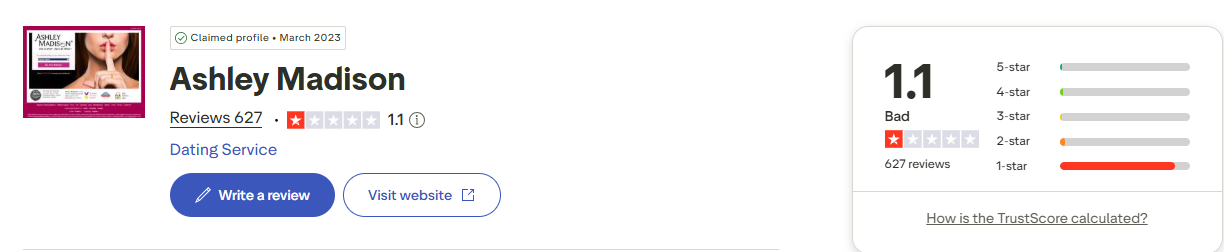 Ashley Madison's Trustpilot score, rated 1.1 out of 5 across 627 reviews.
On Trustpilot, Ashley Madison carries a low 1.1 out of 5 across more than 600 reviews, a score Trustpilot labels as bad, with the large majority being one-star. The complaints center heavily on cost and on doubts about message authenticity.
Sitejabber Reviews
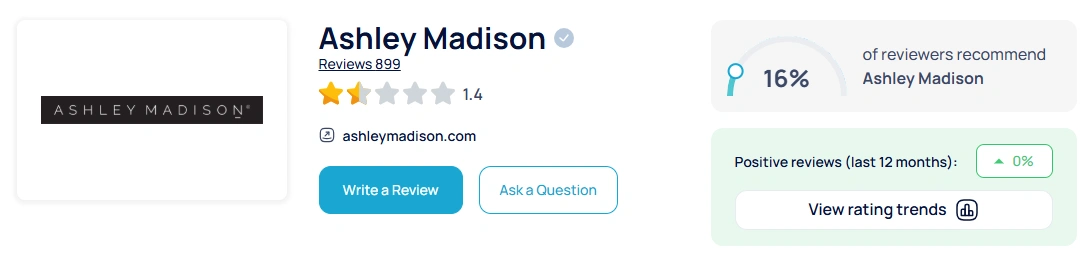 On Sitejabber, Ashley Madison scores 1.4, with only 16 percent of reviewers recommending it across 899 reviews.
Sitejabber tells a similar story, with a 1.4 rating and just 16 percent of reviewers recommending the platform. The recurring themes match Trustpilot, cost frustration and concerns about fake or templated engagement.
PissedConsumer Reviews
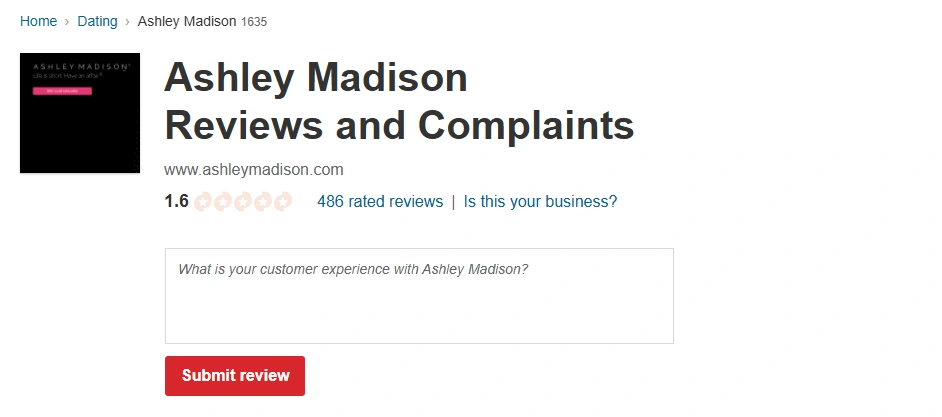 Ashley Madison's PissedConsumer profile, rated 1.6 across 486 reviews.
PissedConsumer lands at 1.6, again driven by billing and credit complaints. The consistency across these consumer-review sites is notable, since three independent platforms cluster in the same low range.
Google Play and App Store Ratings
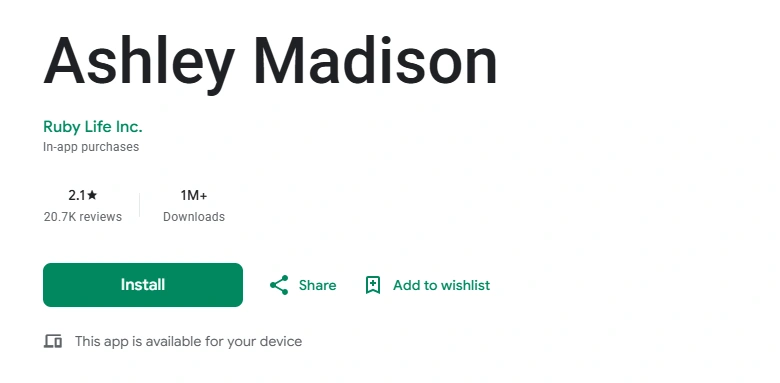 On the Google Play Store, the app rates 2.1 stars from 20.7K reviews, with over a million downloads.
The app store ratings are where it gets interesting, because they diverge sharply. On Google Play, the app sits at 2.1 stars across more than 20,000 reviews, with over a million downloads, low, but higher than the consumer-review sites.
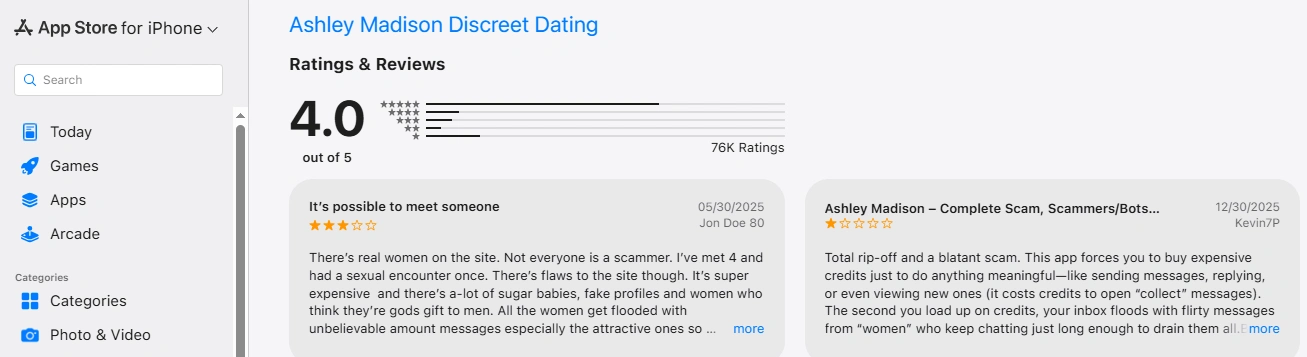 On the Apple App Store, the app rates 4.0 out of 5 across 76K ratings, the highest of any source we checked.
The Apple App Store is the outlier, with a 4.0 rating across 76,000 ratings. Even there, the written reviews are mixed, with positive notes about meeting real people sitting alongside one-star reviews calling it expensive and bot-heavy.
What the Reviews Tell Us
Put together, the honest read is that Ashley Madison's reputation among reviewers is poor to mixed, not glowing. The consumer-review sites cluster around 1.1 to 1.6, Google Play sits at 2.1, and only the Apple App Store reaches 4.0.
The complaints are remarkably consistent across every platform, and they are the same two issues. The cost adds up fast through the credit system, and many users question whether some of the engagement they pay to respond to is genuine. Going in aware of both is the single best way to avoid the frustration these reviews describe.
The Real Risks to Know
An honest overview has to cover the downsides plainly, because they are real and worth weighing before you join.
The first is privacy risk. The platform is far more secure now, but the 2015 breach is a permanent reminder that no service is immune, and the nature of this particular site makes any exposure especially sensitive.
The second is fake and misleading profiles. The company is now legally barred from using its own computer-generated profiles after the FTC settlement, but third-party scammers and catfish accounts still appear, and some users report messages that feel automated.
The third is cost. The credit system can get expensive quickly for men, and the recurring upgrade can add charges that are easy to miss, so spending needs a deliberate eye.
The fourth is ethical and personal. The platform is built around discretion and, historically, affairs, so the decision to use it carries personal and relational weight that only you can judge. We cover the facts here without making that judgment for you.
It is also worth naming a few practical risks that sit underneath the big ones. Because the platform is a known target for scammers precisely due to the sensitivity of its user base, members can be more exposed to blackmail-style approaches and phishing than on an ordinary app, which makes guarding your identity especially important.
There is also the simple risk of overspending. The combination of per-action credit costs and an opt-in recurring upgrade means it is genuinely easy to spend more than you intended, especially in the first enthusiastic days on the platform. Setting a firm budget before you buy credits, and checking your statements afterward, is the practical defense.
None of these risks make the platform illegitimate. They are the normal trade-offs of a discretion-focused, credit-based adult dating service, and the point of listing them is so you can decide with open eyes rather than be surprised later.
Who Is Ashley Madison For?
The platform suits a specific kind of user rather than the general dating market.
It fits people who specifically value discretion, including those in open relationships, polyamorous arrangements, or other consensual non-monogamous situations who want private connections.
For women, the value is straightforward, since access is free and the privacy tools are strong. For men, it can work, but it rewards those near a sizable city who will invest in a good profile and stay patient.
It is a poor fit for anyone wanting cheap, high-volume, conventional dating, since the credit costs and the discretion-first design make it slower and pricier than mainstream apps.
To make it concrete, a few profiles fit naturally. Someone in a committed but non-exclusive arrangement who needs to keep their dating life genuinely private is well served by the anonymity tools.
A woman exploring discreet connections benefits most of all, since the experience is free and the privacy controls are strong. And a man in or near a city who is willing to treat it seriously, with a complete profile and a measured approach to spending, can get real value from the targeted, like-minded audience.
Equally, some people should look elsewhere. If your budget is tight, the credit model can become frustrating fast. If you live somewhere with a thin user base, the experience thins out with it.
And if you are simply after conventional, public dating, a mainstream app will be cheaper, faster, and a better cultural fit. Matching the platform to your actual situation is the difference between a useful tool and a money pit.
How Ashley Madison Compares
Ashley Madison occupies a distinct niche, so it competes differently from mainstream apps and from flat-fee sites.
| Platform Type | Cost Model | Best For |
|---|---|---|
| Ashley Madison | Credit-based, free for women | Discreet, private connections |
| Mainstream dating apps | Mostly free with paid tiers | Open, conventional dating |
| Subscription hookup sites | Flat monthly fee | Predictable casual-dating costs |
Ashley Madison's edge is discretion and a privacy-focused user base. The trade is higher, less predictable cost than flat-fee alternatives.
Against mainstream apps, it trades lower cost and openness for privacy and a focused, like-minded audience. Against flat-fee sites, it trades predictable budgeting for purpose-built discretion tools. Which matters more depends entirely on what you need from the platform.
For a deeper, hands-on assessment of how it performs in practice, including the signup, the messaging experience, and the value question, see our full Ashley Madison Wikipedia background and then our own review for the practical view.
Frequently Asked Questions
Is Ashley Madison a real dating site?
Yes. It is a real, operational dating and social networking service that has run since 2001, with active moderation and a large user base. It is not a fake or scam site, though it does have third-party fake profiles to watch for.
Is Ashley Madison only for married people?
No, not anymore. It was historically marketed to married and attached people seeking affairs, but in 2026 it rebranded as a broader discreet dating app for anyone wanting private, non-traditional connections.
Is Ashley Madison free to use?
Yes for women, no for men. Signing up and browsing are free for everyone, but men must buy credits to message, while women generally use the core features at no cost.
Is Ashley Madison safe after the 2015 hack?
Yes, far more than it was. Since the breach the platform added two-factor authentication, full HTTPS encryption, PCI compliance, and ongoing third-party security audits required by its FTC settlement. No service is perfectly secure, so use a dedicated email and strong password.
Does Ashley Madison still use fake profiles?
No, not its own. Since the FTC settlement the company is legally barred from using computer-generated profiles to lure members, though third-party scammers and catfish accounts can still appear.
Who owns Ashley Madison?
Yes, it has a known parent company. Ashley Madison is operated by Ruby Corp, formerly called Avid Life Media, a Canadian company based in Toronto that rebranded after the 2015 breach.
Is the billing on Ashley Madison discreet?
Yes. Charges appear under a non-descriptive billing descriptor rather than the site name, and the app is designed for privacy. Some banks can override the descriptor, so confirm how yours appears.
Can you use Ashley Madison anonymously?
Yes. You register under a username, control how much you reveal, and can blur or lock your photos, so you can use the platform without publicly exposing your identity.
What was the Ashley Madison scandal about?
Yes, there was a major one, in 2015. A group called The Impact Team breached the site and released the data of tens of millions of users, leading to public fallout, lawsuits, and a later Netflix documentary.
Is Ashley Madison worth trying in 2026?
Yes, if you specifically want discretion and accept the credit-based cost. For women it is an easy yes given free access, and for men it works best with a city location, a strong profile, patience, and careful spending.
How is Ashley Madison different from Tinder or Bumble?
No, it is not the same kind of app. Tinder and Bumble are mainstream, public-facing dating apps focused on visibility and swiping, while Ashley Madison is built around discretion, anonymity, and a credit-based model for a more specific, privacy-focused audience.
Does Ashley Madison have a mobile app?
Yes. There is a free app for iOS and Android, designed with privacy in mind, and signing up and browsing are free within it, with the credit system applying to communication for men.
Can your data be deleted from Ashley Madison?
Yes, though history is relevant here. The platform offers account and data removal, but the 2015 breach famously exposed that its old paid "full delete" did not work as promised, so keep records of any deletion request and follow up to confirm it.

You must be logged in to post a comment.