

The eccentricity of our planet's orbit is mild; aphelion and perihelion differ from the mean Sun-Earth distance by less than 2%. In fact, if you drew Earth's orbit on a sheet of paper, it would be difficult to distinguish from a perfect circle. "Seasonal weather patterns are shaped primarily by the 23.5-degree tilt of our planet's spin axis, not by the mild eccentricity of Earth's orbit," notes Lebo. "During northern summer, the north most point of earth is tilted toward the Sun. Days are long and the Sun is shining more nearly straight down -- that's what makes July so warm."
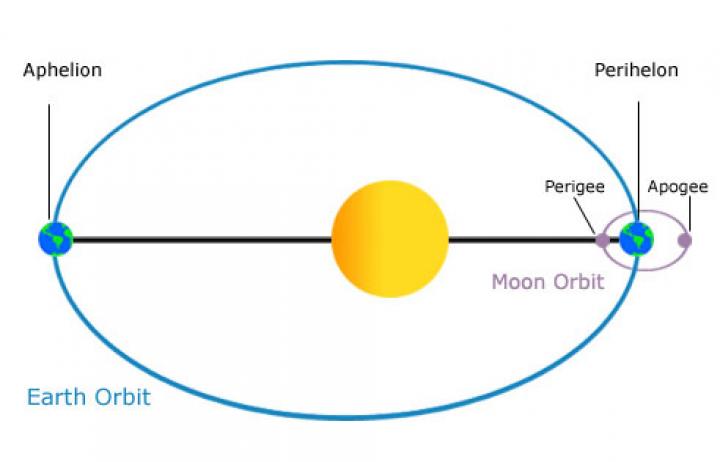
Right: Earth's orbit is eccentric, but not nearly so much as the orbits of Mars or Mercury. In this diagram, solid lines trace each planet's elliptical path around the Sun. "Like all planets in our solar system, Earth travels around the Sun in an elliptical orbit," explains astronomy professor George Lebo, a Summer Faculty Fellow at the NASA Marshall Space Flight Center. "We make our closest approach to the Sun (147.5 million km) in January, that's called perihelion, and we're farthest from the Sun (152.6 million km) in July, that's aphelion. This year, aphelion falls on Independence Day in the USA."
"Averaged over the globe, sunlight falling on Earth in July (aphelion) is indeed about 7% less intense than it is in January (perihelion)." That's the good news. The bad news is it's still hot. "In fact," says Spencer, "the average temperature of Earth at aphelion is about 4o F (2.3o C) higher than it is at perihelion." Earth is actually warmer when we're farther from the Sun!
How can that be? It's because our planet is --in a sense-- lopsided. Continents and oceans aren't distributed evenly around the globe. There's more land in the Northern Hemisphere and more water in the south. During the month of July --near the start of northern summer-- the land-crowded northern half of our planet is tilted toward the Sun. "Earth's temperature (averaged over the entire globe) is slightly higher in July because the Sun is shining down on all that land, which heats up rather easily," says Spencer.
"On the other hand," says Patzert, "oceans have a tremendous heat capacity. They tend to keep [the energy] they capture and are very stingy about giving it back." This quality moderates the temperature swings of ocean environments. "Let's say you went sailing off Malibu Beach at noon," says Patzert. "The offshore temperature might be 75o F (24o C) -- pretty pleasant!" What happens after sunset? "The temperature drops, but only a few degrees because the thermal inertia of the ocean is so high."
All this explains why July is our planet's warmest month: Northern continents baked by the aphelion Sun elevates the average temperature of the entire globe. Six months later, in January, the situation is reversed as our planet presents its water-dominated hemisphere to the Sun. "We're closer to the Sun in January," says Spencer, "but the extra sunlight gets spread throughout the oceans." Southern summer in January (perihelion) is therefore. Cooler than northern summer in July (aphelion). Strange but true!.
"Another notable difference between summers in the two hemispheres is their duration," adds Lebo. According to Kepler's 2nd Law, planets move more slowly at aphelion than they do at perihelion. As a result, Northern summer on Earth is 2 to 3 days longer than southern summer -- which gives the Sun even more time to bake the northern continents.

You must be logged in to post a comment.