
India’s telecom industry continues to expand fibre networks at an impressive pace. BharatNet has already connected over 2.15 lakh gram panchayats, with total optical fibre deployment crossing 42 lakh route kilometres by early 2026. In this massive rollout, cable makers need reliable central strength members that protect delicate glass fibres during installation and for decades afterward.
That’s where uncoated FRP rods come in. Many manufacturers now choose them as the core reinforcement in all-dielectric fibre optic cables. Let’s understand exactly what an uncoated FRP rod is and why it has become a preferred choice for telecom cable production in India.
What Is an Uncoated FRP Rod?
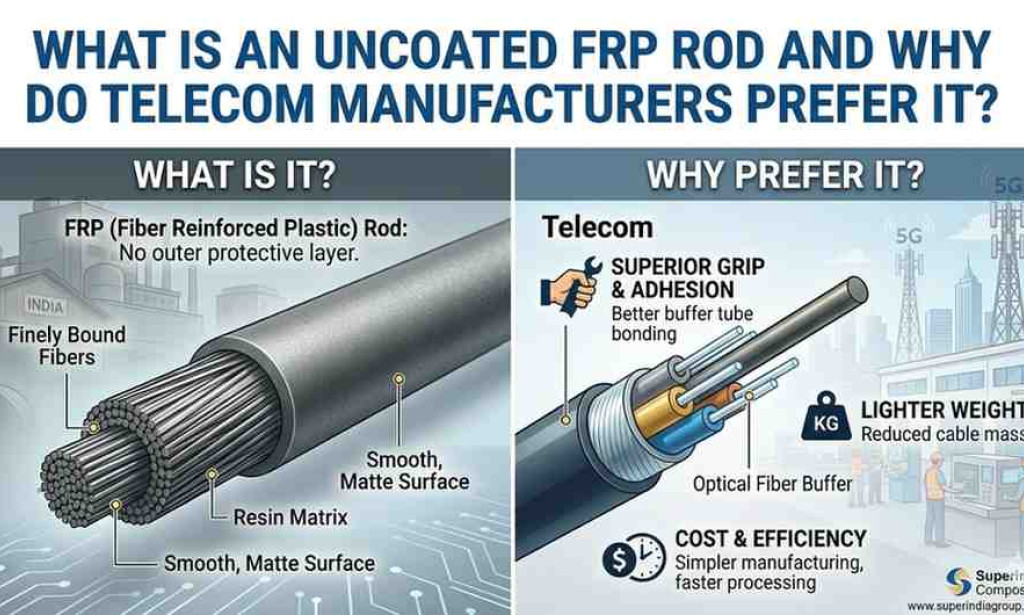
An uncoated FRP rod, also known as a bare or standard FRP rod, is a pultruded composite made from high-quality E-glass fibres embedded in a specialised resin matrix. Manufacturers pull continuous glass fibres through a resin bath and then cure them under controlled heat or UV light to form a solid, rigid rod.
“Uncoated” simply means the rod has no additional polymer layer or coating applied to its surface after pultrusion. It comes with a smooth, natural finish from the manufacturing process. These rods typically range in diameter from 0.4 mm to 4 mm or slightly more, depending on the cable design. They serve primarily as the central strength member (CSM) in loose-tube, uni-tube, slotted-core, or ribbon-type optical fibre cables.
The rod sits right in the middle of the cable, surrounded by the optical fibre tubes. Its job is straightforward but critical: provide high tensile strength during cable pulling and laying, prevent buckling or sagging, and maintain dimensional stability so the delicate fibres stay protected over the cable’s 20–30 year lifespan.
How Uncoated FRP Rods Differ from Coated Versions
Telecom makers produce two main types: uncoated and coated FRP rods.
Uncoated rods offer a clean, smooth surface without any extra layer. Cable manufacturers use them mainly as central strength members where the rod does not need strong chemical bonding with the outer jacket.
Coated rods receive an additional thin polymer layer during or after pultrusion. This coating improves adhesion to the cable’s sheathing material and sometimes enhances bending performance. Manufacturers place coated rods more often as peripheral strength members around the cable core.
Both types deliver similar core mechanical properties—high tensile strength (often exceeding 1500 N/mm²), low weight, and excellent corrosion resistance. The choice depends on the exact cable construction and where the rod sits inside the design.
Key Properties That Make Uncoated FRP Rods Stand Out
Uncoated FRP rods combine several practical advantages that directly help cable manufacturers and network operators.
They deliver outstanding tensile strength while weighing only about one-fourth as much as steel. This light weight reduces transportation costs and makes installation easier, especially in long rural aerial or duct routes common in India.
The material is fully dielectric and non-conductive. It eliminates risks from electromagnetic interference and lightning strikes—important in a country with frequent thunderstorms and mixed power-telecom infrastructure.
Uncoated rods resist corrosion, moisture, salt air, and temperature swings extremely well. In coastal areas or humid rural zones, they maintain performance without the degradation that affects metal reinforcements over time.
They also provide excellent dimensional stability. The rod stays rigid enough to stop cable buckling but handles installation bends without damaging the fibres inside.
Long, continuous splice-free lengths improve manufacturing productivity. Cable lines run smoother with fewer joints, which means faster production and more consistent quality.
Why Telecom Manufacturers Prefer Uncoated FRP Rods
Several real-world reasons drive the growing preference for uncoated versions in Indian cable factories.
Cost-effectiveness Uncoated rods cost less to produce than coated ones. For central strength member applications, the extra coating adds unnecessary expense when strong adhesion to the jacket is not required. Manufacturers pass on these savings while still delivering top performance.
Simpler integration in all-dielectric designs Many modern fibre cables aim for fully non-metallic construction to meet safety and performance standards. An uncoated FRP rod fits perfectly here. It keeps the cable lightweight, corrosion-free, and free from any metallic components that could cause issues.
Reliable performance in Indian conditions Rural BharatNet routes and urban FTTH deployments face dust, heavy rains, high humidity, and temperature extremes. Uncoated FRP rods handle these challenges without rusting or losing strength. Their hydrophobic nature and low water absorption help the cable stay stable even if minor moisture enters during installation.
High productivity on production lines The smooth surface and tight diameter tolerance (±0.05 mm in many cases) allow smooth stranding and jacketing. Cable makers achieve consistent output with fewer defects, which matters when producing thousands of kilometres of cable.
Proven long-term durability Once inside the finished cable, the uncoated rod needs no extra surface protection. The outer cable jacket already shields it. Decades of field use worldwide show that properly made FRP rods maintain their mechanical properties far longer than traditional steel wires.
Indian producers have invested in modern pultrusion lines with advanced quality controls, including AI-based vision systems in some plants. This ensures consistent quality that meets or exceeds international telecom standards.
Real-World Benefits for Network Deployment
Teams installing cables reinforced with uncoated FRP rods notice practical gains. Aerial cables sag less because the rod provides excellent stiffness-to-weight performance. Installers pull longer continuous lengths with lower tension on the fibres. In ducts, the lightweight construction reduces friction and installation effort.
Maintenance teams benefit too. With no corrosion worries, cables require far fewer repairs years after deployment. This lowers the total cost of ownership for operators rolling out large-scale networks.
As India pushes towards deeper rural connectivity and prepares for future 6G demands, reliable, low-maintenance infrastructure becomes essential. Uncoated FRP rods support exactly that goal.
Things to Consider When Choosing Uncoated FRP Rods
Not every application suits an uncoated rod. If your cable design requires strong bonding between the strength member and the outer jacket, a coated version might work better. Very high-compression or special bending requirements could also need custom specifications.
Always source from established manufacturers who control raw material quality, fibre alignment, and resin formulation. Look for consistent tensile strength, tight diameter control, and proper elongation properties. Reputable Indian producers now supply both domestic cable makers and export markets, proving the local quality standard.
The Bigger Picture for Indian Telecom
The shift to FRP rods reflects a smarter approach to building nationwide fibre networks. Manufacturers balance performance, cost, and longevity by choosing the right reinforcement for each cable type. Uncoated FRP rods play a key role in this mix delivering reliable central strength without unnecessary extras.
For cable producers, this means efficient manufacturing and competitive pricing. For operators and end users, it means faster deployments and networks that keep working reliably through India’s challenging environments.
Conclusion
An uncoated FRP rod is a simple yet highly effective component: a pultruded glass-fibre composite that gives optical fibre cables the mechanical backbone they need. Telecom manufacturers prefer it for its excellent strength-to-weight ratio, corrosion resistance, cost efficiency, and seamless fit in all-dielectric cable designs.
As India continues expanding its digital infrastructure, materials like uncoated FRP rods help deliver networks that are lighter, stronger, and built to last. Choosing the right strength member today ensures cables perform flawlessly for decades ahead.
Frequently Asked Questions
What does “uncoated” mean for an FRP rod?
It means the rod has no additional polymer coating on its surface after pultrusion. It retains the natural smooth finish from the manufacturing process and works well as a central strength member.
How strong is an uncoated FRP rod compared to steel?
FRP rods offer tensile strength often above 1500 N/mm² while weighing only about one-fourth as much as steel. They provide comparable or better performance in many cable applications with far less weight.
Can uncoated FRP rods handle India’s weather conditions?
Yes. They resist moisture, salt, heat, and UV exposure effectively. Their non-corrosive nature makes them ideal for both aerial and underground cables in diverse Indian climates.
When should manufacturers choose coated FRP rods instead?
Coated rods are better when the design needs strong adhesion between the rod and the cable jacket, or when the rod serves as a peripheral strength member.
Are uncoated FRP rods widely available in India?
Yes. Several quality-focused manufacturers produce consistent, telecom-grade uncoated rods in volume. Local production supports fast delivery and competitive pricing for domestic cable makers.

You must be logged in to post a comment.