
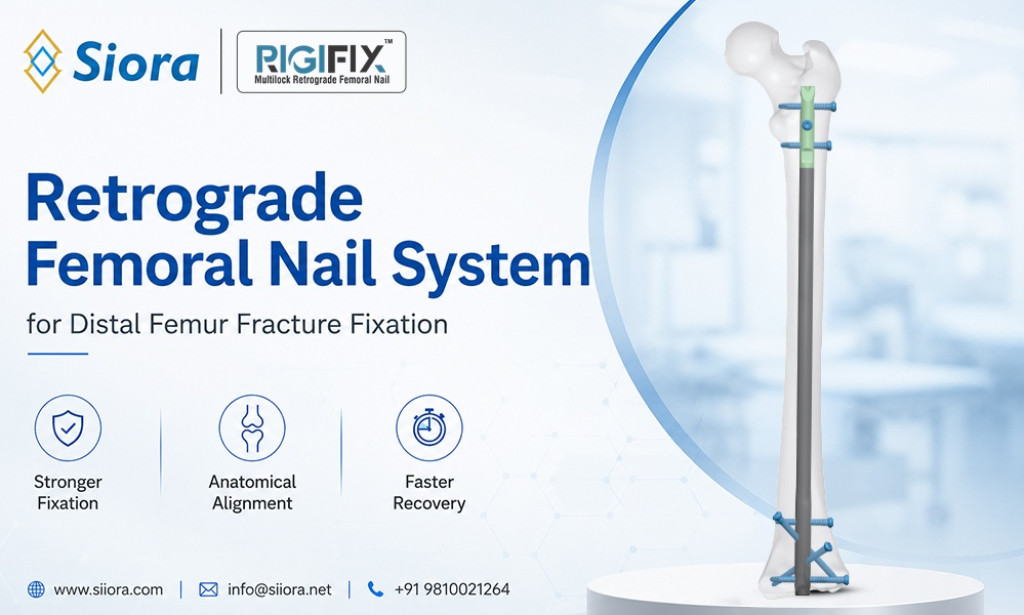
Distal femur fractures account for a small percentage of all femoral fractures, yet they present significant challenges to orthopedic surgeons due to their complex anatomy and proximity to the knee joint. These fractures commonly occur in elderly patients with osteoporotic bones following low-energy falls, while younger individuals often sustain them as a result of high-energy trauma such as road accidents or sports injuries. Achieving stable fixation while preserving surrounding soft tissues is essential for successful recovery. Among the available treatment options, the retrograde femoral nail system has emerged as a reliable and widely accepted solution for distal femur fracture fixation.
Understanding the Retrograde Femoral Nail System
A retrograde femoral nail is an intramedullary device inserted through the intercondylar notch of the femur, just above the knee joint. Unlike antegrade nails, which are introduced from the hip region, retrograde nails are inserted from the distal end of the femur and advanced proximally through the medullary canal.
The system typically consists of a titanium or stainless-steel nail, locking screws, and dedicated instrumentation designed to provide stable internal fixation. The design allows surgeons to stabilize fractures while maintaining proper alignment and minimizing surgical trauma.
Indications for Retrograde Femoral Nailing
Retrograde femoral nailing is particularly beneficial in the following situations:
-
Extra-articular and certain intra-articular distal femur fractures
-
Periprosthetic fractures around total knee replacements with an open femoral box
-
Femoral shaft fractures associated with distal femoral injuries
-
Polytrauma patients requiring rapid stabilization
-
Obese patients where proximal femoral access may be difficult
-
Patients with ipsilateral pelvic, hip, or acetabular injuries
Proper patient selection and thorough preoperative planning are crucial to achieving favorable clinical outcomes.
Surgical Technique Overview
The procedure is generally performed under fluoroscopic guidance. After appropriate anesthesia and patient positioning, a small incision is made near the patellar tendon. The entry point is carefully established in the intercondylar notch of the distal femur.
Following guidewire placement, sequential reaming may be performed depending on the surgical approach. The selected nail is then inserted retrogradely into the femoral canal. Distal and proximal locking screws are placed to secure the construct and prevent rotational or axial instability.
Modern retrograde nail systems offer multiple locking options, enabling surgeons to address various fracture patterns effectively.
Advantages of Retrograde Femoral Nail Fixation
Minimally Invasive Approach
One of the major advantages of retrograde nailing is its minimally invasive nature. Smaller incisions and limited soft tissue disruption help preserve the fracture biology and reduce postoperative complications.
Enhanced Stability
Contemporary retrograde nail systems provide angular stability through multiple locking configurations. This feature is particularly valuable in osteoporotic bone and comminuted fractures.
Early Mobilization
Stable fixation allows patients to begin knee mobilization and rehabilitation earlier. Early movement helps minimize joint stiffness, muscle wasting, and other complications associated with prolonged immobilization.
Reduced Blood Loss
Compared with traditional open plating procedures, retrograde nailing generally results in lower intraoperative blood loss and shorter operative times.
Potential Complications
Although retrograde femoral nailing offers several benefits, complications may occasionally occur. These include:
-
Knee pain or stiffness
-
Malalignment
-
Infection
-
Implant failure
-
Delayed union or nonunion
-
Hardware irritation
Meticulous surgical technique, accurate implant positioning, and adherence to postoperative rehabilitation protocols significantly reduce the risk of such complications.
Rehabilitation and Recovery
Postoperative rehabilitation plays a vital role in restoring function. Physiotherapy is typically initiated soon after surgery, focusing on knee range-of-motion exercises, muscle strengthening, and gradual weight-bearing as advised by the treating surgeon.
Recovery duration varies depending on fracture severity, patient age, bone quality, and associated injuries. Regular follow-up examinations and radiographic assessments help monitor fracture healing and guide rehabilitation progression.
Conclusion
The retrograde femoral nail system has become an indispensable tool for managing distal femur fractures. Its minimally invasive approach, biomechanical stability, and ability to facilitate early mobilization make it a preferred choice for many orthopedic surgeons. When combined with proper patient selection, precise surgical execution, and structured rehabilitation, retrograde femoral nailing can lead to excellent functional and radiological outcomes.
Explore the advanced RIGIFIX retrograde nailing system by Siora Surgicals Pvt. Ltd. and other trauma implant solutions at the prestigious SAOA conference 2026 by the South African Orthopaedic Association.

You must be logged in to post a comment.