
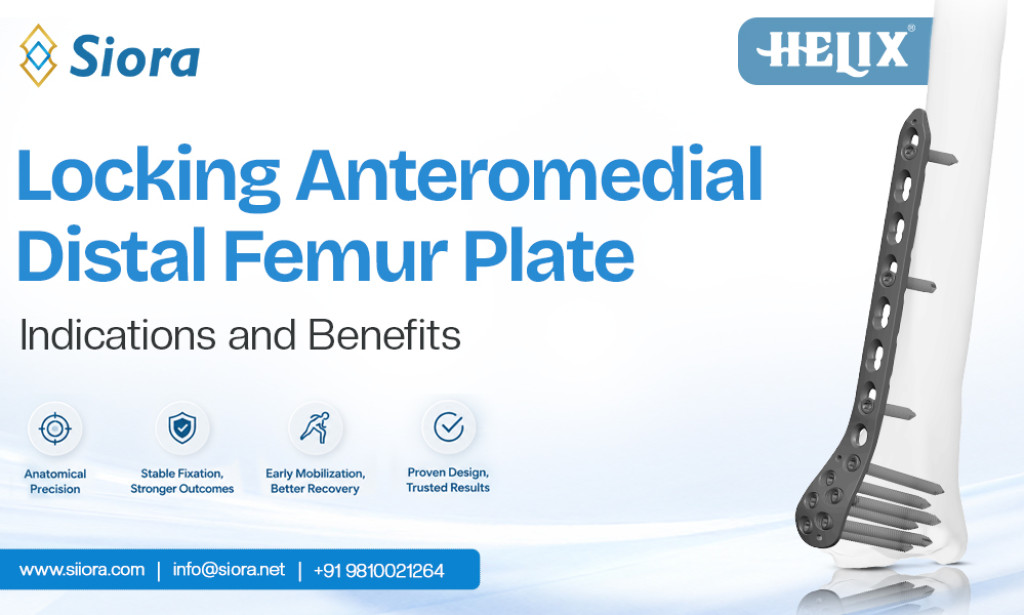
Fractures involving the distal femur can be difficult to manage because of the complex anatomy of the knee region and the significant forces acting across the lower limb. Successful treatment requires stable fixation, allowing early mobilization and maintaining proper alignment of the fractured bone. Over the years, advancements in orthopedic implant technology have led to the development of specialized fixation systems, among which the Locking Anteromedial Distal Femur Plate has gained considerable importance.
Designed specifically for fractures occurring in the distal segment of the femur, this implant provides reliable fixation, particularly in challenging clinical situations where conventional plating techniques may not be sufficient.
What is a Locking Anteromedial Distal Femur Plate?
A Locking Anteromedial Distal Femur Plate is an anatomically contoured orthopedic implant used to stabilize fractures occurring in the distal femur. Positioned along the anteromedial aspect of the femur, the plate accommodates the natural shape of the bone and allows surgeons to achieve secure fixation using locking screws.
Unlike traditional plates, locking systems create a fixed-angle construct between the screw and the plate. This feature enhances stability and minimizes the risk of screw loosening, especially in patients with poor bone quality.
Indications for Using a Locking Anteromedial Distal Femur Plate
The implant is recommended in a variety of clinical scenarios where stable fixation is essential.
Distal Femur Fractures
One of the primary indications is the treatment of distal femoral fractures, particularly fractures involving the medial condyle or those extending into the metaphyseal region.
Medial Condyle Fractures
Isolated fractures of the medial femoral condyle often require strong buttressing support. The anteromedial plate serves this purpose effectively by resisting medial collapse and maintaining anatomical reduction.
Periprosthetic Fractures
Fractures occurring around existing knee prostheses can be difficult to treat because of limited bone stock. Locking plate technology offers enhanced fixation in such cases and helps preserve implant stability.
Osteoporotic Bone
Patients with osteoporosis frequently present challenges due to reduced bone density. Locking screws provide improved purchase in weak bone, making this plate a suitable option for elderly individuals.
Nonunion and Malunion Cases
The implant may also be utilized during revision procedures for delayed union, nonunion, or malunion of distal femoral fractures where additional stability is required.
Key Benefits of the Locking Anteromedial Distal Femur Plate
Superior Mechanical Stability
The locking mechanism between the plate and screws creates a fixed-angle construct. This design distributes forces more evenly and minimizes the likelihood of fixation failure.
Preservation of Blood Supply
Modern locking plates are designed to reduce excessive compression between the plate and the bone surface. As a result, periosteal blood circulation is better preserved, promoting biological healing.
Enhanced Fixation in Poor-Quality Bone
Conventional screws may loosen in osteoporotic bone. Locking screws, however, remain firmly engaged with the plate, providing dependable fixation even when bone quality is compromised.
Reduced Risk of Loss of Reduction
Maintaining fracture alignment throughout the healing period is critical. The rigid construct offered by locking plates decreases the chances of secondary displacement or collapse.
Anatomical Fit
The plate is pre-contoured to match the natural anatomy of the distal femur. This reduces intraoperative bending requirements and helps surgeons achieve accurate placement.
Early Mobilization
Stable fixation often allows patients to begin controlled knee movements earlier in the rehabilitation process. This contributes to better joint function and reduces the risk of postoperative stiffness.
Surgical Considerations
Successful outcomes depend not only on implant selection but also on meticulous surgical technique. Proper fracture reduction, accurate plate positioning, and careful soft tissue handling remain essential. Patient-specific factors such as age, bone quality, fracture pattern, and overall health should always be considered during treatment planning.
Conclusion
The Locking Anteromedial Distal Femur Plate has become an important solution for managing complex distal femoral fractures. Its ability to provide stable fixation, particularly in osteoporotic bone and difficult fracture patterns, makes it a valuable tool in modern orthopedic trauma surgery. By combining anatomical design with advanced locking technology, this trauma implant supports fracture healing, facilitates early rehabilitation, and contributes to improved clinical outcomes.

You must be logged in to post a comment.