
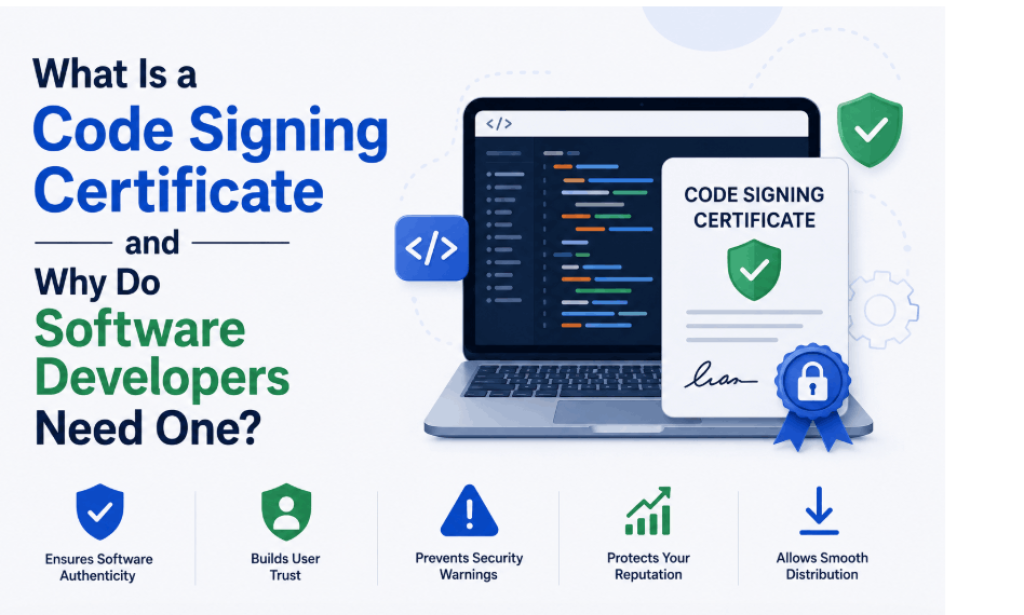
What Is a Code Signing Certificate and Why Do Software Developers Need One?
When users download software, one question often comes to mind:
"Can I trust this file?"
Cybercriminals frequently disguise malware as legitimate software. As a result, users have become more cautious about downloading applications, browser extensions, mobile apps, and executable files.
A code signing certificate helps solve this problem.
It allows software developers to digitally sign their code and prove that the software comes from a verified publisher. It also helps users confirm that the file has not been modified after it was signed.
For software companies, a code signing certificate is an important tool for building trust and protecting their applications.
What Is a Code Signing Certificate?
A code signing certificate is a digital certificate used to sign software, scripts, applications, and executable files.
The certificate creates a digital signature that verifies two important things:
-
The identity of the software publisher
-
The integrity of the software
When users download signed software, their operating system can verify that the application was published by the stated developer and has not been altered since signing.
This helps users feel more confident when installing software.
How Does Code Signing Work?
Code signing uses cryptographic technology.
When a developer signs an application, a unique digital fingerprint is created.
This fingerprint is linked to the software file.
If someone changes even a small part of the file after signing, the fingerprint changes and the signature becomes invalid.
As a result, users and operating systems can detect whether a file has been tampered with.
Why Is Code Signing Important?
Software security is more important than ever.
Users regularly download applications from websites, app stores, and software repositories. Without a way to verify software authenticity, attackers can distribute malicious files disguised as legitimate programs.
Code signing helps reduce this risk.
It provides proof that the software originated from a verified publisher.
Builds User Trust
People are more likely to install software when they know who created it.
Unsigned software often triggers warnings that make users hesitate.
A signed application appears more trustworthy because it includes verified publisher information.
This can improve download and installation rates.
Protects Software Integrity
A code signing certificate helps protect software from unauthorized changes.
If an attacker modifies the application after it has been signed, the digital signature will no longer match.
This allows users and systems to identify potential tampering.
Reduces Security Warnings
Modern operating systems use security mechanisms to protect users.
Unsigned software may trigger warning messages that discourage installations.
Code signing helps establish software legitimacy and can reduce trust-related alerts.
This creates a smoother experience for users.
Who Needs a Code Signing Certificate?
A code signing certificate is useful for:
-
Software developers
-
SaaS companies
-
Mobile app developers
-
Independent software vendors
-
Enterprise software providers
-
Game developers
-
Browser extension developers
Any organization that distributes software can benefit from code signing.
Types of Code Signing Certificates
There are two common types.
Standard Code Signing Certificate
This certificate verifies the publisher's identity and allows developers to sign software.
It is suitable for most software development projects.
Extended Validation Code Signing Certificate
An Extended Validation certificate requires a more rigorous verification process.
It provides a higher level of publisher validation and is often preferred by larger software companies.
What Can Be Signed?
Code signing certificates can be used to sign:
-
Windows applications
-
Executable files
-
Drivers
-
Mobile applications
-
Scripts
-
Browser extensions
-
Software updates
This helps ensure authenticity across many types of software distribution.
What Happens Without Code Signing?
Without code signing, users have no easy way to verify the source of a file.
This can create several problems:
-
Reduced user trust
-
More installation warnings
-
Lower download conversion rates
-
Increased risk of software impersonation
For businesses that distribute software, these issues can affect growth and reputation.
Code Signing and Software Security
Code signing is not a replacement for secure development practices.
However, it is an important layer of protection.
When combined with secure coding, vulnerability testing, and software updates, code signing helps create a safer environment for users.
It also demonstrates that a software publisher takes security seriously.
Final Thoughts
A code signing certificate helps software developers prove their identity and protect the integrity of their applications.
It builds trust, reduces security concerns, and gives users confidence when downloading software.
As cyber threats continue to evolve, users expect software publishers to provide stronger security measures.
Code signing is one of the simplest and most effective ways to meet those expectations.
For any business or developer distributing software, a code signing certificate is no longer just a security feature.
It is a trust signal that can directly influence user confidence and software adoption.

You must be logged in to post a comment.