
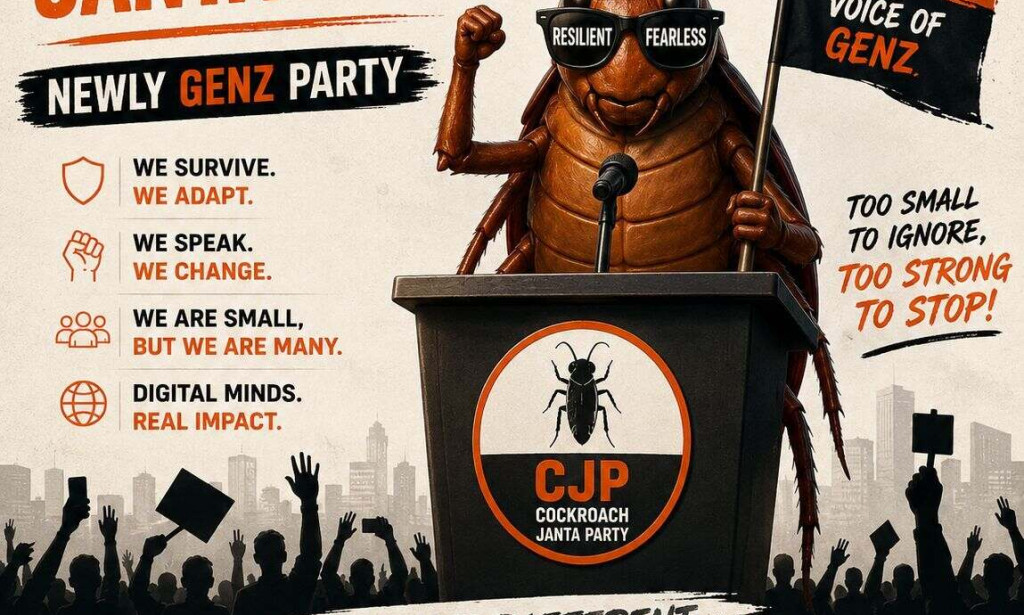
Cockroach Janta Party is not a conventional political party that grew through ground workers, rallies, or decades of organizational building. It is a satirical online campaign that, according to recent reporting, was launched by Abhijeet Dipke on May 16, 2026, after controversial remarks attributed to the Chief Justice of India about unemployed youth and social media users sparked anger online. In just a few days, the account grew at extraordinary speed, with India Today reporting that it crossed 10 million Instagram followers in five days, while LiveMint reported 12.3 million followers and described the campaign as a tongue-in-cheek play on the ruling party’s name.
That speed matters. It shows that the movement did not become visible because of a traditional political machine. It became visible because the internet recognized something emotionally sharp in it: a mix of irony, anger, humor, and youth identity.
In a country where political attention is often assumed to come from rallies and long-form speeches, this campaign demonstrated that a meme-fueled format can gather mass attention in days, not years. That is not just a social media story; it is a cultural shift.
Why the name became instantly memorable?
The name “Cockroach Janta Party” works because it is unusual, slightly absurd, and impossible to ignore. Internet culture rewards names that trigger curiosity first and understanding later. A phrase like this makes people pause, click, share, and ask questions. The irony is part of the appeal: something that sounds humorous on the surface is carrying a serious social message underneath. That combination is exactly what makes a trend feel alive online rather than polished and forgettable.
The name also contains built-in symbolism. “Janta” suggests a people’s movement, while “cockroach” suggests survival under pressure. Put together, the phrase communicates a kind of sarcastic resilience: a generation that may be mocked, underestimated, or dismissed, but is still here, still active, and still capable of organizing attention. In the age of social media, attention is power. A strange name can become a political weapon if it catches the public imagination fast enough. That is what appears to have happened here.
The real reason Gen Z connected with it
To understand why the movement spread so quickly, it helps to look at how Gen Z actually behaves online. Google’s India-focused research says 79% of Gen Z consumers in India report using Google and/or YouTube daily, and that YouTube is their top video platform. The same source says Gen Z values authenticity and transparency, and that they are active search users rather than passive consumers. Ipsos’ India digital marketing report similarly says Gen Z and young millennials are reshaping digital behavior through high engagement on social media, streaming platforms, and e-commerce, with content consumed predominantly through short-form videos, memes, and live streams.
That matters because the movement is not just “about politics.” It is about communication style. Gen Z tends to process serious issues through short-form, emotionally coded, visually fast content. A meme, a reel, a caption, or a satirical page can carry more emotional truth for them than a formal speech or a newspaper column. The Cockroach Janta Party tapped into that instinct immediately. It felt native to the platforms where young audiences already live.
Social media as the new public square
Older political movements were built in public spaces. This one was built in feeds. That distinction is not cosmetic; it changes everything. Social platforms reward content that creates reaction, and the Cockroach Janta Party was designed in a language that naturally triggers reaction: humor, irritation, sarcasm, identification, and debate. India Today reported that the campaign spread through “sarcasm, reels, and viral rage,” and that it crossed millions of followers in a remarkably short time. That is the logic of platform-native politics: the platform does not just distribute the message; it shapes the message itself.
Google’s India research also notes that Gen Z does not just scroll; they search, discover, evaluate, and trust creators who feel authentic. In other words, they are not merely consuming content. They are building judgment through content. A satirical movement like Cockroach Janta Party works because it feels like a community signal rather than a campaign ad. It says, “We understand the joke, and we understand the frustration behind it.” That is a powerful kind of belonging.
From meme to movement: how the idea spread
Every viral movement follows a process, and Cockroach Janta Party appears to have moved through a very clear sequence. First came the trigger: public remarks that many young people felt were insulting or dismissive. Then came the symbolic response: a satirical identity that converted anger into a shareable form. Then came the amplification stage, where creators, influencers, political voices, and ordinary users all began repeating and reinterpreting the idea. India Today reported that supporters included YouTubers, activist-lawyers, and political figures, while LiveMint reported registrations and the growth of the Instagram account.
That sequence is important because it reveals how internet movements become larger than the original joke. They start with a sharp reaction, but they continue because people begin to project their own grievances into the same symbol. For one person, it is about unemployment. For another, it is about dignity. For another, it is about being told that young people are lazy when they feel overworked and underpaid. The movement works because it is not limited to one complaint. It becomes a container for many complaints at once. That is why it scales.
Why this speaks to youth frustration in India?
India’s digital youth are not short on energy; they are short on certainty. The tension around jobs, educational pressure, paper leaks, cost of living, and social expectations has made many young people feel trapped between high ambition and unstable reality. India Today reported that the campaign evolved into a digital movement tapping into frustrations around unemployment, exam paper leaks, political accountability, and a disconnect between institutions and Gen Z concerns. That is a key clue: the movement was not only a response to one comment. It was a response to a much larger mood.
Ipsos’ India report reinforces that this generation is shaping digital culture through high engagement and a preference for fast, visual formats. When such a generation feels unheard, it does not wait silently for a formal invitation to speak. It creates one. The Cockroach Janta Party is a perfect example of that behavior. It is what happens when a generation that is already fluent in internet language decides to turn that language into a political gesture.
The deeper symbolism of “cockroach”
The word “cockroach” is doing far more work here than people may notice at first glance. In ordinary conversation, it is usually used as an insult or a sign of disgust. But online, Gen Z often reclaims language by turning shame into irony. By embracing a word that was meant to degrade, the movement converts humiliation into identity. That is a classic internet move: taking a negative label and using it as a badge of stubborn survival.
There is also a psychological layer to this symbolism. Cockroaches are associated with persistence, adaptation, and the ability to survive difficult environments. That is exactly how many young people experience adulthood today. They feel they are living in a world that keeps changing the rules while still demanding success, stability, and perfect behavior. So when the metaphor appears, it lands emotionally. It says, “We are not glamorous, but we are surviving.” That message is funny, but it is also deeply human.
How satire is replacing old-style activism online?
Political memes have become a recognized form of online expression. Research published in 2023 found that political memes are a common way for people to be exposed to political content and express political views online, while a 2025 Indian study on meme culture and political communication argues that memes now play a significant role in youth engagement, persuasion, and the interpretation of political issues. In other words, the format is no longer marginal. It is part of the communication system itself.
That helps explain why a satirical movement like Cockroach Janta Party can feel more persuasive to young users than a traditional political statement. Memes are fast, symbolic, and easy to remix. They allow people to participate without needing to join a formal structure. A like, share, repost, or comment becomes a small act of belonging. For digital natives, that matters. Their political identity is often built through micro-participation rather than big institutional commitment.
What the party reveals about political communication?
The rise of Cockroach Janta Party reveals a simple but important truth: political communication is no longer controlled only by institutions. It is increasingly shaped by creators, audiences, and algorithms. India Today reported that the campaign outpaced major political parties on Instagram in follower growth, while LiveMint noted that its X account was withheld in India and that its Instagram following still surged. Whether one views this as a joke, a protest, or a brand experiment, the communication lesson is clear: narrative speed now matters as much as narrative control.
The role of creators, influencers, and online communities
One reason the movement accelerated so quickly is that it did not stay inside one account. India Today reported that politicians, YouTubers, and other high-visibility online voices publicly engaged with the idea, while reports also described the emergence of unofficial “state units” and broader community participation online. That is how digital movements mature: they start as a post, then become a conversation, then become a network of people who want to attach themselves to the symbol.
This also shows how much influence creators now have in framing political feeling. A creator does not need to formally endorse a platform to amplify its emotional message. By commenting, sharing, remixing, or joking about it, they help translate it into the language their audience already understands. That translation function is crucial. Without it, many internet-born movements would remain isolated jokes. With it, they become social events.
Why this is not just a joke?
It would be easy to dismiss Cockroach Janta Party as just another fleeting meme. But that would miss the larger pattern. Memes can be playful while still carrying genuine social energy. In fact, humor often lowers the barrier to participation, which is why serious feelings can move faster when they are wrapped in satire. The speed of this campaign, its scale, and the nature of the response all suggest that people were not only entertained; they were emotionally activated.
The movement matters because it shows how young people test the boundaries of public speech. When they believe they are being spoken about unfairly, they respond not only with disagreement but with design: a name, a page, a symbol, a community, a message. That is a sophisticated form of participation. It is not random chaos. It is digital meaning-making.
The criticism and the limits of viral movements
Still, not every viral movement produces lasting structural change. One of the biggest criticisms of meme-based politics is that it can create attention without accountability. Viral fame can be mistaken for political power, but the two are not the same. India Today itself noted that online followers are very different from formal party membership, and that this distinction matters if the movement wants to become something more than a surge of attention. That is an important caution.
There is also the risk of reduction. When complex issues like unemployment, institutional trust, or exam leaks are compressed into jokes, some nuance may be lost. Memes can begin conversations, but they cannot by themselves solve policy problems. The strongest digital movements are the ones that use humor as an entry point, then move into organized discussion. If Cockroach Janta Party remains only a viral punchline, it may fade. If it turns that attention into sustained civic pressure, it could become something more durable.
What happens after the trend?
The next phase of a movement like this depends on whether it can evolve from emotional reaction into cultural structure. That may mean community building, issue-based campaigns, consistent messaging, or even offline engagement. LiveMint reported registrations and manifesto-style demands, suggesting that the project already has ambitions beyond humor alone. India Today also reported discussion around demands such as employment rights and accountability issues being raised in the movement’s orbit. Those are signs that the idea may be trying to move from satire toward agenda-setting.
If that happens, Cockroach Janta Party could become a template. Not necessarily as a literal political party, but as a model for how young people package grievance in a language that is native to digital platforms. The future of youth mobilization may not look like old politics at all. It may look like a hybrid of meme, identity, commentary, and cause. This movement is one of the clearest examples of that transition.
Conclusion
Cockroach Janta Party is more than a trending phrase. It is a snapshot of how Gen Z turns frustration into language, language into community, and community into public pressure. The phrase spread because it was funny. It endured because it was honest. It resonated because it captured the emotional texture of a generation that feels under pressure but not defeated.
What makes this moment important is not just the follower count or the viral posts. It is the fact that a satirical online identity could become a lens for discussing youth unemployment, institutional respect, digital culture, and political expression all at once. That tells us something powerful about the present: the internet is no longer just where young people pass time. It is where they build meaning, resistance, and voice. Cockroach Janta Party is one of the clearest examples of that new reality.
FAQs
1. What is Cockroach Janta Party?
It is a satirical, internet-born Gen Z movement that emerged online as a response to remarks reported in the media about youth and unemployment. It became known for its humorous name, fast follower growth, and strong social media presence.
2. Is Cockroach Janta Party a real political party?
It is better understood as a digital movement or satirical political campaign rather than a conventional registered party. Reporting describes it as an online movement with manifesto-style demands and strong social media engagement.
3. Why did it become so popular so quickly?
Because it combined humor, anger, identity, and a highly shareable internet format. It spread through reels, sarcasm, creator participation, and platform-native virality.
4. Why does Gen Z connect with it?
Gen Z in India is highly active on Google, YouTube, and social media, and prefers authentic, short-form, visual content. The movement fits that communication style and reflects youth frustration in a relatable way.
5. What does the cockroach symbol mean?
It represents survival, resilience, and adaptation under pressure. In this context, the word is used ironically to turn a negative label into a sign of persistence.
6. Can a meme-based movement create real change?
Yes, it can shape conversation, attention, and public awareness. But long-term change usually requires organization, sustained participation, and clear goals beyond viral momentum.
7. What does this trend say about the future of politics?
It suggests that younger audiences increasingly respond to political ideas through satire, creators, and social platforms rather than only through traditional institutions. That makes digital communication a major force in modern political culture.

You must be logged in to post a comment.