

A cloudburst can suddenly dump 72,300 tons of water over one square acre. This is quite a wallop, and luckily it does not happen very often. A real cloudburst is very rare. Sometimes we call a sharp shower in the mountains a cloudburst, when it really is not. The runoff from the slopes creates such a deluge that is seems that a cloud has burst open like a paper bag.
Of course, even in a real cloudburst, the cloud does not break open. It happens because the rain forming in the cloud has been unable to fall down in a steady shower. Sometimes this happens when the cloud is ready to rain and the ground below is scorching hot. Or maybe a very warm current of air is blowing under the rain cloud. Either of these events causes a strong updraft of warm air. Raindrops find it very hard to fall through a current of rising air. When they start down, up they are whisked again.
If this goes on for any length of time, the cloud gets an overload of rain. The drops that should have fallen are returned and new drops are being: formed all the time. Finally, something happens to change the situation. The weight of rain is able to break through, or maybe the updraft suddenly stops for some reason. Then all the raindrops, new ones and old, come tumbling down at once. Truly, it seems as if the rain clouds burst.
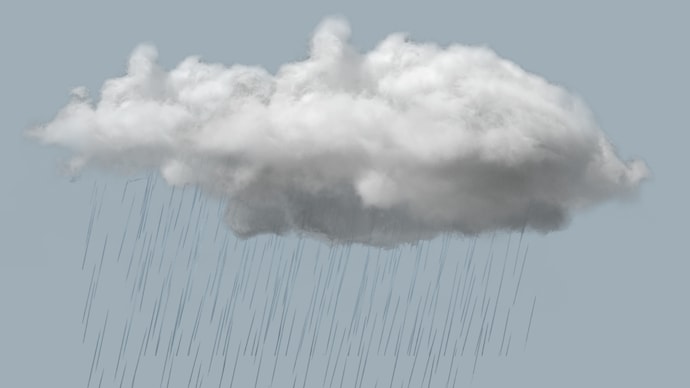
A cloudburst is the maximum volume of precipitation in a small duration of time. It is occasionally accompanied by hailstorms and thunder. It is effective in creating floods. Cloudbursts can fastly create large amounts of water. But, they are rare because they occur only when a huge amount of air is lifted by geographical aspects like a line of hills or a mountain range. Generally, cloudbursts do not last for more than a few minutes.
Cloudbursts happen when drenched clouds are not able to cause rain because of the rising movement of the extremely hot current of air. Rather than falling down, raindrops get larger in dimension and are forced up because of the air current. Finally, they will be heavier to carry and fall down, directing to more rainfall than normal.
What are the properties of a cloudburst?
- A rainfall rate that is equal to 100 mm or more than 100 mm per hour is a cloudburst.
- The Swedish weather service describes the Swedish term ‘Sky fall’ as 1 mm per minute for short bursts and 50 mm per hour for long-lasting rainfalls. The corresponding conducting cloud can go up to a height of 15 km from the ground level.
- During the time of a cloudburst, more than 20 mm of rain can fall in a short duration of time. The results can be devastating. They are responsible for flash floods.
Examples of Cloudburst in India.
- The Indian valley saw a severe flood in July 1970. This resulted in a cloudburst on the night of 20th July 1970 on the southern mountain front in the valley. Floods carried about 15.9 × 10⁶ tonnes of sediment in a day. On August 17th, 1998, a huge landslide causing heavy rain and a cloudburst at a village killed 250 people, including 60 pilgrims in Indian valley. On July 6th, 2004, 17 people were killed, and 28 people were injured when three vehicles were swept into the river by heavy landslides caused by a cloudburst that left nearly 5,000 pilgrims helpless near the shrine area.
- On September 29th, 2010, a cloudburst left many people injured and a number of vehicles and buildings damaged due to the corresponding flash floods in NDA, Pune, in Maharashtra. Again on October 4th, 2010, a cloudburst in Pune, in Maharashtra caused the death of 4 people, many people injured and a number of vehicles and buildings damaged, it is the highest record of rainfall in intensity and quantity in Pune city, in about 118 years old of October 24, 1892. On October 4th, 2010, a cloudburst occurred in Pune. It is the world’s first predicted cloudburst. But even after taking the necessary steps and precautions, four people died one young scientist was also there. On July 30th, 2014, a landslide occurred in Pune, located in the Pune district of India. The landslide hit the village in the early morning while all its residents were still sleeping. It killed 20 people.
- On June 9th, 2011, a cloudburst in India left four people dead and several injured on the highway. On September 15th, 2011, a cloudburst happened in Delhi. It was the highest rainfall in the city since 1959.
- On July 31st, 2014, a cloudburst happened in the TIndia. Nearly four people were dead.
- On September 6th, 2014, a cloudburst in the Indian valley killed more than 200 people. On July 20th, 2017, a cloudburst occurred in India, killing 6 people. On July 28th, 2021, a cloudburst happened in India which resulted in the death of 26 persons, and 17 people injured. On 8th July 2022, a cloudburst happened at cave shrine.
- On December 2nd, 2015, Chennai recorded 494 mm rainfall causing the 2015 South India floods.
- On May 4th, 2018, a cloudburst occurred in India. It reported 95mm of rain in an hour.
Impacts.
The impacts caused by the cloudburst disaster were huge. The effects will be:
- Households will be affected.
- Loss of lives of humans and animals.
- Loss of buildings and property damage.
- Loss of forests.
- Loss of current crops and fruits.
- Loss of cultivable land.
- Loss of bridges and flyovers.
Question 1: Is Cloudburst a natural disaster?
Answer:
Cloudburst is one of the major natural disasters. It brings flash floods, landslides, and a huge amount of destruction of property.
Question 2: Where does cloudburst occur?
Answer:
Cloudburst occurs mainly in the desert and mountain ranges, and in interior regions of continental mainlands because of the hot air current from the ground or the below clouds moving up and carrying the dropping raindrops up with it.
Question 3: How can we prevent cloudburst?
Answer:
The major technique is to retain the water on the ground and control it instead of installing big and costly pipes underground. By doing this, cloudburst areas will collect and move the water away from the exposed, low-lying areas.

You must be logged in to post a comment.