

TYPES OF WELDING
GAS WELDING:
Gas welding is accomplished by heating the ends or edges of meta l par ts to a molten state w ith a high temperature f lame. The oxy-acetylene f lame, with a temperature of approximately 6 300 °Fahrenheit (F), is produced with a torch burning acetylene and mixing it with pure oxygen. Hydrogen may be used in place of acetylene for aluminum welding, but the heat output is reduced to about 4 000 °F. Gas welding was the method most commonly used in production on aircraft materials under 3/16-inch in thickness until the mid 1950s, when it was replaced by electric welding for economic (not engineering) reasons. Gas welding continues to be a very popular and proven method for repair operations.
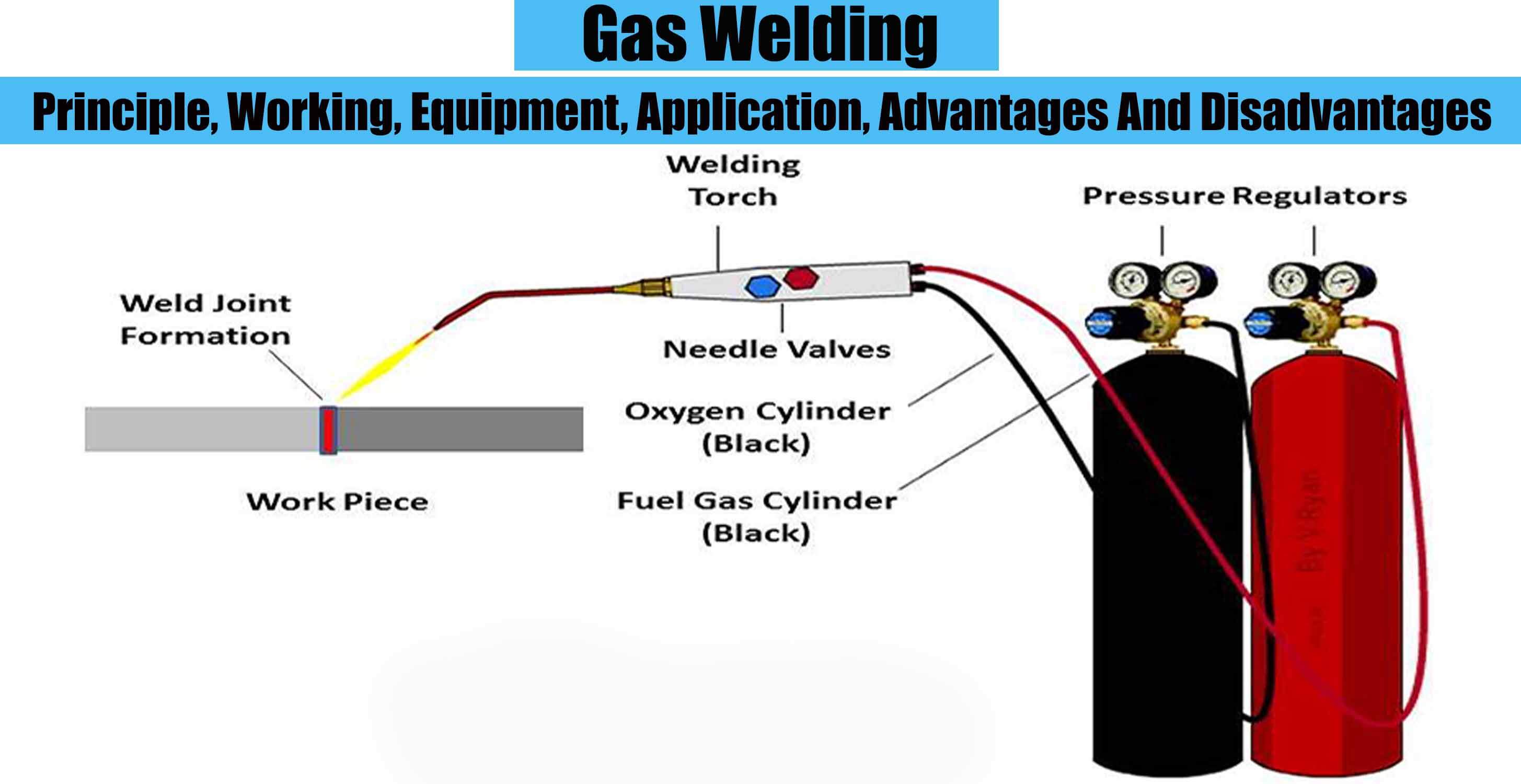
Nearly all gas welding in aircraft fabrication is performed with oxy-acetylene welding equipment consisting of:
• Two cylinders, acetylene and oxygen.
• Acetylene and oxygen pressure regulators and cylinder pressure gauges.
• Two lengths of colored hose (red for acetylene and green for oxygen) with adapter connections for the regulators and torch.
• A welding torch with an internal mixing head, various size tips, and hose connections.
• Welding goggles fitted with appropriate lenses.
• A flint or spark lighter.
• Special wrench for acetylene tank valve.
• An appropriately-rated fire extinguisher.
• Safety chain for securing tanks in cart
PLASMA ARC WELDING (PAW):
Plasma arc welding (PAW) was developed in 1964 as a method of bringing better control to the arc welding process. PAW provides an advanced level of control and accuracy using automated equipment to produce high quality welds in miniature and precision applications. F u r t he r mor e , PAW i s e q u a l l y s u it e d to m a nu a l operation and can be performed by a person using skills similar to those for GTAW.
In the plasma welding torch, a non-consumable tungsten electrode is located within a fine-bore copper nozzle. A pilot arc is initiated between the torch electrode and nozzle tip. This arc is then transferred to the metal being welded.
By forcing the plasma gas and arc through a constricted orifice, the torch delivers a high concentration of heat to a small area. The plasma process produces exceptionally high quality welds.
Plasma gas is normally argon. The torch also uses a secondary gas, such as argon/helium or argon/nitrogen, that assists in shielding the molten weld puddle and minimizing oxidation of the weld.

CHARACTERISTICS OF A GOOD WELD
A c o m p l e t e d w e l d s h o u l d h a v e t h e f o l l o w i n g characteristics:
1. The seam should be smooth, the bead ripples evenly spaced, and of a uniform thickness.
2. The weld should be built up, slightly convex, thus providing extra thickness at the joint.
3. The weld should taper off smoothly into the base metal
4. No oxide should be formed on the base metal close to the weld.
5. The weld should show no signs of blowholes, porosity, or projecting globules.
6. The base metal should show no signs of burns, pits, cracks, or distortion.
GAS METAL ARC WELDING (TIG WELDING):
The TIG process as it is known today is a combination of the work done by General Electric in the 1920s to develop the basic process, the work done by Northrop in the 1940s to develop the torch itself, and the use of helium shielding gas and a tungsten electrode. The process was developed for welding magnesium in the Northrop XP-56 flying wing to eliminate the corrosion and porosity issues with the atomic hydrogen process they had been using with a boron flux. It was not readily used on other materials until the late 1950s when it found merit in welding space-age super alloys. It was also later used on other metals, such as aluminum and steel, to a much greater degree.
Modern TIG welding machines are offered in DC, AC, or with AC/DC conf igurations, and use either transformer or inverter-based technology. Typically, a machine capable of AC output is required for aluminum. The TIG torch itself has changed little since the first Northrop patent. TIG welding is similar to oxy-fuel welding in that the heat source (torch) is manipulated with one hand, and the filler, if used, is manipulated with the other. A distinct difference is to control the heat input to the metal. The heat control may be preset and fixed by a machine setting or variable by use of a foot pedal or torch mounted control.
Several types of tungsten electrode are used with the T IG welder. Thoriated and zirconiated electrodes have bet ter elect ron emission cha racter istics than pure tungsten, mak ing them more suitable for DC operations on transformer-based machines, or either AC or DC with the newer inverter-based machines. Pure tungsten provides a better current balance with AC welding with a transformer based machine, which is advantageous when welding aluminum and magnesium. The equipment manufacturers' suggestions for tungsten t y pe and form should be followed as this is an ever changing part of the TIG technology.
Use a TIG welder w ith high-frequency starting to eliminate arc strikes. Do not weld where there is any breeze or draft; the welds should be allowed to cool slowly. Preheating is not necessary for tubing of less than 0.120-inch wall thickness; however, postweld tempering (stress relieving) is still recommended to prevent the possible brittleness of the area surrounding the weld due to the untempered martensite formations caused by the rapid cooling of the weld inherent to the TIG process.

You must be logged in to post a comment.