
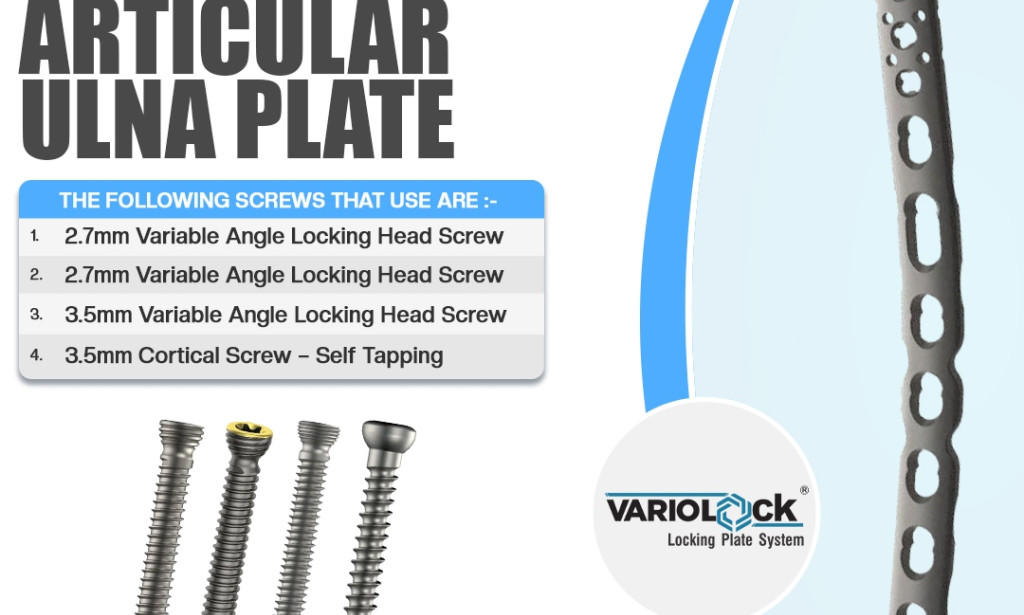
Forearm fractures are among the most common injuries treated in orthopedic practice. Since the radius and ulna work together to support movement of the wrist and elbow, proper fixation is important for restoring normal arm function. In many cases involving fractures near the ulna, surgeons prefer using an extra articular ulna plate because it provides stable fixation without interfering with the nearby joint surface.
Over the years, these plates have become widely used due to their reliable performance and better anatomical fit. They are especially helpful in fractures where maintaining alignment and early movement are important for recovery.
What is an Extra Articular Ulna Plate?
An extra articular ulna plate is a specially designed implant used to stabilize fractures of the ulna that do not extend into the joint. The plate is shaped to match the natural contour of the bone, allowing it to sit properly along the ulna with minimal soft tissue irritation.
These plates are commonly manufactured from stainless steel or titanium. Many modern designs also include locking screw options, which improve fixation strength, particularly in weak or osteoporotic bone.
When Is It Used?
Extra articular ulna plates are generally used for fractures involving the distal or shaft region of the ulna, where the joint surface remains unaffected. They are often preferred in cases where conservative treatment may not provide enough stability.
Common indications include:
-
Displaced ulna fractures
-
Comminuted forearm fractures
-
Unstable fracture patterns
-
Fractures requiring early mobilization
-
Osteoporotic bone conditions
The choice of implant depends on fracture type, bone quality, and patient activity level.
Advantages of Extra Articular Ulna Plates
One of the biggest advantages of these plates is their ability to provide stable fixation while preserving joint integrity. Since the implant is placed outside the articular area, it reduces the risk of disturbing joint movement.
Another benefit is anatomical contouring. Modern extra articular plates are pre-shaped to match the ulna, which reduces the need for excessive bending during surgery. This can save operative time and help achieve better fracture alignment.
Locking plate technology has also improved outcomes in difficult fractures. Locking screws create a stronger fixed-angle construct, which is useful in osteoporotic patients or fractures with multiple fragments.
Surgical Considerations
Successful fixation depends not only on the implant but also on proper surgical technique. Adequate fracture reduction, correct plate positioning, and careful soft tissue handling are important for achieving good outcomes.
Surgeons usually select plate length based on fracture pattern and bone quality. Longer plates may be preferred in comminuted fractures to distribute stress more evenly along the bone.
Care should also be taken to avoid excessive soft tissue stripping, as preserving the blood supply plays a major role in fracture healing.
Recovery and Functional Outcome
Most patients begin gentle motion exercises after surgery, depending on fracture stability and surgeon preference. Stable fixation with an extra articular ulna plate often allows earlier rehabilitation compared to non-operative management.
Healing time varies from patient to patient, but many individuals gradually regain normal forearm function with proper physiotherapy and follow-up care.
Complications such as irritation, delayed union, or implant-related discomfort may occur occasionally, though these problems are usually manageable when the fracture is treated properly.
Conclusion
Extra articular ulna plates have become an important option in the treatment of forearm fractures. Their anatomical design, stable fixation, and compatibility with modern locking systems make them suitable for a wide range of fracture patterns. When combined with proper surgical planning and rehabilitation, these trauma implant plates can help restore stability, movement, and overall arm function effectively.

not good
You must be logged in to post a comment.