
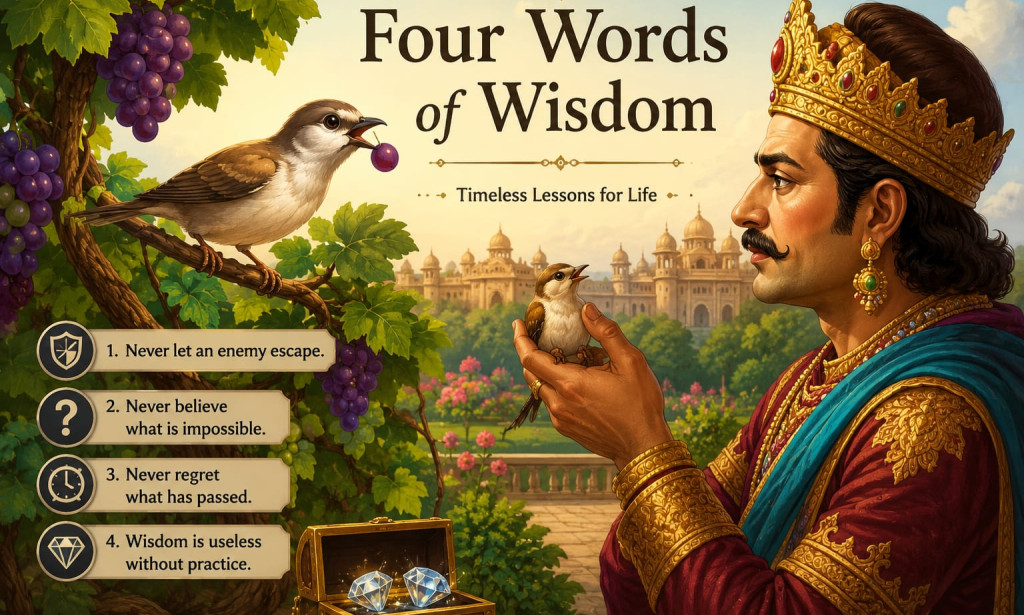
Once upon a time, there was a magnificent palace belonging to a king. Inside the palace was a beautiful garden where a grapevine grew. Every day, a little bird would come to the garden, pick the sweetest grapes to eat, and throw the sour, unripe grapes onto the ground.
The gardener tried many times to catch the bird, but he always failed. Finally, discouraged, he told the king about the matter. The king, Bhanu Pratap, was surprised to hear this and decided to teach the bird a lesson. He hid himself in the garden and waited.
When the bird came to eat the grapes, the king quickly caught it. As he was about to kill the bird, it pleaded,
"O King, please do not kill me. In return, I will share four valuable lessons of wisdom with you."
The king replied,
"Very well. Speak quickly."
The bird said,
"First, never let an enemy escape once you have captured them."
The king nodded and said,
"Now tell me the second lesson."
The bird continued,
"Second, never believe something that is impossible. Third, never regret what has already passed."
The king then asked,
"Now tell me the fourth lesson."
The bird replied,
"The fourth lesson is deep and mysterious. Please loosen your grip a little because I can hardly breathe. Let me catch my breath, and I will tell you."
As soon as the king loosened his hand, the bird flew up and perched on a nearby branch. Then it said,
"There are two diamonds inside my stomach."
Hearing this, the king was filled with regret. Seeing the king's disappointment, the bird said,
"O King, there is no benefit in merely hearing or reading words of wisdom. Their true value lies in putting them into practice. You failed to follow the very lessons I gave you."
"I was your enemy, yet you let me go after capturing me."
"I told you something impossible—that my tiny stomach contained two diamonds—yet you believed it."
"And now you are regretting the loss of imaginary diamonds that never existed."
Moral of the Story
Wisdom has no value unless it is applied in real life. Knowledge becomes meaningful only when it is practiced.

You must be logged in to post a comment.