
A production line working for three full shifts can still produce defects. If the wrong solder paste and SMT adhesives are placed on the stencil printer or the dispensing station, defects can go unnoticed. Many electronics manufacturers learn this the hard way: through field failures, rework costs, or rejected batches.
Most buyers analyze the pick and place accuracy and the AOI and reflow profiling systems. The materials connecting the components to the PCB usually receive less scrutiny than the equipment, despite the equipment's importance. Studies conducted in the industry show that almost 50% of all PCB assembly issues relating to quality that stem from soldering can be traced back to defects. Soldering processes and materials can be easily controlled, which places greater value on the decision making of EMS, automotive, LED and other electronics manufacturers and OEMs. Choosing the right solder paste and SMT adhesives is a decision that affects the reliability of their systems.
Solder Paste and SMT Adhesives Specifications That Directly Affect Yield
Solder Paste Types Used in Modern SMT Production
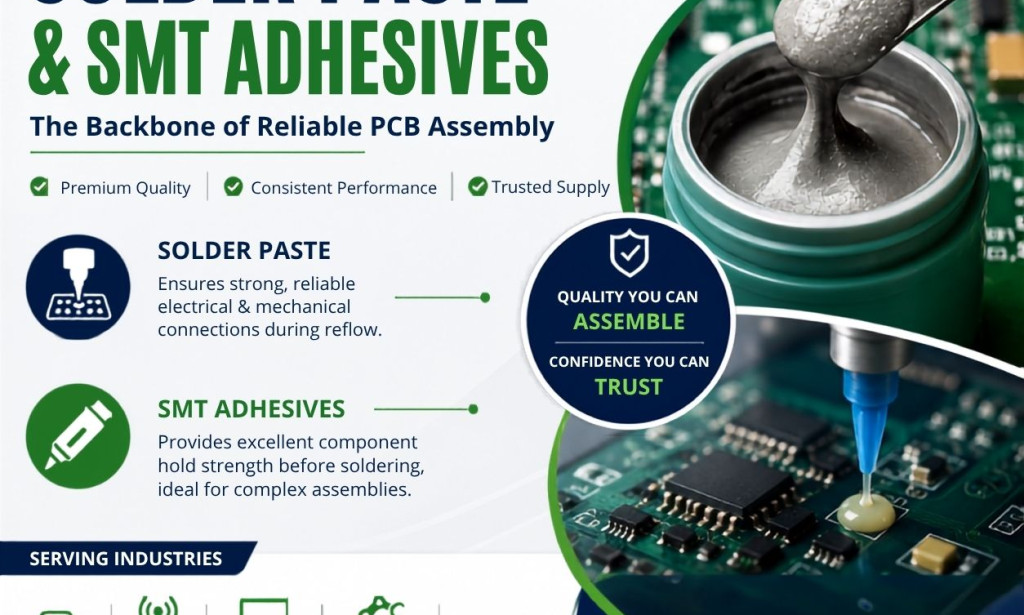
Solder paste is solder alloys combined with flux. Popular variants are SAC305, or the leaded Sn63/Pb37, when regulations allow. Paste type, which can be Type 3, Type 4, or Type 5, affects the print on tight tolerance (<0.5 mm) components.
SMT Adhesive Categories
SMT adhesives are typically epoxy materials that bond components in advance of wave soldering or in high vibration applications. These adhesives bond components for automotive, industrial automation and defense electronics, and are used in many applications.
The Specification Detail Most Buyers Overlook
Shelf-life management and cold-chain storage cause as many production headaches as choosing an alloy, but no one talks about it.
Many manufacturers assess cost against weight but ignore storage conditions. When solder paste is stored outside the recommend temperature range, it can exhibit a change in viscosity which negatively impacts stencil release and the solder's wetting. A few degree temperature fluctuation can create issues that persist on the production floor well after the solder paste is artificially aged.
Five Supplier Evaluation Checks That Prevent Expensive Production Problems
Before selecting a supplier, evaluate these five areas carefully:
-
Material Traceability
-
Good answer: Batch-level tracking with documentation.
-
Bad answer: "We'll share details if there's a complaint."
-
-
Technical Support Availability
-
Good answer: Process engineers available during implementation.
-
Bad answer: "Contact the manufacturer directly."
-
-
Shelf-Life Management
-
Good answer: Controlled storage and documented inventory rotation.
-
Bad answer: "We ship whatever stock is available."
-
-
Certification and Compliance
-
Good answer: RoHS, REACH, and supporting test reports available.
-
Bad answer: "Most customers don't ask for certificates."
-
-
Failure Investigation Process
-
Good answer: Root-cause support and material analysis assistance.
-
Bad answer: "We'll handle defects case by case."
-
A supplier who cannot explain how they investigate soldering failures is selling products, not supporting manufacturing.
Benefits That Protect Margins, Not Just Production Lines
The right materials reduce risk in ways that directly affect profitability.
-
Lower defect rates reduce rework labor, which can consume 8–15% of assembly costs in poorly controlled SMT environments.
-
Better stencil print consistency minimizes solder bridging and insufficient solder defects.
-
Stable adhesive performance prevents component movement during thermal processing.
-
Reliable wetting characteristics improve first-pass yield, reducing production delays.
-
Consistent material quality simplifies process validation across multiple production batches.
-
Strong technical support shortens troubleshooting time when introducing new PCB designs.
Which means fewer surprises during customer audits and fewer uncomfortable conversations about delayed shipments.
Availability of Solder Paste and SMT Adhesives in India
The growth of India’s electronics manufacturing sector has been supported by domestic production initiatives. India’s electronics manufacturing market is valued at more than USD 100 billion, leading to an increasing need for reliable SMT consumables.
For buyers looking for Solder Paste and SMT Adhesive Suppliers in India, convenient access to products is becoming just as important as high quality supplies. Since lead-times of imported supplies are typically 4 to 6 weeks, it disrupts operations more than a small price increase.
This is the reason why many EMS companies prefer to partner with trusted Solder Paste and SMT Adhesive Suppliers, who are backed by local stock and technical personnel.
Procurement managers, who are assessing the range of Solder Paste and SMT Adhesives suppliers in India, are likely to give importance to logistics. Manufacturers, who are positioned in close vicinity to the primary electronics hubs of Delhi NCR, Bengaluru, Chennai, Pune and Noida, enjoy the benefit of faster restocking and technical support.
About IMTronics
We partner with electronics manufacturers who value more than just listings and pricing. We help customers pick suitable SMT materials and equipment as well as inspection systems, soldering systems, and production support services concerning the actual conditions of the factory.
We have seen production lines come to a halt because a shipment came with no storage documentation. We have also seen costly defects arising from choosing consumables based only on cost.
One of the operational details that most people ignore is that we often talk to customers about stencil aperture design and storage and reflow practices before they pick a consumable. These factors most of the time have a greater impact on the outcomes than what is written on the label of the product.
Request a Material Recommendation Before Your Next Production Run
If you're evaluating Solder Paste and SMT Adhesives, send us the following:
-
PCB type and application
-
Component package details
-
Monthly production volume
-
Current soldering challenges
-
Required compliance standards
We typically respond within one business day.
At IMTronics, our MOQ depends on the material category and production requirement. Share your specifications, and we'll recommend suitable options along with availability and technical guidance.
Conclusion
Achieving an optimal yield depends on many factors. In addition to ensuring your end product meets customer needs, there are warranty costs, reliability, and, most importantly, your reputation. The latter is the most valuable factor. As the world develops and creates more complex electronic components, the solder paste, SMT adhesives, and materials selected play an integral role. Long-lasting, high-quality electronics are more likely to come from companies using high-quality strategic-sourced inputs as solder paste, SMT adhesives, and consumables.
Frequently Asked Questions
How to choose the right Solder Paste and SMT Adhesives?
Begin with component size, solder paste and SMT adhesives requirements, PCB design and assembly reliability. It's a common error among manufacturers to only consider costs when making these selections.
Are there good Solder Paste and SMT Adhesives suppliers in India?
Yes, there are many good Solder Paste and SMT Adhesives suppliers in India with good local stock, technical support and compliance documentation. Check their storage before making large orders.
Which industries use SMT adhesives?
Used heavily in automotive electronics, LED manufacturing, industrial automation, defense electronics and consumer electronics for component retention and assembly stability.
What happens if you don't manage the shelf-life for solder paste?
There are negative effects to printing and solderability if materials are expired or stored incorrectly. Even the best products will underperform when storage instructions are ignored.
Do Solder Paste and SMT Adhesives wholesalers offer technical support?
It ranges from no to yes. Many Solder Paste and SMT Adhesives wholesalers are just that – wholesalers, but many others employ technical teams for support and process enhancement in their line of work.

You must be logged in to post a comment.