

TikTok’s role during the invasion of Ukraine has changed the common misconception of a website predominantly used by its young users to post videos of lip-synced songs or dance challenges. During Russia’s military buildup, users posted videos of military equipment being transported to the Ukrainian border. Since that equipment crossed that border, numerous TikToks have shown missiles, destroyed buildings or the daily life of Ukrainians who have to spend their days in shelters, leading some commenters to even call this a “TikTok war”. But this isn’t the first time TikTok has played a role for open source investigators. Videos that appeared on TikTok in Myanmar in early 2021 showed men in uniform threatening to kill anti-coup protesters. During search efforts to find the disappeared US travel blogger Gabby Petito, TikToks reportedly uploaded information that helped solve the case. Videos of mass protests, including Black Lives Matter marches in 2020, were also regularly shared on the platform. In our previous guide detailing “how to investigate TikTok like a pro”, we introduced and detailed various search options that can help find relevant information on the app. Nevertheless, it’s still tricky to monitor specific topics on TikTok over a longer period of time. Compared to those of other social media platforms, TikTok’s API (Application Programming Interface) presents more obstacles to developers. It can change frequently, making it harder for developers to use and harder for researchers to draw wider insights from trends as they develop over weeks and months. Bellingcat’s Investigative Tech Team has therefore created the Bellingcat TikTok Analysis Tool (built on the basis of a TikTok scraper offered by GitHub user drawrowfly) that allows researchers to collect a dataset of TikToks associated with specific hashtags over lengthier periods. The tool also allows researchers to analyze what other topics appear together with selected hashtags most frequently. When reviewing large datasets, it can be particularly interesting to discover which hashtags are regularly added to TikToks which already share one specific tag. Many TikToks contain multiple hashtags, as illustrated by the image below of a train transporting Russian military equipment from January 2022.
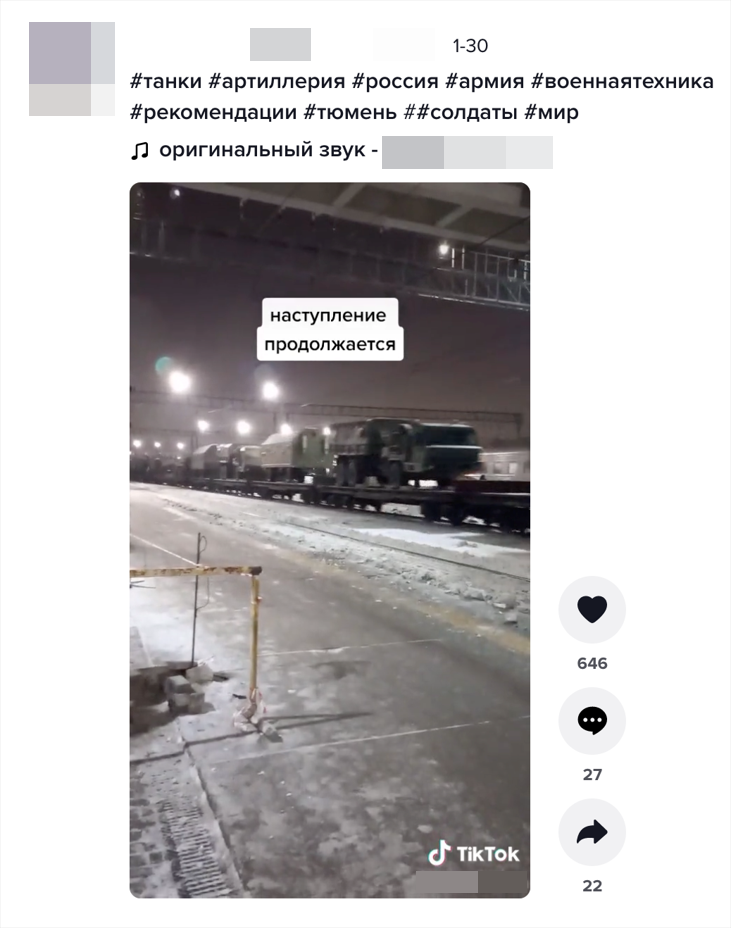
Example of a TikTok video documented on the Russia-Ukraine Monitor Map, a project by the Center for Information Resilience, to which Bellingcat also contributes.
By analyzing patterns in the joint use of hashtags, researchers could, for instance, help identify coordinated disinformation or influence campaigns. In such cases, the same set of hashtags may be used over and over again across several posts. Looking at a larger number of posts can also help researchers learn more about the context in which a specific hashtag is used.
This is what Bellingcat’s TikTok tool does
With the help of this tool, we were able to compile a list of 732 TikToks which used the hashtag #schützteurekinder. This German-language hashtag translates to “protect your children”. It’s similar to the English #savethechildren hashtag, which was widely used by QAnon believers on TikTok before the platform took measures to stop its spread by conspiracy theorists.
We wanted to find out whether this German hashtag has been used in a similar context and, if so, what that might mean.
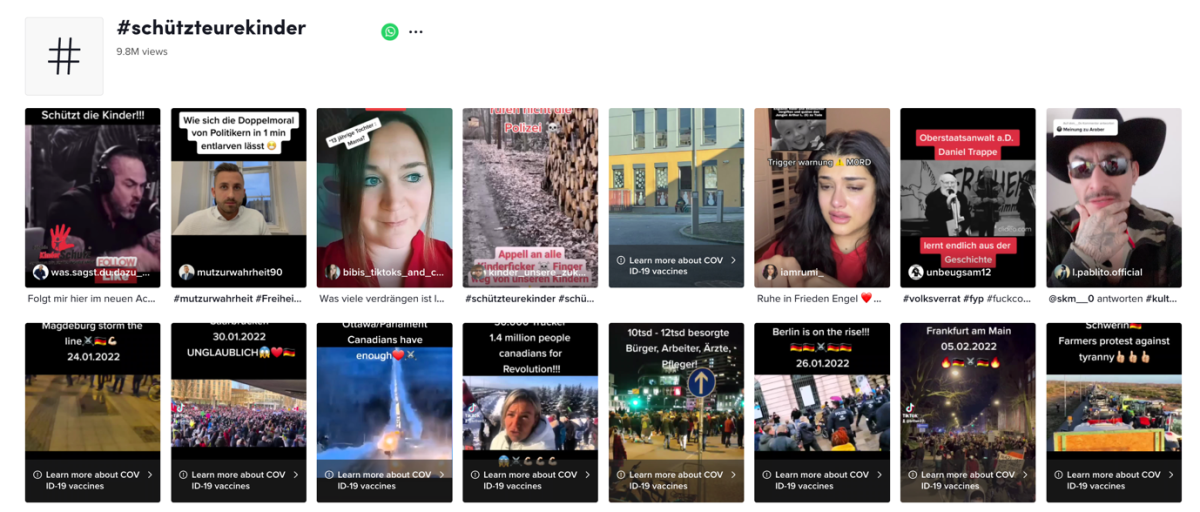
TikTok provides a dedicated page for each hashtag. This is the page for #schützteurekinder.
Our tool then allowed us to view all the hashtags that showed up most frequently alongside #schützteurekinder in the 732 TikToks in our dataset. What we found was that among the 30 most frequently used hashtags were a combination of keywords that are often used in anti-vax communities.
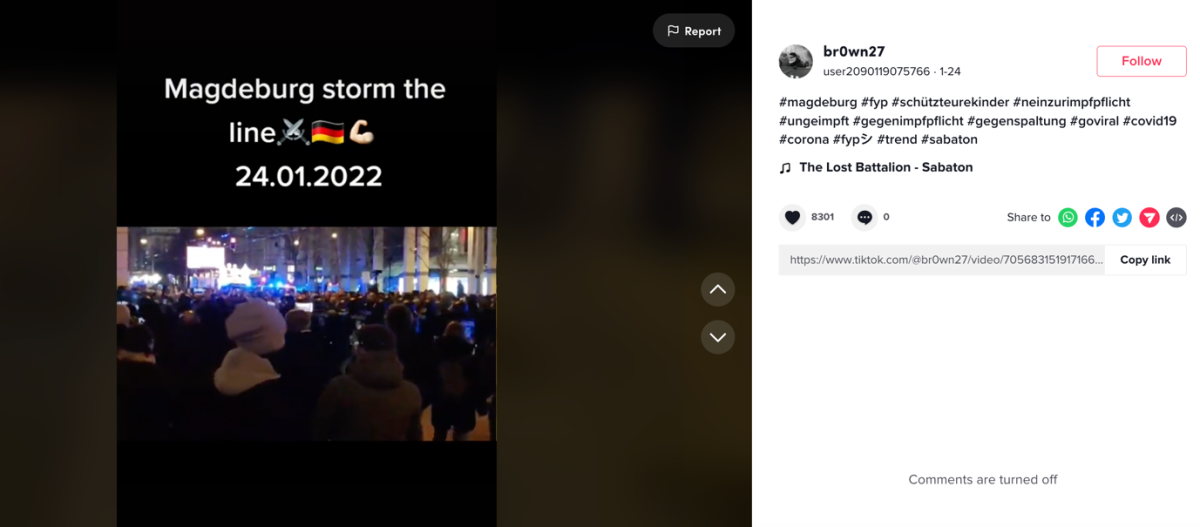
A TikTok that refers to protests in Germany against pandemic-related public health measures and Covid-19 vaccines. It uses the hashtag #schützteurekinder but also a list of other hashtags, including #ungeimpft (unvaccinated) and #neinzurimpfpflicht (no to a vaccine mandate).
The list included terms such as (unvaccinated), (stand up), (truth) and (against vaccine mandate).

You must be logged in to post a comment.