
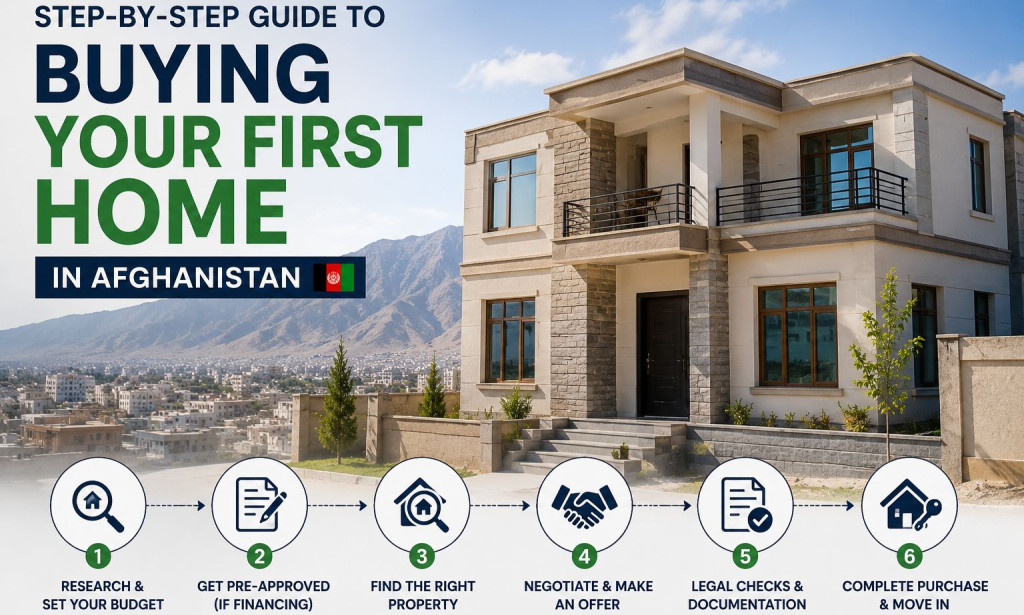
Buying your first home in Afghanistan involves five main stages: setting your budget, searching for the right property, inspecting it in detail, verifying the legal documents, and completing the sale with a registered deed. Skipping any of these stages usually costs buyers money later. A house can look excellent from the entrance and still have a cracked roof, weak wiring, or a water supply that fails in summer. Walking through every room before you sign anything is the only way to know what you are actually paying for, not just what a property listing shows in photos.
This guide walks you through the full home-buying process, room by room, so you can inspect any house or apartment in Kabul, Herat, Mazar-e-Sharif, or any other Afghan city with confidence.
Quick Answer: How to Buy Your First Home in Afghanistan
In short, buying a home in Afghanistan follows these steps:
- Set your budget and decide which city or neighborhood fits your needs.
- Search verified property listings for houses or apartments for sale.
- Shortlist a few properties and schedule a property viewing for each.
- Inspect the property room by room, including the roof, walls, plumbing, and electrical system.
- Verify the ownership documents with a local lawyer before making any commitment.
- Negotiate the price based on the property's real condition, not just its appearance.
- Agree on payment terms and complete the sale deed.
- Register the transfer and move utilities, such as water and electricity, into your name.
The rest of this guide covers each step in detail, along with a complete room-by-room inspection checklist you can bring to every property viewing.
Step 1: Set Your Budget Before You Start Searching
Decide how much you can spend before you look at a single house. This includes the purchase price plus extra costs such as legal fees, transfer costs, repairs, and moving expenses.
Most residential property sales in Afghanistan are settled in cash rather than through a mortgage, since formal home loans are limited. If you plan to save toward a purchase or use family support, build in a buffer of at least 10 to 15 percent above the listing price for repairs and fees. This is a general recommendation, not a fixed rule, so adjust it to your own situation.
Step 2: Decide on Location and Property Type
Think about what matters most: distance to work or school, access to water and electricity, security of the neighborhood, and whether you want a house, an apartment, or land to build on later.
Kabul has the largest number of listings, but cities like Herat, Mazar-e-Sharif, and Kandahar each have their own price ranges and neighborhood character. A quiet residential street may cost less than a similar property on a busy commercial road, even in the same district.
If you are also considering income-generating property, compare residential property against commercial property, since the two have different resale value, tenant demand, and maintenance needs.
Step 3: Search Listings and Shortlist Properties
Once you know your budget and preferred area, start browsing property listings that match your criteria. Save the ones that fit and note down any questions you have for the seller or real estate agent before the viewing.
A good real estate agent can save you time by filtering out properties that do not match your budget or legal requirements. Ask the agent directly whether the ownership documents are clear before you schedule a visit, so you do not waste a trip on a property with unresolved title issues.
Step 4: Inspect the Property in Person
Never commit to a property based on photos alone. Photos can hide water stains, uneven floors, and cracks that are obvious in person. The full room-by-room checklist below covers everything you should look at during a property viewing.
Try to view the property at two different times of day if possible, such as morning and evening. This helps you notice things like street noise, sunlight in each room, and how reliable the electricity supply is at different hours.
Step 5: Verify Ownership and Legal Documents
Afghanistan has a mix of customary and formally registered property deeds, often referred to locally as qabala. Some properties are backed by documents that were never registered with a government land office, which can lead to ownership disputes later.
Before you commit to a purchase, ask to see the original ownership documents and confirm the seller's identity matches the name on the deed. A local lawyer or notary can check whether the property has a clear title, whether it is registered, and whether there are any outstanding disputes or debts tied to the land.
Property laws, registration offices, and required documents can vary by province and may change over time. Always verify the current requirements with a local lawyer or the relevant land authority in your area rather than relying on general information alone.
Step 6: Negotiate the Price
Use what you found during the inspection to negotiate. A property with an aging roof, outdated wiring, or a weak water supply is worth less than one in excellent condition, even if both are the same size and location.
Compare the asking price to similar properties currently listed in the same neighborhood. If you noticed repair needs during your inspection, ask the seller to either fix them before closing or reduce the price to cover the cost.
Step 7: Agree on Payment and Complete the Sale Deed
Once you agree on a price, put the terms in writing, including the full price, payment schedule, and what happens if either side backs out. Many home sales in Afghanistan are paid in full at the time of the sale deed, so confirm this with the seller and your lawyer in advance.
The sale deed should be prepared and reviewed by a qualified lawyer, and the transaction should be properly registered rather than handled only through an informal agreement. This step protects both the buyer and the seller if a dispute comes up later.
Step 8: Register the Property and Transfer Utilities
After the sale deed is signed, complete the property registration with the relevant local authority so your ownership is on record. Then transfer utilities such as water, electricity, and any existing service contracts into your name.
Keep copies of every document from the sale: the deed, payment receipts, identification records, and any inspection notes. These become important if you ever sell the property or need to resolve a boundary question with a neighbor.
Room-by-Room Property Inspection Checklist
A property inspection means checking a house or apartment section by section for damage, wear, and safety issues before you buy it. Doing this well is one of the most valuable skills a first-time homebuyer can learn, because it turns a guess into an informed decision.
Below is a full room-by-room breakdown. For each area, you will find what to inspect, why it matters, warning signs to watch for, and questions worth asking the seller or agent.
Exterior and Perimeter Wall
What to inspect: Look at the outer walls, the boundary wall, the main gate, and how the building sits on the land. Check for visible cracks, leaning sections, or recent patch-up work.
Why it matters: Exterior damage often signals a foundation problem or water drainage issue that is more expensive to fix than anything inside the house. The boundary wall also marks the legal edge of the property, so its condition and position matter.
Warning signs: Diagonal cracks wider than a pencil, a wall that leans outward, fresh plaster covering only one section of a wall, or a boundary wall that does not match the property's stated dimensions.
Questions to ask: Has the boundary ever been disputed by a neighbor? Was any exterior repair work done recently, and why?
Entrance and Main Door
What to inspect: Test the main door, the lock, and the frame. Check whether the entrance floor is level and whether water pools near the doorway after rain.
Why it matters: The entrance is a security point as well as a drainage point. A door that does not close properly is a security risk, and pooling water near the entrance often points to poor grading or drainage around the house.
Warning signs: A door frame that has shifted, gaps around the lock, or staining on the floor just inside the entrance.
Questions to ask: Is this the original door and lock, or has it been replaced? How old is the current lock system?
Living Room
What to inspect: Walk the full perimeter of the room. Check the walls, ceiling, and flooring for cracks, damp patches, or uneven sections. Test the light switches and count the electrical outlets.
Why it matters: The living room is usually the largest shared space in the home, so problems here are the most expensive to repair per square meter. It is also a good general indicator of how well the rest of the house was maintained.
Warning signs: A ceiling with a slight sag, paint that bubbles or peels near the top of a wall, or a strong smell of dampness with no visible source.
Questions to ask: Has this room ever flooded or had a leak from above?
Kitchen
What to inspect: Check the sink, water pressure, cabinet condition, ventilation, and whether there is a working gas or electric connection for cooking. Open cabinets and look under the sink for leaks or mold.
Why it matters: Kitchens combine plumbing, electrical, and gas systems in one small space, so they tend to reveal maintenance problems faster than other rooms. Poor ventilation here can lead to long-term dampness and mold.
Warning signs: Soft or discolored cabinet flooring under the sink, a gas smell, weak water pressure, or no exhaust fan or window for ventilation.
Questions to ask: Is the kitchen connected to a gas cylinder or a piped gas line? How old is the plumbing under the sink?
Bedrooms
What to inspect: Check every bedroom, not just the largest one. Look at wall corners for cracks, test windows for smooth opening and closing, and check for adequate natural light and airflow.
Why it matters: Bedrooms are used daily, so poor ventilation or damp walls affect health and comfort more than almost any other room. Smaller bedrooms are also more likely to be skipped during a rushed inspection.
Warning signs: Musty smell, a window that will not close fully, or visible mold in a corner near the ceiling.
Questions to ask: Which direction does each bedroom face, and how does the room feel in winter versus summer?
Bathrooms
What to inspect: Turn on every tap and flush every toilet. Check water pressure, drainage speed, tile condition, and whether hot water is available and how it is heated.
Why it matters: Bathroom repairs involve plumbing work that is disruptive and costly once you have moved in. Weak drainage or low water pressure is often a sign of a wider plumbing issue in the building.
Warning signs: Slow-draining water, loose or cracked tiles near the shower, a toilet that rocks when you sit on it, or a strong sewage smell.
Questions to ask: Is hot water provided by an electric heater, a gas heater, or a central system? How reliable is it in winter?
Roof
What to inspect: If you can access the roof safely, check for cracks, water pooling areas, and the condition of any water tank stored there. If you cannot access it directly, ask about its age and check ceilings on the top floor for staining instead.
Why it matters: Roof problems are among the most expensive repairs in any home, and flat roofs common in many Afghan houses can develop pooling and leaks if drainage was not built correctly.
Warning signs: Water stains on top-floor ceilings, visible cracks in the roof surface, or a water tank with rust or sediment buildup.
Questions to ask: When was the roof last resurfaced or repaired? Has the top floor ever had a leak during heavy rain or snow?
Walls
What to inspect: Check both interior and exterior walls for cracks, dampness, and unevenness. Press gently on any suspicious patch of plaster to see if it is loose.
Why it matters: Wall cracks can be simple settling or a sign of a structural problem, and the difference matters a great deal for cost and safety.
Warning signs: Cracks that run diagonally from window or door corners, or cracks that appear on both the inside and outside of the same wall in the same spot.
Questions to ask: Was the house built with brick, concrete block, or another material? Has any structural repair ever been done?
Ceiling
What to inspect: Look for sagging, staining, or recent paint that might be covering a water mark. Check ceilings in every room, not just the ones that look newest.
Why it matters: A ceiling stain almost always means water has entered from above at some point, whether from a roof leak or a plumbing issue on a higher floor.
Warning signs: A yellow or brown ring on the ceiling, fresh paint in only one section, or a slightly soft texture when touched carefully.
Questions to ask: Has this ceiling ever been repainted to cover a leak?
Flooring
What to inspect: Walk across every room slowly. Check for uneven or sloping floors, loose tiles, and squeaking sections. Look closely where the floor meets the wall for gaps.
Why it matters: Flooring problems can point to foundation movement, and even where the cause is minor, uneven floors are a tripping hazard for children and older family members.
Warning signs: A visible slope when you place a small ball or marble on the floor, tiles that shift underfoot, or a gap along the base of the wall.
Questions to ask: Has the flooring been replaced recently, and if so, why?
Windows
What to inspect: Open and close every window in the house. Check the seals, frames, and glass for cracks, and see whether the windows let in draughts.
Why it matters: Windows affect both security and energy costs. A window that does not seal properly makes the home harder to heat in winter and easier to break into.
Warning signs: Warped wooden frames, cracked glass, broken latches, or visible gaps between the frame and the wall.
Questions to ask: Are the windows original to the building, and have any been replaced or upgraded?
Doors
What to inspect: Check every interior door, not just the main entrance. Test hinges, locks, and how well each door fits its frame.
Why it matters: Doors that stick or do not close properly often indicate the building has shifted slightly, and they are also a basic part of privacy and security within the home.
Warning signs: A door that scrapes the floor, a frame that is visibly out of square, or a lock that does not fully engage.
Questions to ask: Have any interior doors been replaced or adjusted recently?
Electrical System
What to inspect: Test light switches and outlets in every room. Look at the main electrical panel or fuse box for exposed wiring, and ask about the power source, since many homes rely on a mix of city electricity, a generator, or solar panels.
Why it matters: Electrical faults are a fire risk, and unreliable power supply directly affects daily life, especially for heating, cooling, and water pumps.
Warning signs: Exposed or taped wiring, outlets that feel warm to the touch, flickering lights, or a fuse box that looks outdated or overloaded.
Questions to ask: How many hours of city electricity does this area typically get, and is there a backup generator or solar system included in the sale?
Plumbing
What to inspect: Run every tap in the house at the same time if possible, and check water pressure and drainage speed. Look under sinks and around visible pipes for corrosion or past leaks.
Why it matters: Plumbing problems are often hidden inside walls or under floors, so visible signs like low pressure or slow drains are your best early warning.
Warning signs: Rust-colored water, unusually low pressure, visible pipe corrosion, or damp patches near any pipe run.
Questions to ask: Is the property connected to a piped water network, or does it rely on a private well or water tank?
Water Supply
What to inspect: Ask specifically how the property gets its water, whether from a municipal network, a private well, or a delivery tanker, and check the condition and cleanliness of any storage tank.
Why it matters: Water access varies significantly across Afghan cities and neighborhoods. A property that looks identical to another nearby can have a very different water situation, which affects daily life and long-term costs.
Warning signs: A storage tank with visible sediment or rust, no clear answer from the seller about the water source, or a well that neighbors describe as unreliable in summer.
Questions to ask: How often does the water supply run dry, and what is the backup plan when it does?
Heating and Cooling
What to inspect: Identify how the home is heated in winter, whether by a wood or gas stove, a bukhari, an electric heater, or a central system, and check ventilation for any combustion-based heater.
Why it matters: Winters in much of Afghanistan are cold, and heating costs and safety vary a great deal depending on the system installed. Poor ventilation with a fuel-burning heater is a safety hazard.
Warning signs: Soot marks near a heater or chimney, no visible ventilation for a gas or wood stove, or a heating system that looks improvised rather than properly installed.
Questions to ask: What is the average monthly cost for heating fuel or electricity in winter?
Storage Areas
What to inspect: Check any basement, storeroom, or under-stair storage space for dampness, ventilation, and structural condition, since these areas are often overlooked during a quick viewing.
Why it matters: Storage areas, especially below ground, are prone to damp and poor airflow, which can damage stored belongings and sometimes signals a wider drainage issue around the foundation.
Warning signs: A musty smell, visible water marks near the floor, or a storage area that feels noticeably colder and damper than the rest of the house.
Questions to ask: Has this storage area ever flooded or taken on water during heavy rain?
Balcony
What to inspect: Check the railing for stability, the floor for cracks, and the drainage at the edge of the balcony. Push gently on the railing to test how solid it feels.
Why it matters: A weak balcony railing is a direct safety hazard, particularly for homes with children. Poor drainage on a balcony can also let water seep into the wall below.
Warning signs: A railing that moves when pushed, cracks radiating from the balcony floor, or staining on the wall beneath the balcony.
Questions to ask: Has the balcony railing or flooring been repaired or reinforced recently?
Garage
What to inspect: If the property includes a garage, check the door mechanism, flooring, and ventilation. Confirm whether it is large enough for your actual vehicle, not just described as a garage.
Why it matters: A garage adds real value only if it is functional and correctly sized. Poor ventilation also matters if you plan to store fuel or run a vehicle engine inside briefly.
Warning signs: A garage door that does not open smoothly, cracked flooring, or no ventilation at all in an enclosed space.
Questions to ask: Is the garage part of the registered property, or is it a separate or shared structure?
Outdoor Space and Land
What to inspect: Walk the full outdoor area, including any yard, courtyard, or garden. Confirm the land boundaries match what was described in the listing, and check drainage across the open space.
Why it matters: Outdoor space adds real value in many Afghan homes, especially courtyards used daily by the family. In Afghanistan, land is often measured in jarib, a traditional unit roughly equal to 2,000 square meters, so confirm which unit the seller is using and have it verified against the official measurement.
Warning signs: A boundary that does not match the deed description, standing water after rain, or a neighbor's structure that appears to encroach on the property line.
Questions to ask: Has a licensed surveyor confirmed the exact boundaries and total land area?
Room-by-Room Inspection Checklist Table
Use this table as a quick reference during a property viewing. Bring a printed or saved copy so you do not miss any area.
| Area | Key Checks | Ask the Seller |
|---|---|---|
| Exterior and walls | Cracks, leaning sections, boundary condition | Any recent repair work? |
| Entrance | Door, lock, floor drainage | Original lock or replaced? |
| Living room | Walls, ceiling, outlets, flooring | Any past flooding or leaks? |
| Kitchen | Sink, cabinets, ventilation, gas connection | Piped gas or cylinder? |
| Bedrooms | Windows, ventilation, wall corners | Room orientation and light |
| Bathrooms | Water pressure, drainage, hot water source | How is hot water heated? |
| Roof | Cracks, pooling, water tank condition | Age of last resurfacing? |
| Walls | Cracks, dampness, plaster condition | Structural repairs done? |
| Ceiling | Staining, sagging, fresh paint patches | Ever repainted to cover a leak? |
| Flooring | Level surface, loose tiles, gaps at walls | Recently replaced? |
| Windows | Seals, frames, glass condition | Original or upgraded? |
| Doors | Fit, hinges, locks | Recently adjusted or replaced? |
| Electrical system | Panel condition, outlets, power source | Hours of city power, backup source |
| Plumbing | Pressure, drainage, pipe condition | Piped network or private well? |
| Water supply | Source, tank condition, reliability | How often does supply run dry? |
| Heating and cooling | System type, ventilation, safety | Average monthly fuel or power cost |
| Storage areas | Dampness, ventilation | Ever flooded? |
| Balcony | Railing stability, drainage | Recently repaired or reinforced? |
| Garage | Door function, size, ventilation | Registered as part of the property? |
| Outdoor space and land | Boundary match, drainage, land size | Surveyor-confirmed boundaries? |
Common Warning Signs Table
This table summarizes red flags that are worth taking seriously during any property inspection, wherever they appear in the house.
| Warning Sign | What It May Indicate |
|---|---|
| Fresh paint in one small patch only | Hidden water stain or crack being covered |
| Diagonal cracks from window or door corners | Possible structural settling |
| Musty or damp smell with no visible cause | Hidden moisture or poor ventilation |
| Sloping or uneven floor | Foundation movement or old repair work |
| Very low water pressure throughout | Plumbing blockage or aging pipe system |
| Exposed or taped electrical wiring | Unsafe or outdated electrical work |
| Seller reluctant to show ownership documents | Possible unclear or disputed title |
| Boundary wall not matching stated land size | Land measurement or boundary dispute |
Quick Tip: If you notice more than two or three warning signs from this table in the same property, treat it as a signal to slow down, not necessarily to walk away. Bring in an independent contractor or engineer to assess the cost of repairs before you finalize a price.
Practical Tips for First-Time Buyers
- Visit the property at least twice, ideally at different times of day, before making an offer.
- Bring a flashlight to check dark corners, storage areas, and under sinks properly.
- Take photos and short videos of every room during the viewing so you can compare properties later.
- Ask neighbors about the area, including how often the water and power supply are interrupted.
- Never rely only on verbal promises about repairs; get any agreed fixes in writing before you pay.
- Confirm the exact land size and boundaries with an independent measurement rather than trusting the listing alone.
- If you are unfamiliar with construction, bring someone who understands building materials and structural basics to a second viewing.
Tip: A property listing photo taken with a wide-angle lens can make a room look larger than it actually is. Measure key rooms yourself during the viewing rather than estimating from photos.
Common Mistakes Buyers Make
Skipping the legal check because the price feels right. A good price on paper means little if the ownership documents are unclear or the deed was never properly registered. Always verify the legal status before you get emotionally attached to a property.
Inspecting only the rooms that look finished. Sellers sometimes focus attention on the living room or kitchen while storage areas, the roof, or a rear bedroom get less care. Check every room with the same attention.
Ignoring the water and power situation. Buyers often focus on the structure of the house and forget to ask how reliable the water supply and electricity actually are in that specific neighborhood, which can vary block by block.
Not budgeting for repairs found during inspection. If your inspection reveals real issues, factor the repair cost into your offer instead of assuming you will deal with it later.
Rushing because of pressure from the seller or agent. A genuine buyer is allowed to take a second viewing, ask a lawyer to review documents, and compare other property listings before committing.
Frequently Asked Questions
What is the most important thing to check before buying a home in Afghanistan? Verifying the ownership documents is the most important step, since an unclear or unregistered deed can lead to a dispute later. This should happen before you agree on a final price, not after.
How long does a full property inspection usually take? A careful room-by-room inspection of an average house typically takes 45 minutes to over an hour. Apartments are often quicker, while larger houses with a yard or multiple floors can take longer.
Should I hire a professional inspector or engineer? For a full house, especially an older one, bringing in someone with construction knowledge is a reasonable extra step if you notice several warning signs during your own inspection. It is not always necessary for every purchase, but it is worth it when repair costs could be significant.
Is it normal to negotiate the price after an inspection? Yes. Using specific issues found during your inspection, such as an aging roof or weak water pressure, is a normal and reasonable basis for negotiating the price or asking the seller to make repairs first.
What documents should I ask to see before buying? Ask for the original ownership deed, proof of the seller's identity matching the deed, and any available registration or tax records tied to the property. A local lawyer can confirm exactly which documents apply to your specific case, since requirements can vary by location.
Can I buy an apartment the same way I buy a house? The room-by-room inspection approach applies to apartments as well, though you should also ask about shared building systems, such as the water tank, elevator if there is one, and how maintenance of shared areas is handled.
Final Thoughts
Buying your first home is one of the largest financial decisions most people make, and in Afghanistan, where formal records and building standards can vary widely between properties, a careful inspection matters even more than in many other markets. Taking the time to check every room, ask direct questions, and verify the legal documents protects you long after the sale is complete.
Start by browsing current houses for sale and apartments for sale that match your budget, or explore land listings if building is part of your plan. If you are weighing renting against buying, compare these listings with houses for rent and apartments for rent before you decide. For more guidance like this, visit the Emllak real estate blog.

You must be logged in to post a comment.