

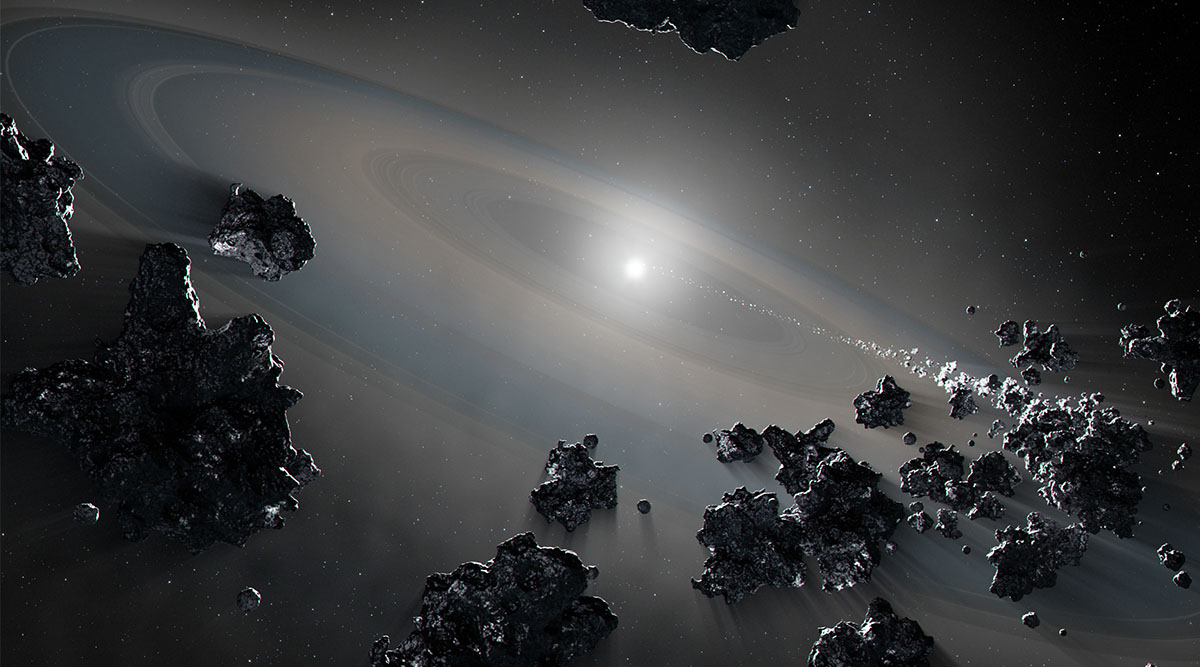
From China’s lander finding evidence of native water on the moon and the country saying that it had detected signs of an alien civilization to NASA’s Perseverance rover finding an unexpected piece of foil on Mars and the discovery of the fastest-growing black hole, the last week has been very exciting for all the space nerds out there. Here, we have put together some of the most interesting space news from last week, in case you have missed it. China said it may have detected signs of alien civilizations China said that its massive Giant Eye telescope may have picked up signs of alien civilizations, according to a report by the state-backed Science and Technology Daily. The publication later appeared to have deleted reports and posts about the discovery, but not before it began trending on Weibo and got picked up by various news outlets. China says it may have detected signals from alien civilizations Sky Eye detected narrowband electromagnetic signals that differ from previous ones captured, and the team is investigating them, according to Zhang Tonkin, chief scientist of an extraterrestrial civilization search team co-founded by Beijing Normal University, the National Astronomical Observatory of the Chinese Academy of Sciences and the University of California, Berkeley, who was cited by the daily. NASA Perseverance rover finds a piece of foil on Mars The Perseverance Mar rover captured an unexpected image with its left Mast cam camera; a shiny piece of foil stuck on a rock on the neighboring planet. The object was determined to be part of a thermal blanket that may have come from the descent stage of the rocket that landed the rover and the Ingenuity Mars helicopter on the planet China Chang’E-5 lander finds native water evidence on the moon samples collected by China lunar lander Chang’E-5 have delivered the first real-time on-site definitive confirmation of the evidence of local origin water on the moon. Chang’E-5 collected samples from the Moon’s Oceanus, which is an ancient basalt mare whose name means “Ocean of Storms”. China Chang’E-5 lander finds evidence of native water on the Moon The first confirmation of water signal was given by an on-board spectral analysis in 2021 and this was later validated when the lander returned in 2021 with laboratory tests of the samples. The team later determined that the water originated from the moon itself, instead of being a consequence of solar wind or other external factors. White dwarf star ripping up an entire planetary system in a case of “cosmic cannibalism” A star’s death throes are so violent that the dead star left behind, called a white dwarf, is disrupting an entire planetary ecosystem by sucking in debris from both its inner and outer reaches. This phenomenon also marks the first time that a white dwarf star is consuming both rocky-metallic and icy material, both of which are “ingredients of planets”. Cosmic cannibalism Astronomers observe a dead star ripping up an entire planetary system Scientists were able to diagnose this case of “cosmic cannibalism” using data from the Hubble Space Telescope and other NASA observatories. White dwarf stars are formed when low-mass stars like our sun exhaust most of their nuclear fuel. They are typically dense and about the size of a planet. These findings are particularly interesting because the kind of icy objects pulled in by the dwarf star is credited for crashing into dry rocky planets in the solar system and “irrigating” them. Such comets and asteroids are believed to have delivered water to Earth billions of years ago, making life possible on the planet

Superbbbb
Nice
Nice
Nice
Superbbb
Nice
Waiting for nxt article
Woah....
Nice bro
Woah
Woah
Woah
You must be logged in to post a comment.