
Receiving a breast cancer diagnosis is an emotionally overwhelming milestone that thrusts patients into a whirlwind of fast-paced medical decisions. For decades, the primary surgical choice was framed as a stark, compromise-driven trade-off: choose a standard lumpectomy to save the breast but accept the potential for a dented, asymmetric, or misshapen result, or undergo a full mastectomy to definitively remove the tissue and consult a plastic surgeon to begin the complex process of total breast reconstruction.
Fortunately, the field of surgical oncology has evolved dramatically. Today, patients no longer have to choose between clearing their cancer and preserving their physical identity. A revolutionary approach known as oncoplastic surgery has risen to become the modern standard of care, seamlessly blending the rigorous principles of cancer removal with the artistic techniques of plastic surgery.
What Exactly is Oncoplastic Surgery?
To understand oncoplastic surgery, it helps to break down the word itself: "onco" refers to oncology (cancer treatment), and "plastic" refers to reshaping or restructuring tissue.
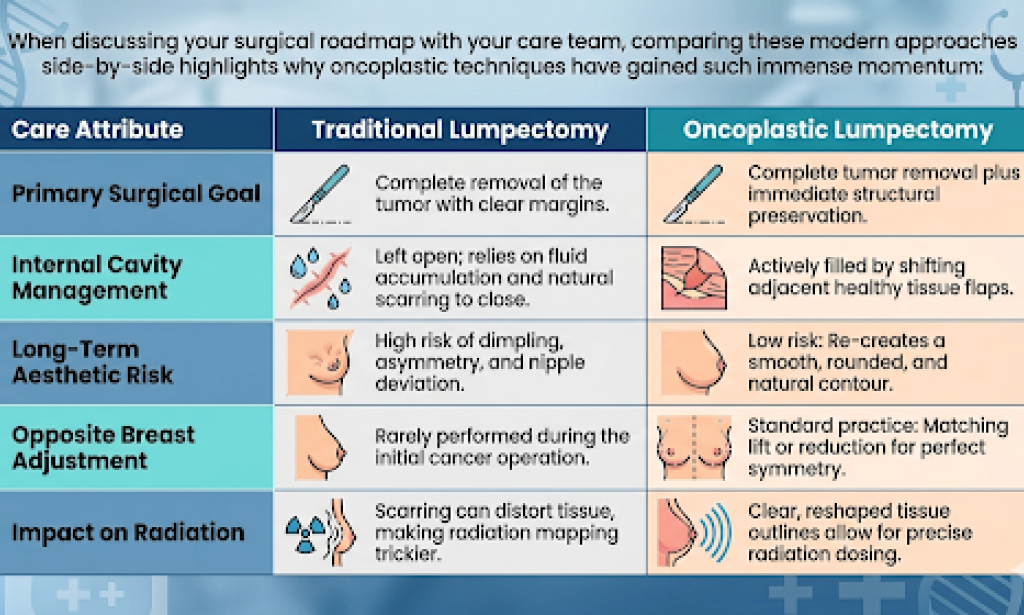
In a traditional lumpectomy, a surgical oncologist removes the tumor along with a safety margin of healthy tissue. Once that tissue is gone, a hollow cavity remains. As the area heals and undergoes radiation therapy, the skin can pull inward, resulting in a visible dimple, contour defect, or a breast that looks significantly smaller and differently shaped than its partner.
An oncoplastic approach completely rewrites this script. It is a highly collaborative procedure where a dedicated breast cancer surgeon and a plastic surgeon work together, or a single, specially trained oncoplastic surgeon manages both steps seamlessly.
[Tumor Removal] ➔ [Immediate Tissue Rearrangement] ➔ [Opposite Side Symmetry Adjustments]
Immediately after the tumor is safely cleared, the surgeon utilizes advanced plastic surgery techniques to mobilize the remaining healthy breast tissue, sliding it into the empty cavity to fill the defect. Instead of leaving a hollow space, the internal tissue is meticulously rearranged to re-create a natural, smooth, and rounded breast shape.
The Dual-Benefit: Clear Margins and Aesthetic Symmetry
Oncoplastic surgery is fundamentally divided into two main categories based on how much breast tissue needs to be removed:
Oncoplastic Level I (Volume Displacement): Used when less than 20% of the breast tissue is removed. The surgeon undermines the surrounding tissue and shifts it locally to close the gap, preventing the skin from collapsing inward.
Oncoplastic Level II (Volume Reduction): Used when a large tumor requires removing 20% to 50% of the breast tissue. In these cases, the surgery is performed exactly like a breast reduction or a breast lift (mastopexy). The surgeon removes the cancer, lifts the remaining tissue, and repositions the nipple-areola complex into a youthful, natural position.
[Level I: Volume Displacement] ➔ Small tissue shifts to fill dimples
/
[Oncoplastic Care]
\
[Level II: Volume Reduction] ➔ Integrated breast lift/reduction layout
Crucially, Level II oncoplastic surgery typically involves a contralateral symmetry procedure. This means the surgeon operates on the healthy, opposite breast during the same surgery, performing a matching reduction or lift. The final result is a pair of breasts that are beautifully symmetrical, balanced, and frequently more uplifted and proportional to the patient's frame than they were before the diagnosis.
Evaluating the Approaches: Traditional vs. Oncoplastic
Why Timing Matters: The Power of Immediate Reconstruction
One of the most significant psychological benefits of oncoplastic surgery is that the reconstruction happens immediately at the time of cancer removal. Waking up from anesthesia with a fully formed, symmetrical breast envelope drastically reduces the acute trauma of surgery. It allows patients to transition into their subsequent treatments such as radiation or chemotherapy feeling whole and confident in their bodies.
Furthermore, moving healthy tissue into the surgical cavity before radiation is vital. Radiation therapy causes the skin to lose elasticity and stiffen. Trying to cosmetically fix a severely dimpled or scarred breast after it has undergone radiation is incredibly difficult. By reshaping the breast architecture on day one, the tissue is far better equipped to withstand the structural stresses of radiation therapy.
Finding Your Path Forward
Oncoplastic surgery is an ideal solution for women with medium-to-large breasts who are facing a lumpectomy for a large or poorly positioned tumor. It successfully broadens the pool of patients who can safely choose breast-conserving surgery over a full mastectomy.
As you navigate your treatment options, advocate for your long-term quality of life. Ask your surgical team if you are a candidate for an oncoplastic approach. By marrying the precision of cancer eradication with the artistry of plastic surgery, oncoplastic procedures offer a powerful reminder that beating cancer does not have to come at the expense of loving what you see in the mirror.

You must be logged in to post a comment.