
You don’t realize how fast a deal can go wrong until the first batch of gears lands and half of them don’t mesh cleanly under load. That’s usually when buyers start questioning their Gears Manufacturers—too late, after payment terms are already locked.
Most buyers focus on price first. That’s the mistake.
Here’s the reality: rack and pinion systems fail less because of design and more because of poor supplier conversations upfront. Tooth profile mismatches, inconsistent hardness, sloppy tolerances—these aren’t rare issues. According to industry inspection data, nearly 18–22% of rejected gear batches in export markets are due to dimensional inconsistency and surface finish errors.
And yet, suppliers will happily nod through vague requirements.
This is exactly why asking the right questions before signing matters.
SPECIFICATION
Types of Rack Pinion Gears You’ll Actually Encounter
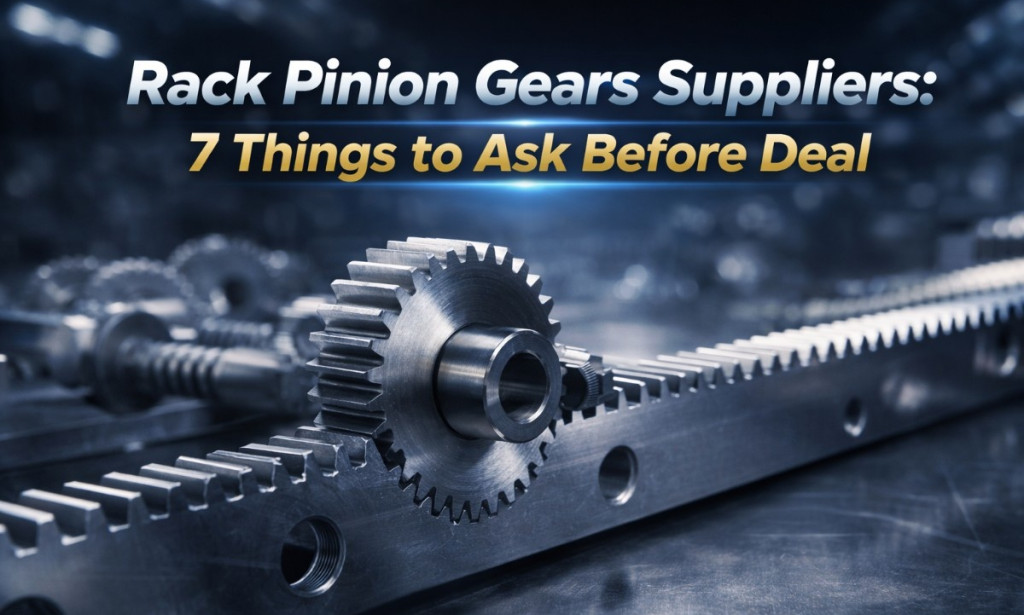
Straight racks dominate standard industrial setups. Helical racks are used where noise reduction and smoother motion matter—especially in automation lines.
Which means your supplier should clearly differentiate pressure angle (usually 20° or 14.5°) and module sizes.
A surprising number don’t.
Material Grades and Heat Treatment Reality
Most Rack Pinion Gears Manufacturers will offer EN8, EN19, or alloy steels. That sounds fine on paper.
But here’s what buyers overlook: case depth consistency after carburizing.
A gear with 0.8 mm case depth behaves very differently from one with 1.2 mm under cyclic load. And no, visual inspection won’t catch that. You need test reports.
Tolerance and Surface Finish (The Quiet Deal Breaker)
Nobody tells you this, but backlash issues often come from tolerance stacking, not a single bad gear.
ISO standards like ISO 1328 define gear accuracy grades, yet many Rack Pinion Gears Suppliers don’t explicitly commit to a grade in writing.
That’s a red flag.
OBJECTIVE
1. Ask for Inspection Reports — Not Just “Quality Assurance”
A good supplier shows batch-wise inspection data.
A bad one says, “We check everything before dispatch.” That’s not a system. That’s a claim.
2. Clarify Heat Treatment Process
Here’s what you want: process type, hardness range (e.g., 58–62 HRC), and case depth.
If the answer is “standard process,” walk away.
3. Check Production Capacity vs Your Volume
Most buyers underestimate scaling issues.
A supplier handling 5,000 units/month will struggle if you suddenly need 18,500 units with tight timelines. And delays in gear supply can halt entire assembly lines.
4. Ask About Rejection Policy
A supplier who says “we’ll review after inspection” is avoiding commitment.
Which means you’ll be negotiating after the problem, not before it.
5. Confirm Tooling Ownership
Custom racks often require dedicated tooling.
If ownership isn’t defined, you may end up paying again when switching vendors.
BENEFITS
Lower rejection rates mean fewer returns and less operational chaos.
And yes, that directly protects your margins.
Consistent hardness improves gear life by up to 27% in high-load environments, based on field performance data from industrial applications.
Which means fewer warranty claims.
Better tolerance control reduces noise and vibration. That matters more than most buyers admit—especially in automotive or automation assemblies.
Reliable Motor Gears Suppliers in India who also produce rack systems often maintain better consistency across components, which simplifies procurement.
And fewer vendors mean fewer coordination issues.
Working with experienced Mini Gears Manufacturers in India also helps when your design includes compact assemblies—because micro-level inaccuracies become bigger problems at smaller scales.
AVAILABILITY
India has become a strong sourcing hub for precision gears, particularly in regions like Faridabad, Rajkot, and Pune.
That’s not random.
These clusters reduce lead times because raw materials, heat treatment units, and machining facilities are located within 50–80 km of each other. It’s a supply chain advantage most global buyers underestimate.
If you're sourcing from Motor Gears Manufacturers in India, you’ll often find overlapping capabilities with Rack Pinion Gears Suppliers, especially in export-focused units.
Which means better pricing leverage.
And yes, logistics from India have improved—average export clearance times have dropped by nearly 12% over the last five years.
ABOUT US
We’ve been manufacturing gears for demanding industrial applications and exporting to 31 countries, working closely with wholesalers and OEM buyers who don’t have time for trial-and-error sourcing.
And we’ve learned the hard way.
Back in 2019, we rejected an entire batch of hardened racks after noticing micro-cracks during final inspection—despite passing earlier checks. That shipment delay cost us a client deadline, but it also changed how we handle post-heat treatment inspection.
We don’t skip that step anymore.
That’s the difference experience makes.
CONCLUSION
Choosing the right Gears Manufacturers is less about finding options and more about asking better questions early. The difference shows up in performance, not brochures. Buyers who get this right don’t just avoid losses—they build stable supply chains. And that’s what scales operations forward.
FAQs
1. How do I choose between different Rack Pinion Gears Suppliers?
Focus on inspection capability and tolerance commitment. Many Rack Pinion Gears Suppliers look similar until you ask for measurable data.
2. Are Motor Gears Suppliers in India reliable for export orders?
Yes, many Motor Gears Suppliers in India handle export volumes regularly. That said, not all maintain consistent documentation—always verify batch reports.
3. What materials do Motor Gears Manufacturers in India typically use?
Most Motor Gears Manufacturers in India offer EN series steels and alloy variants. But availability depends on order size and application requirements.
4. Can one supplier handle both rack and motor gears?
Some Motor Gears Suppliers in India also produce rack systems. It simplifies sourcing, but you should still validate expertise in both categories.
5. Are Mini Gears Manufacturers in India suitable for precision applications?
Yes, experienced Mini Gears Manufacturers in India can deliver high precision. However, smaller gears demand tighter tolerances, and not every supplier can maintain that consistently.
6. What is the biggest risk when working with Rack Pinion Gears Manufacturers?
Unclear specifications. Many Rack Pinion Gears Manufacturers proceed with assumptions if drawings lack detail, leading to mismatched expectations.
7. How do I evaluate Mini Gears Suppliers in India for bulk orders?
You don’t realize how fast a deal can go wrong until the first batch of gears lands and half of them don’t mesh cleanly under load. That’s usually when buyers start questioning their Gears Manufacturers—too late, after payment terms are already locked.
Most buyers focus on price first. That’s the mistake.
Here’s the reality: rack and pinion systems fail less because of design and more because of poor supplier conversations upfront. Tooth profile mismatches, inconsistent hardness, sloppy tolerances—these aren’t rare issues. According to industry inspection data, nearly 18–22% of rejected gear batches in export markets are due to dimensional inconsistency and surface finish errors.
And yet, suppliers will happily nod through vague requirements.
This is exactly why asking the right questions before signing matters.
SPECIFICATION
Types of Rack Pinion Gears You’ll Actually Encounter
Straight racks dominate standard industrial setups. Helical racks are used where noise reduction and smoother motion matter—especially in automation lines.
Which means your supplier should clearly differentiate pressure angle (usually 20° or 14.5°) and module sizes.
A surprising number don’t.
Material Grades and Heat Treatment Reality
Most Rack Pinion Gears Manufacturers will offer EN8, EN19, or alloy steels. That sounds fine on paper.
But here’s what buyers overlook: case depth consistency after carburizing.
A gear with 0.8 mm case depth behaves very differently from one with 1.2 mm under cyclic load. And no, visual inspection won’t catch that. You need test reports.
Tolerance and Surface Finish (The Quiet Deal Breaker)
Nobody tells you this, but backlash issues often come from tolerance stacking, not a single bad gear.
ISO standards like ISO 1328 define gear accuracy grades, yet many Rack Pinion Gears Suppliers don’t explicitly commit to a grade in writing.
That’s a red flag.
OBJECTIVE
1. Ask for Inspection Reports — Not Just “Quality Assurance”
A good supplier shows batch-wise inspection data.
A bad one says, “We check everything before dispatch.” That’s not a system. That’s a claim.
2. Clarify Heat Treatment Process
Here’s what you want: process type, hardness range (e.g., 58–62 HRC), and case depth.
If the answer is “standard process,” walk away.
3. Check Production Capacity vs Your Volume
Most buyers underestimate scaling issues.
A supplier handling 5,000 units/month will struggle if you suddenly need 18,500 units with tight timelines. And delays in gear supply can halt entire assembly lines.
4. Ask About Rejection Policy
A supplier who says “we’ll review after inspection” is avoiding commitment.
Which means you’ll be negotiating after the problem, not before it.
5. Confirm Tooling Ownership
Custom racks often require dedicated tooling.
If ownership isn’t defined, you may end up paying again when switching vendors.
BENEFITS
Lower rejection rates mean fewer returns and less operational chaos.
And yes, that directly protects your margins.
Consistent hardness improves gear life by up to 27% in high-load environments, based on field performance data from industrial applications.
Which means fewer warranty claims.
Better tolerance control reduces noise and vibration. That matters more than most buyers admit—especially in automotive or automation assemblies.
Reliable Motor Gears Suppliers in India who also produce rack systems often maintain better consistency across components, which simplifies procurement.
And fewer vendors mean fewer coordination issues.
Working with experienced Mini Gears Manufacturers in India also helps when your design includes compact assemblies—because micro-level inaccuracies become bigger problems at smaller scales.
AVAILABILITY
India has become a strong sourcing hub for precision gears, particularly in regions like Faridabad, Rajkot, and Pune.
That’s not random.
These clusters reduce lead times because raw materials, heat treatment units, and machining facilities are located within 50–80 km of each other. It’s a supply chain advantage most global buyers underestimate.
If you're sourcing from Motor Gears Manufacturers in India, you’ll often find overlapping capabilities with Rack Pinion Gears Suppliers, especially in export-focused units.
Which means better pricing leverage.
And yes, logistics from India have improved—average export clearance times have dropped by nearly 12% over the last five years.
ABOUT US
We’ve been manufacturing gears for demanding industrial applications and exporting to 31 countries, working closely with wholesalers and OEM buyers who don’t have time for trial-and-error sourcing.
And we’ve learned the hard way.
Back in 2019, we rejected an entire batch of hardened racks after noticing micro-cracks during final inspection—despite passing earlier checks. That shipment delay cost us a client deadline, but it also changed how we handle post-heat treatment inspection.
We don’t skip that step anymore.
That’s the difference experience makes.
CONCLUSION
Choosing the right Gears Manufacturers is less about finding options and more about asking better questions early. The difference shows up in performance, not brochures. Buyers who get this right don’t just avoid losses—they build stable supply chains. And that’s what scales operations forward.
FAQs
1. How do I choose between different Rack Pinion Gears Suppliers?
Focus on inspection capability and tolerance commitment. Many Rack Pinion Gears Suppliers look similar until you ask for measurable data.
2. Are Motor Gears Suppliers in India reliable for export orders?
Yes, many Motor Gears Suppliers in India handle export volumes regularly. That said, not all maintain consistent documentation—always verify batch reports.
3. What materials do Motor Gears Manufacturers in India typically use?
Most Motor Gears Manufacturers in India offer EN series steels and alloy variants. But availability depends on order size and application requirements.
4. Can one supplier handle both rack and motor gears?
Some Motor Gears Suppliers in India also produce rack systems. It simplifies sourcing, but you should still validate expertise in both categories.
5. Are Mini Gears Manufacturers in India suitable for precision applications?
Yes, experienced Mini Gears Manufacturers in India can deliver high precision. However, smaller gears demand tighter tolerances, and not every supplier can maintain that consistently.
6. What is the biggest risk when working with Rack Pinion Gears Manufacturers?
Unclear specifications. Many Rack Pinion Gears Manufacturers proceed with assumptions if drawings lack detail, leading to mismatched expectations.
7. How do I evaluate Mini Gears Suppliers in India for bulk orders?
You don’t realize how fast a deal can go wrong until the first batch of gears lands and half of them don’t mesh cleanly under load. That’s usually when buyers start questioning their Gears Manufacturers—too late, after payment terms are already locked.
Most buyers focus on price first. That’s the mistake.
Here’s the reality: rack and pinion systems fail less because of design and more because of poor supplier conversations upfront. Tooth profile mismatches, inconsistent hardness, sloppy tolerances—these aren’t rare issues. According to industry inspection data, nearly 18–22% of rejected gear batches in export markets are due to dimensional inconsistency and surface finish errors.
And yet, suppliers will happily nod through vague requirements.
This is exactly why asking the right questions before signing matters.
SPECIFICATION
Types of Rack Pinion Gears You’ll Actually Encounter
Straight racks dominate standard industrial setups. Helical racks are used where noise reduction and smoother motion matter—especially in automation lines.
Which means your supplier should clearly differentiate pressure angle (usually 20° or 14.5°) and module sizes.
A surprising number don’t.
Material Grades and Heat Treatment Reality
Most Rack Pinion Gears Manufacturers will offer EN8, EN19, or alloy steels. That sounds fine on paper.
But here’s what buyers overlook: case depth consistency after carburizing.
A gear with 0.8 mm case depth behaves very differently from one with 1.2 mm under cyclic load. And no, visual inspection won’t catch that. You need test reports.
Tolerance and Surface Finish (The Quiet Deal Breaker)
Nobody tells you this, but backlash issues often come from tolerance stacking, not a single bad gear.
ISO standards like ISO 1328 define gear accuracy grades, yet many Rack Pinion Gears Suppliers don’t explicitly commit to a grade in writing.
That’s a red flag.
OBJECTIVE
1. Ask for Inspection Reports — Not Just “Quality Assurance”
A good supplier shows batch-wise inspection data.
A bad one says, “We check everything before dispatch.” That’s not a system. That’s a claim.
2. Clarify Heat Treatment Process
Here’s what you want: process type, hardness range (e.g., 58–62 HRC), and case depth.
If the answer is “standard process,” walk away.
3. Check Production Capacity vs Your Volume
Most buyers underestimate scaling issues.
A supplier handling 5,000 units/month will struggle if you suddenly need 18,500 units with tight timelines. And delays in gear supply can halt entire assembly lines.
4. Ask About Rejection Policy
A supplier who says “we’ll review after inspection” is avoiding commitment.
Which means you’ll be negotiating after the problem, not before it.
5. Confirm Tooling Ownership
Custom racks often require dedicated tooling.
If ownership isn’t defined, you may end up paying again when switching vendors.
BENEFITS
Lower rejection rates mean fewer returns and less operational chaos.
And yes, that directly protects your margins.
Consistent hardness improves gear life by up to 27% in high-load environments, based on field performance data from industrial applications.
Which means fewer warranty claims.
Better tolerance control reduces noise and vibration. That matters more than most buyers admit—especially in automotive or automation assemblies.
Reliable Motor Gears Suppliers in India who also produce rack systems often maintain better consistency across components, which simplifies procurement.
And fewer vendors mean fewer coordination issues.
Working with experienced Mini Gears Manufacturers in India also helps when your design includes compact assemblies—because micro-level inaccuracies become bigger problems at smaller scales.
AVAILABILITY
India has become a strong sourcing hub for precision gears, particularly in regions like Faridabad, Rajkot, and Pune.
That’s not random.
These clusters reduce lead times because raw materials, heat treatment units, and machining facilities are located within 50–80 km of each other. It’s a supply chain advantage most global buyers underestimate.
If you're sourcing from Motor Gears Manufacturers in India, you’ll often find overlapping capabilities with Rack Pinion Gears Suppliers, especially in export-focused units.
Which means better pricing leverage.
And yes, logistics from India have improved—average export clearance times have dropped by nearly 12% over the last five years.
ABOUT US
We’ve been manufacturing gears for demanding industrial applications and exporting to 31 countries, working closely with wholesalers and OEM buyers who don’t have time for trial-and-error sourcing.
And we’ve learned the hard way.
Back in 2019, we rejected an entire batch of hardened racks after noticing micro-cracks during final inspection—despite passing earlier checks. That shipment delay cost us a client deadline, but it also changed how we handle post-heat treatment inspection.
We don’t skip that step anymore.
That’s the difference experience makes.
CONCLUSION
Choosing the right Gears Manufacturers is less about finding options and more about asking better questions early. The difference shows up in performance, not brochures. Buyers who get this right don’t just avoid losses—they build stable supply chains. And that’s what scales operations forward.
FAQs
1. How do I choose between different Rack Pinion Gears Suppliers?
Focus on inspection capability and tolerance commitment. Many Rack Pinion Gears Suppliers look similar until you ask for measurable data.
2. Are Motor Gears Suppliers in India reliable for export orders?
Yes, many Motor Gears Suppliers in India handle export volumes regularly. That said, not all maintain consistent documentation—always verify batch reports.
3. What materials do Motor Gears Manufacturers in India typically use?
Most Motor Gears Manufacturers in India offer EN series steels and alloy variants. But availability depends on order size and application requirements.
4. Can one supplier handle both rack and motor gears?
Some Motor Gears Suppliers in India also produce rack systems. It simplifies sourcing, but you should still validate expertise in both categories.
5. Are Mini Gears Manufacturers in India suitable for precision applications?
Yes, experienced Mini Gears Manufacturers in India can deliver high precision. However, smaller gears demand tighter tolerances, and not every supplier can maintain that consistently.
6. What is the biggest risk when working with Rack Pinion Gears Manufacturers?
Unclear specifications. Many Rack Pinion Gears Manufacturers proceed with assumptions if drawings lack detail, leading to mismatched expectations.
7. How do I evaluate Mini Gears Suppliers in India for bulk orders?
Check scaling ability. Some Mini Gears Suppliers in India perform well on samples but struggle with volume consistency.

You must be logged in to post a comment.