
Most salaried employees in India receive health coverage through their employer's group health insurance policy. While corporate policies are a valuable benefit, relying solely on them can leave significant gaps in your protection. Private medical insurance — purchased independently — offers distinct advantages that make it a smart complement or even a better standalone option for many individuals.
Limitations of Corporate Health Policies
Corporate health policies are designed for the group, not for the individual. They typically offer a standard sum insured (often ₹3–5 lakh) that may be insufficient for serious illnesses, cover only the employee and immediate dependants (not parents in all cases), lapse immediately upon resignation or termination, do not offer portability of waiting period credits to a new individual plan, and have limited customisation options.
Advantages of Private Medical Insurance
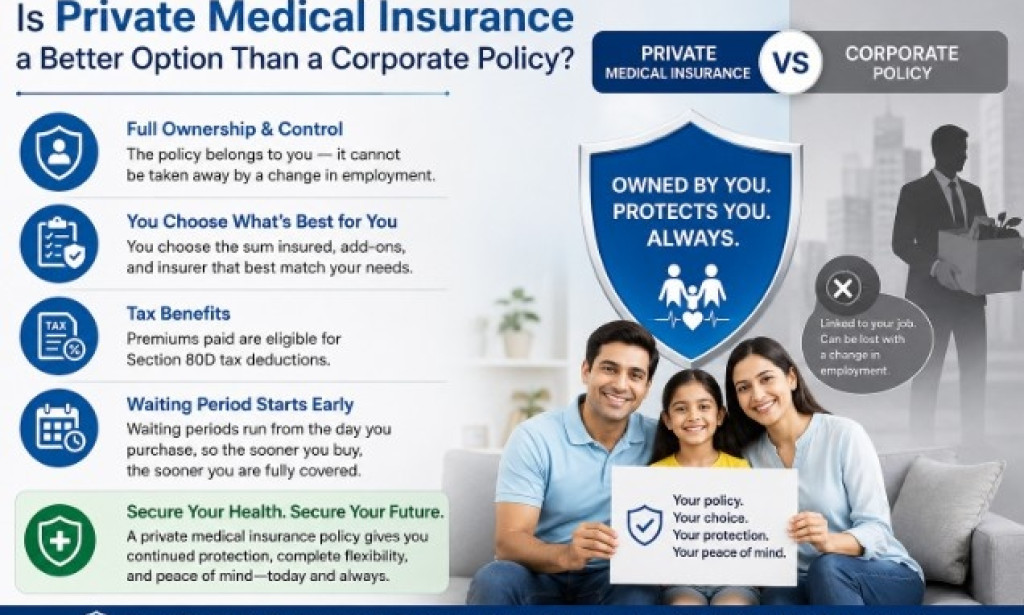
The Private medical insurance offers full ownership and control. The policy belongs to you — it cannot be taken away by a change in employment. You choose the sum insured, add-ons, and insurer that best match your needs. Premiums paid are eligible for Section 80D tax deductions. Waiting periods run from the day you purchase, so the sooner you buy, the sooner you are fully covered.
Cashless Health Insurance: A Key Feature of Private Plans
One of the most valued features of modern private medical insurance is cashless health insurance — the ability to receive treatment at network hospitals without paying upfront. The insurer directly settles the bill with the hospital. In a medical emergency, the last thing you want is to arrange funds quickly. Cashless access at a wide h ospital network is a critical benefit that top private plans offer.
What Happens When You Change Jobs?
If you switch jobs or take a career break, your corporate health policy lapses. If you do not have a private plan in place, this gap in coverage can leave you completely uninsured. Worse, you will need to start a new waiting period for pre-existing conditions when you eventually buy a new policy. Maintaining a private medical insurance plan eliminates this risk entirely.
Should You Have Both?
Ideally, yes. Your corporate policy can serve as the first line of coverage, while your private medical insurance acts as a super top-up or a backup for when you are between jobs or need higher coverage. This dual-coverage strategy is increasingly popular among financially savvy professionals who understand the risks of over-reliance on employer-provided plans.
Cost Consideration
Private medical insurance premiums vary widely by age, sum insured, and insurer. A healthy 30-year-old can secure a ₹10 lakh individual plan for approximately ₹8,000–₹14,000 per year. Given the comprehensive protection it offers, this represents exceptional value — particularly when you account for the Section 80D tax deduction that effectively reduces your net cost.
What is not covered in cashless health insurance?
Even when you have a comprehensive cashless health insurance policy, cashless does not mean 100% free. It simply means the covered portions of your hospital bill are settled directly between the insurer and the hospital.
At the time of discharge, you will almost always face an out-of-pocket bill. The expenses that are not covered under standard cashless health insurance fall into a few primary categories:
1. The "Non-Payable" Consumables
This is the most frequent surprise for policyholders. In a typical surgery, these items can easily account for 10% to 15% of the total bill. Unless you have a specific "Consumables Cover" add-on, you must pay for:
-
Hygiene & Disposable Supplies: Surgical gloves, masks, gowns, syringes, needles, drapes, and PPE kits.
-
Administrative Charges: Hospital registration fees, admission fees, medical certificate documentation, and data entry charges.
-
Personal Comfort Items: Toiletries, tissues, water bottles, companion dows, and specialized diet food ordered for family members (only the patient's doctor-prescribed therapeutic diet is covered).
2. Standard Permanent Exclusions
Under Insurance Regulatory and Development Authority of India (IRDAI) guidelines, there are standard treatments and conditions that regular health insurance plans permanently exclude:
-
Cosmetic & Aesthetic Procedures: Botox, liposuction, hair transplants, or plastic surgery (unless medically required due to a severe accident or burns).
-
Fertility & Birth Control: In vitro fertilization (IVF), surrogacy, hormone treatments, and voluntary abortions or contraceptives.
-
Lifestyle & Self-Inflicted Conditions: Treatment for injuries resulting from attempted suicide or self-harm, as well as illnesses directly arising from chronic drug or alcohol abuse.
-
Routine Vision and Dental Care: Dental implants, root canals, dentures, or LASIK eye surgery (unless the refractive error is extremely severe, typically greater than 7.5 diopters).
-
Adventure Sports: Any injuries sustained while participating in hazardous or extreme sports like skydiving, paragliding, or motor racing.
3. Policy Boundaries & Waiting Periods
Sometimes a treatment is coverable, but your cashless request will be denied because of the timing or structure of your policy:
-
The 30-Day Initial Window: No claims are accepted within the first 30 days of buying a new policy, except for emergency hospitalizations due to an accident.
-
Pre-Existing Disease (PED) Waiting Periods: Chronic conditions you had before buying the policy (like diabetes or hypertension) are excluded from coverage for a specific waiting period, usually between 1 to 3 years.
-
Diagnostic Admissions: If you get admitted to a hospital solely for checkups, blood tests, or scans without an active, ongoing treatment plan, the insurer will deny the claim.
Pro Tip: When a cashless claim is approved, the insurer issues a Pre-Authorization Letter to the hospital. Always ask the hospital's insurance desk for a breakdown of the "deductibles"—the specific items your insurer has marked as non-payable—so you aren't blindsided by the final bill at discharge.
Conclusion
Private medical insurance and corporate health policies are not mutually exclusive — they are complementary. While your corporate policy covers your everyday medical needs, a personal private plan provides the financial security, flexibility, and continuity that employer benefits simply cannot guarantee. In an uncertain job market, owning your own health insurance is one of the smartest decisions you can make.

You must be logged in to post a comment.