

An astrocyte in a mouse brain. (Image credit: Gerry Shaw, CC-BY-SA 3.0)
An astrocyte in a mouse brain. (Image credit: Gerry Shaw, CC-BY-SA 3.0)
For a long time, scientists believed that memory loss and neuronal death associated with Alzheimer's disease was caused by accumulation of misfolded aggregates of amyloid-beta proteins. In 2020, a team of researchers demonstrated the link between star-shaped non neuronal cells in the brain, astrocytes and Alzheimer's disease as well as its progression. The researchers have further investigated the molecular processes involved with the astrocytic response. The researchers have found the missing link between amyloid-beta protein plaques and the symptoms of Alzheimer's disease, which is the conversion of amyloid-beta proteins to urea within the brain. The urea cycle widely studied and understood as a major metabolic pathway in the liver and kidneys, as part of human digestive and excretory processes.
In the liver, ammonia, a toxic product from protein digestion is converted into urea, which is excreted by the kidneys as urine. Previous studies have reported elevated levels of urea in the brains of those suffering from Alzheimer's disease. The researchers have found that the urea cycle is 'switched on' in the brains of those suffering from Alzheimer's disease, to clean up the accumulation of amyloid-beta protein aggregates, and remove them in the form of urea. The clean up of the amyloid-beta proteins however, produces another undesirable metabolite, known as ornithine. The astrocytes produce the enzyme ornithine decarboxylase 1 (ODC1) to clean up the ornithine, and convert it to putrescine. This process, increases the concentration of a neurotransmitter γ-aminobutyric acid (GABA) in the brain, as well as increases the levels of toxic byproducts such as hydrogen peroxide and ammonia in the brain.
The ammonia further feeds back into the urea cycle, causing an increasing accumulation of toxic byproducts. The high levels of GABA released by the astrocytes inhibits neuronal transmission, contributing to the loss of memory seen in Alzheimer's disease. The new findings demonstrate precisely how the increased GABA, hydrogen peroxide and ammonia contribute to and exacerbate the loss of memory and neuronal death associated with Alzheimer's disease.
First author of the paper, Ju Yeon Ha says, "For years, scientists have been debating about the beneficial and detrimental role of reactive astrocytes, and with the findings of this study, our group is able to clearly demarcate the beneficial urea cycle and the detrimental conversion of ornithine to putrescine and GABA, thereby providing evidence of the dual nature of astrocytes in Alzheimer's disease brain."
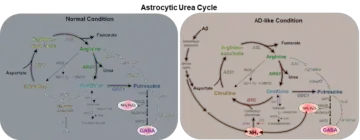 The non-cyclic urea metabolism turns into a cyclic state in reactive, Alzheimer's disease-like conditions. (Image credit: Institute for Basic Science)
The researchers found that gene silencing of ODC1 in a transgenic Alzheimer's disease mouse model was able to stop excessive GABA production, as well as neuronal inhibition. The mice performed better in memory-related behavioral tests, and recovered from Alzheimer's disease associated memory loss. The number of plaques caused by amyloid-beta proteins were also found to be significantly reduced indicating a more efficient urea cycle with less production of toxic byproducts such as hydrogen peroxide, ammonia and GABA.
Corresponding author of the study, C Justin Lee says, "With the results from this study, we were able to finally delineate the pathway linking amyloid-beta plaques to astrocytic reactivity, uncovering the presence of a functional urea cycle in reactive astrocytes for the first time. We also found increased levels of enzyme ODC1 in human AD patients' brains, raising the possibility of translating the results from our mouse study to humans and indicating that ODC1 may be a novel and powerful therapeutic target against the disease, inhibition of which could clear amyloid-beta plaques as well as improve memory."
A paper describing the findings has been published in Cell Metabolism.

You must be logged in to post a comment.